About this template
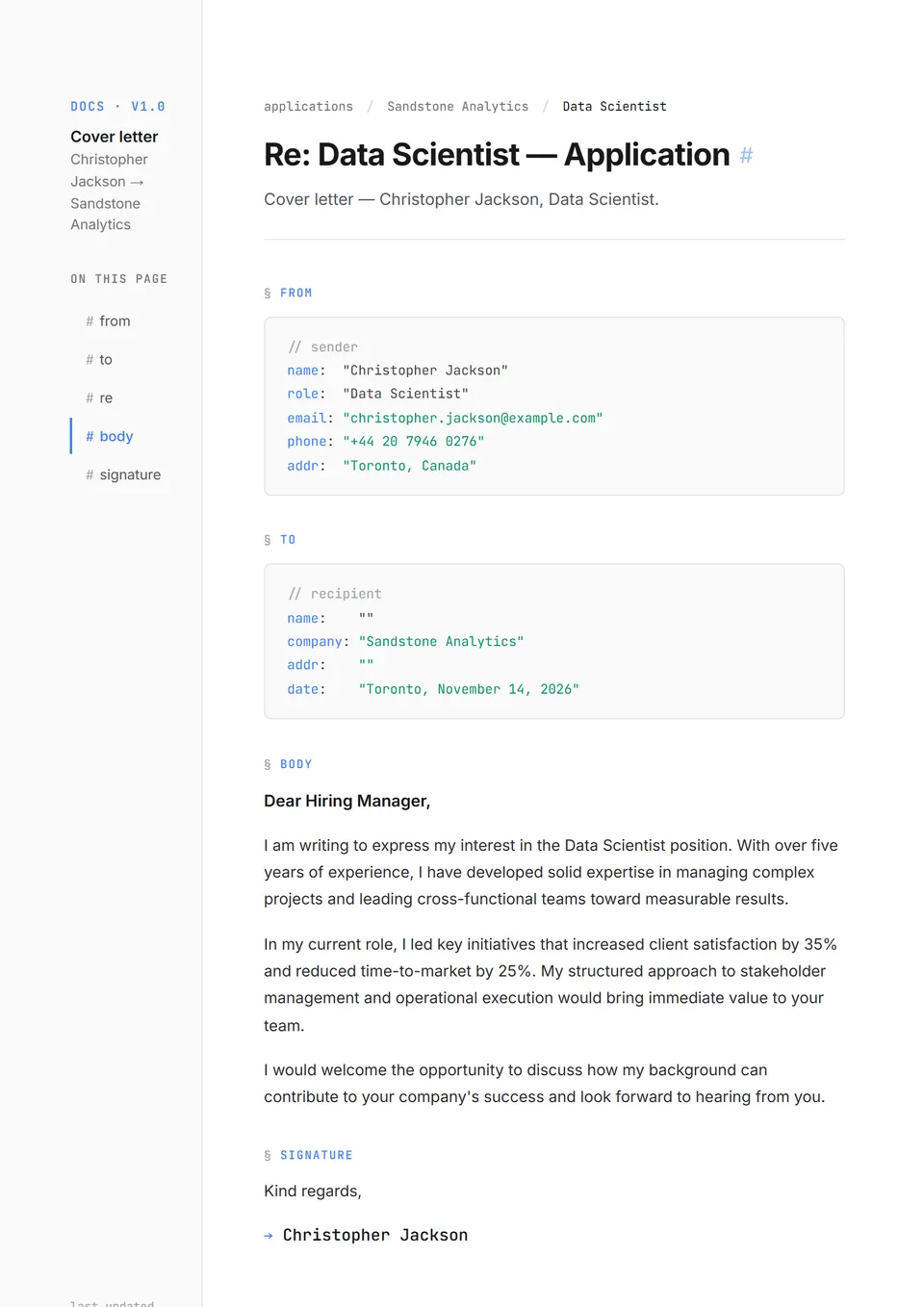
The Mono Grid template is a cover letter set entirely in JetBrains Mono on a strict 12-column grid with visible column rules in the margin. Caps headings, ruled baseline — a tech-native design that speaks to the developer-tools ecosystem. It parses through modern ATS (Greenhouse, Lever, Ashby, Recruitee); the grid never enters parsing.
Who is it for?
It suits software engineers (backend, fullstack, embedded), platform engineers, infrastructure architects, technical writers and developer advocates, and product managers at developer-tools companies. The all-mono composition reads as native at DevTools startups (Hugging Face, Replicate, Linear, Vercel, Cycle.io, Anthropic) and at developer-tools vendors (JetBrains, GitLab, GitHub, Datadog, Sentry, PostHog).
How to use it
The 100% monospace identity demands text as structured as a config file: clear sections, vertical lists, no run-on prose. Name precise tools (Cursor, Linear, Sentry, PostHog, Datadog APM, Honeycomb), dominant languages (Go, Rust, TypeScript strict, Kotlin, Elixir) and managed volumes. For a platform engineer, state the size of the Kubernetes fleet operated and the SLOs held. For a developer advocate, cite a talk delivered at a recognised conference (KubeCon, GopherCon, RustConf, JSConf, React Conf).
Frequently asked questions
Is all-monospace readable across 600 words?
Yes if heavily aerated: 1.6 line-height, 25mm margins, 11pt body. JetBrains Mono is built for long-form IDE reading — it holds a full A4 or US Letter page well. For a dense two-page format, prefer Inter or Söhne in the body, with mono reserved for code blocks and numerical figures.
Does it suit an IT consulting application?
For pure-play tech consultancies (ThoughtWorks, Slalom Engineering, EPAM, Capgemini Engineering), yes — the visual code reads as native. For broader digital-transformation consultancies (Accenture, Deloitte Digital, BearingPoint), prefer Swiss Grid or Platinum Edge: all-mono can read as too niche outside engineering-led firms.
Should I include code in the letter?
No — the letter is not a README. Code stays on GitHub. The letter proves through technical references and angle of approach, not through a snippet. One exception: a well-formatted numerical block (latency, throughput, coverage) gains from being set in mono — visual rigour without turning the letter into documentation.