
When You Need a Cover Letter for Accountant
A cover letter for a standard Accountant job application demonstrates your attention to detail and communication skills—two core competencies the resume cannot fully convey. It allows you to explain why you're interested in the specific company and how your technical expertise in areas like GAAP, reconciliation, or financial reporting aligns with their needs. Use it to provide context for career progression, certifications, or specialized accounting software proficiency that sets you apart from other candidates.
An Accountant internship cover letter should emphasize your academic foundation, relevant coursework (such as Intermediate Accounting, Tax, or Auditing), and any volunteer or student organization experience where you handled budgets or financial records. Focus on your eagerness to learn, familiarity with tools like Excel or QuickBooks, and soft skills like accuracy and time management. Highlight any part-time bookkeeping, tax preparation volunteer work, or campus finance roles to demonstrate initiative even without formal professional experience.
When transitioning into an Accountant role from another field, your cover letter must bridge the gap by showcasing transferable skills such as analytical thinking, data management, regulatory compliance, or financial analysis from your previous career. Explain any relevant certifications you've pursued (e.g., CPA candidacy, bookkeeping certificate) and how your unique background—whether in operations, sales analytics, or project budgeting—provides a fresh perspective on financial stewardship. Frame your career change as a deliberate, well-prepared move rather than a pivot born of necessity.
An internal promotion cover letter for an Accountant role should acknowledge your familiarity with the company's systems, culture, and financial processes while articulating how you're ready for increased responsibility. Highlight specific contributions—such as process improvements, successful audits, or month-end close efficiencies—that demonstrate leadership and strategic thinking. Maintain a tone of respectful ambition, showing gratitude for growth opportunities while making a clear case for why you're the natural choice for the senior or supervisory position.
Recommended templates for Accountant
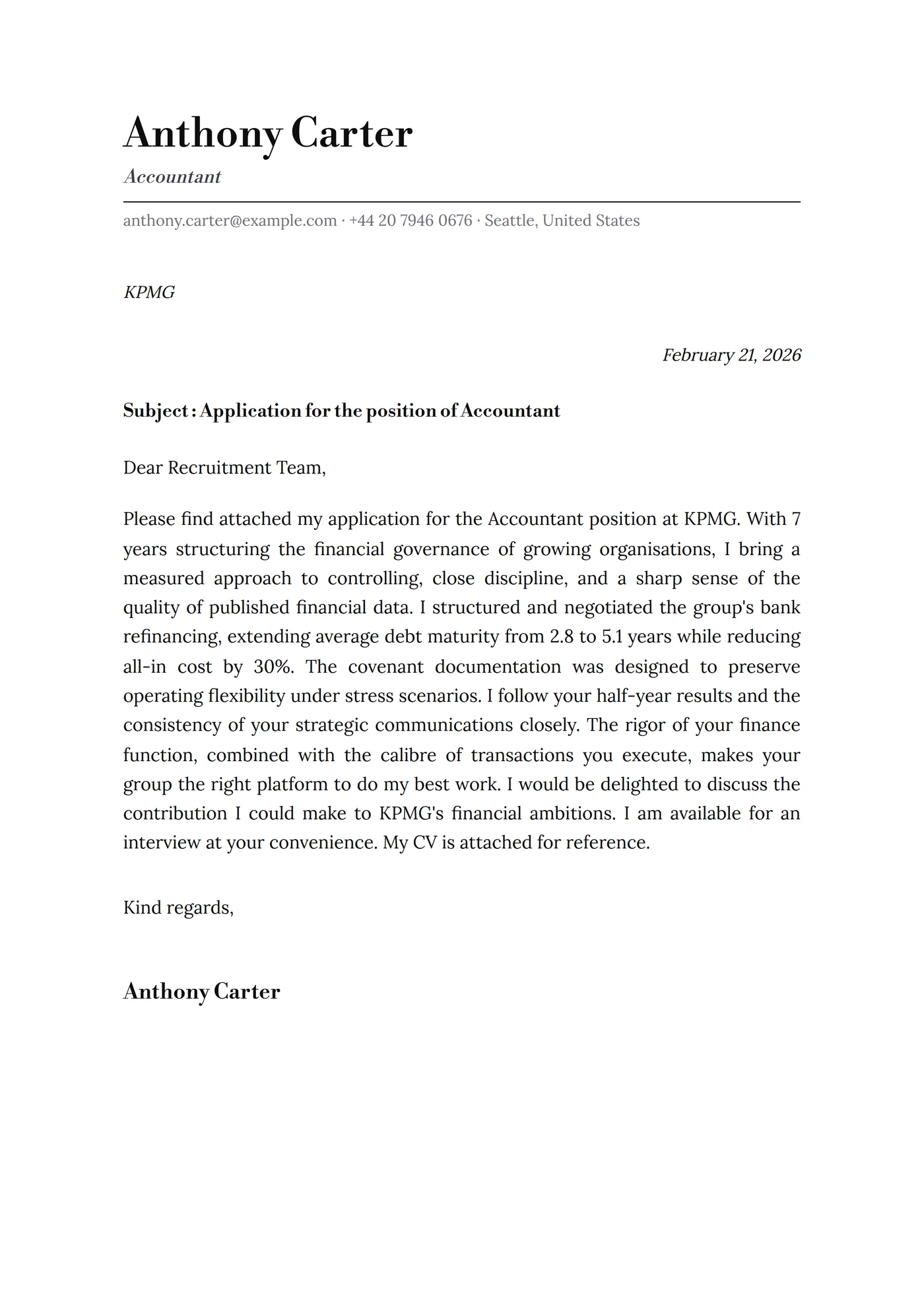
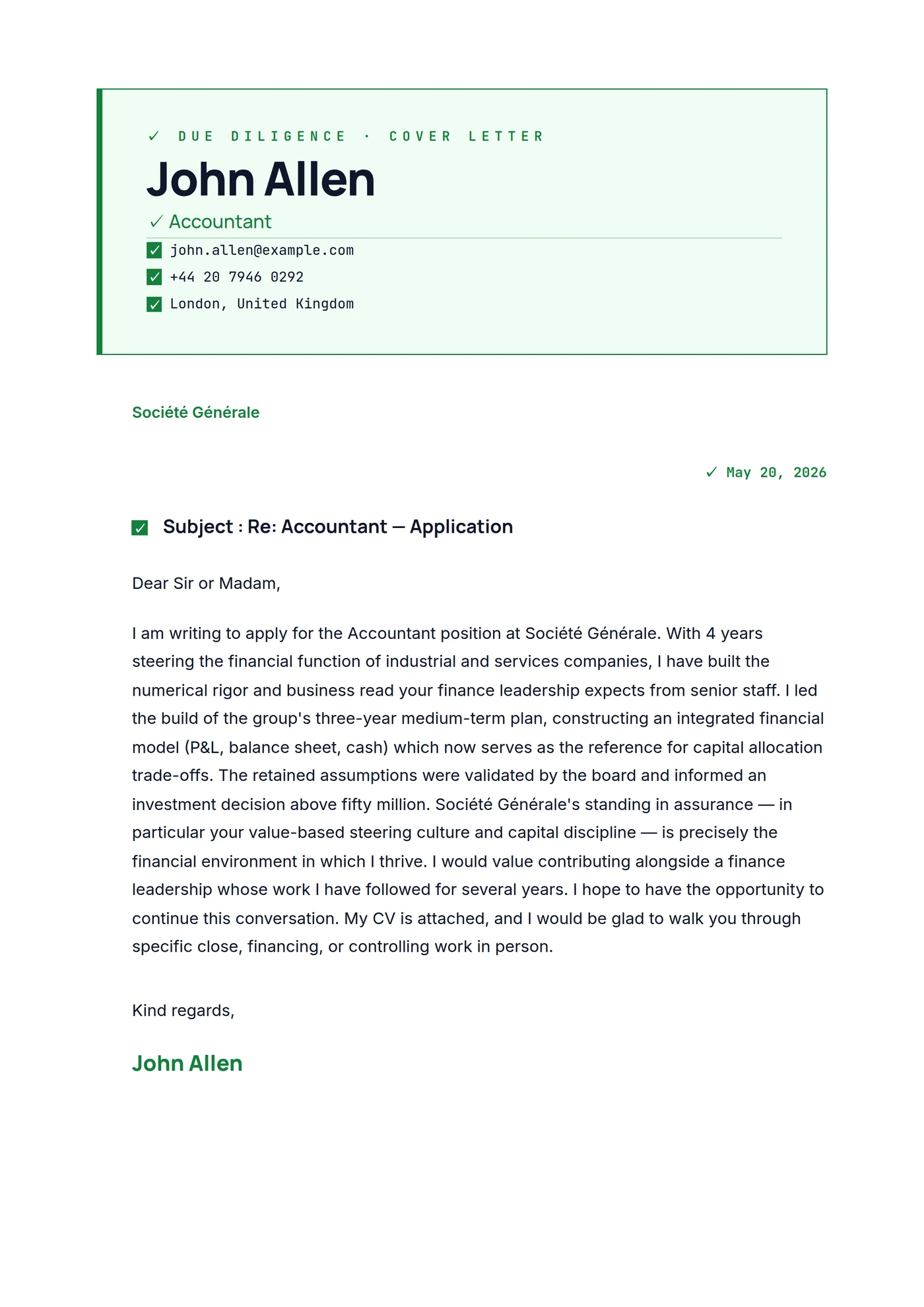
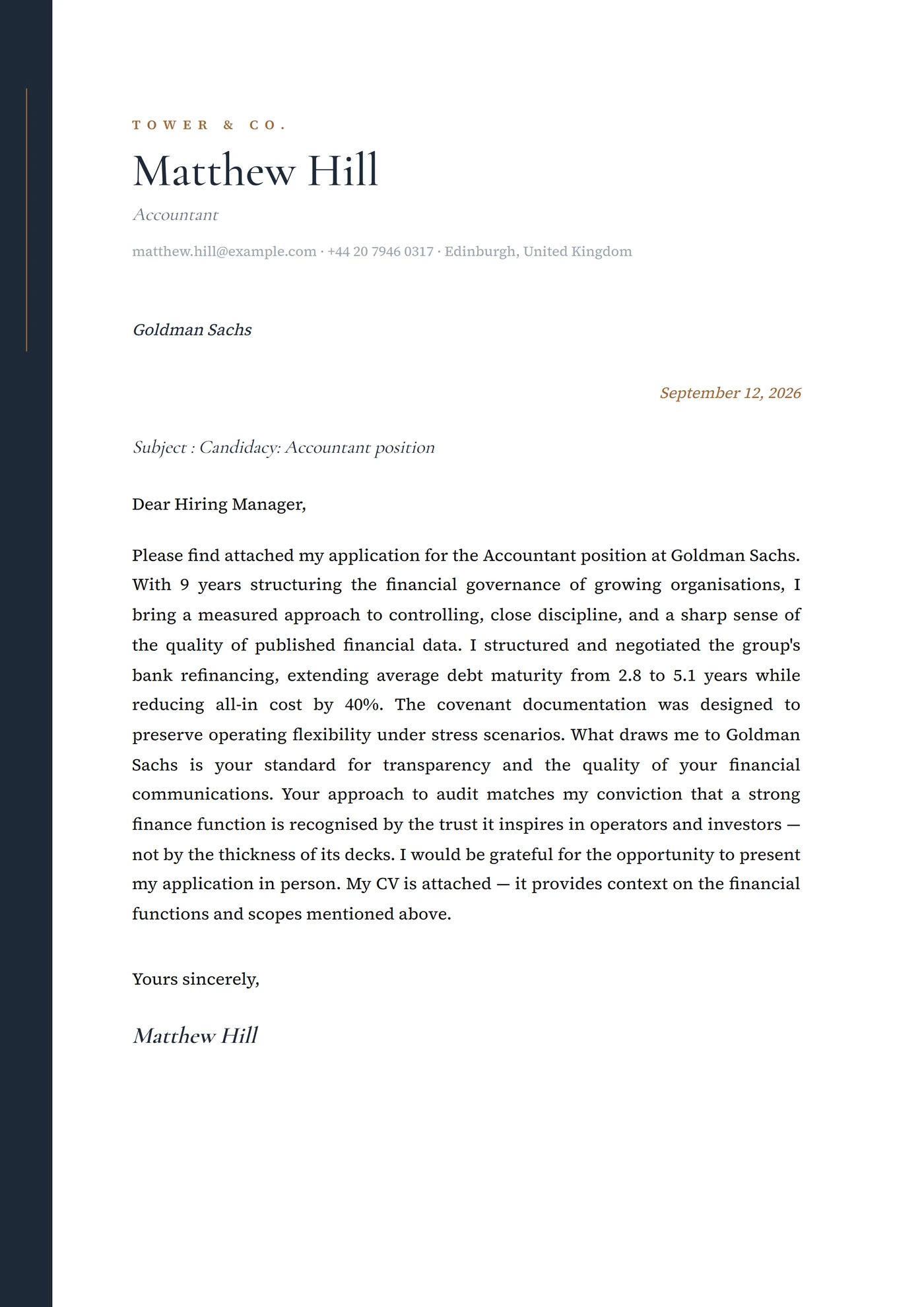
Three templates selected for this role, from junior to senior level. Tap a template to discover its full design and use it in your document.
How to Write a Accountant Cover Letter
Open your Accountant cover letter with a personalized greeting—research the hiring manager's name on LinkedIn or the company website and use "Dear [Name]" rather than a generic salutation. Your first sentence should immediately state the position you're applying for and include a compelling hook: a notable achievement (e.g., "reduced month-end close time by 30%"), a shared connection, or specific knowledge of the company's recent growth, acquisition, or system implementation. Avoid clichés like "I am writing to express my interest"; instead, lead with impact—"As a CPA with five years of experience streamlining financial reporting for mid-sized manufacturing firms, I am excited to bring process excellence to [Company Name]'s finance team." Personalization is critical in accounting, where employers value precision and diligence. Reference the job description directly, mirroring language around GAAP compliance, variance analysis, or ERP systems to show you've tailored the letter. If the company recently adopted new software, expanded into new markets, or published financial results, mention it to demonstrate genuine interest. This opening paragraph should be three to four sentences that establish who you are, what role you want, and why this specific opportunity aligns with your expertise and career goals.
The body of your Accountant cover letter should consist of two to three focused paragraphs, each serving a distinct purpose. The first body paragraph highlights your most relevant technical skills and accomplishments: discuss your proficiency with general ledger management, account reconciliation, financial statement preparation, or tax compliance, and quantify your impact wherever possible—"managed accounts payable for a $15M portfolio" or "identified $50K in cost savings through expense audits." Use the STAR method (Situation, Task, Action, Result) to briefly narrate one or two key achievements that align with the job posting's requirements, such as leading a successful audit, implementing new controls, or improving reporting accuracy. The second body paragraph should address cultural fit, soft skills, and motivation. Explain why you're drawn to this company—perhaps their industry (healthcare, tech, nonprofit), their commitment to innovation in financial systems, or their reputation for professional development. Weave in soft skills like attention to detail, deadline management, cross-departmental collaboration, and ethical integrity, providing brief examples (e.g., "collaborated with operations and sales teams to ensure accurate revenue recognition"). If you're pursuing or hold certifications like CPA, CMA, or CIA, mention them here to reinforce your commitment to the profession. Keep each paragraph to four to six sentences, balancing specificity with brevity to respect the reader's time.
Close your Accountant cover letter with a confident call to action that invites further conversation. Use a sentence like "I would welcome the opportunity to discuss how my experience in financial reporting and process improvement can contribute to [Company Name]'s continued success" or "I look forward to exploring how my skills in reconciliation and compliance align with your team's goals." Avoid passive phrases such as "I hope to hear from you"—instead, express enthusiasm and readiness to engage. Sign off with a professional closing: "Sincerely," "Best regards," or "Respectfully," followed by your full name. If submitting electronically, include your contact information (phone, email, LinkedIn) below your name for easy follow-up, even though it's also on your resume.
Accountant cover letters should strike a tone that is professional, precise, and confident without being overly formal or stiff. The accounting profession values accuracy, integrity, and clear communication, so your language should reflect those qualities—avoid jargon or overly casual phrasing, but also steer clear of archaic business-speak like "enclosed please find" or "to whom it may concern." Use active voice, strong verbs ("reconciled," "analyzed," "streamlined," "ensured"), and concrete examples to convey competence and initiative. While the tone should remain respectful and measured, it's appropriate to show genuine enthusiasm for the role and the organization. Accounting is detail-oriented but also collaborative, so let your personality emerge through your motivation and examples of teamwork. Tailor your tone slightly to the company culture—Big Four firms or corporate finance departments may expect a more traditional register, while startups or creative industries may appreciate a touch more warmth. Regardless, prioritize clarity, brevity, and a results-oriented mindset that signals you understand the business impact of accurate financial management.
Skills to Mention in Your Accountant Cover Letter
Common Mistakes
A generic Accountant cover letter that could apply to any finance role signals a lack of genuine interest and fails to pass ATS filters tuned to specific job descriptions. Avoid boilerplate phrases like "I am a hard-working professional with strong accounting skills"—instead, reference the company's industry, recent initiatives, or the specific systems and standards mentioned in the posting (e.g., "your transition to NetSuite ERP" or "your focus on nonprofit fund accounting"). Tailor every letter by mirroring keywords and demonstrating that you understand the unique challenges and opportunities of that particular role.
Accountant cover letters should be no longer than one page (approximately 250–400 words or three to four concise paragraphs), as hiring managers and recruiters often review dozens of applications and value brevity. Cut redundant phrases, avoid rehashing your entire resume, and focus on two to three high-impact achievements that directly relate to the job posting. If your draft exceeds one page, eliminate filler sentences, combine related points, and ensure every sentence adds new, relevant information about your fit for the role.
Listing job duties—"responsible for reconciling accounts" or "prepared financial statements"—without quantifiable achievements makes your cover letter indistinguishable from countless others. Reframe each responsibility as a result: "reconciled over 200 accounts monthly with 99.8% accuracy," "prepared quarterly financial statements that supported a successful $10M credit facility approval," or "reduced discrepancies by 40% through enhanced internal controls." Use metrics—percentages, dollar amounts, time saved—to demonstrate the business impact of your work and show employers you think beyond tasks to outcomes.
Formatting errors undermine the precision accountants are known for. Use a standard business letter format with 1-inch margins, a professional font like Arial, Calibri, or Times New Roman in 10–12 pt, and single spacing with a blank line between paragraphs. Save and submit your cover letter as a PDF to preserve formatting across devices, unless the job posting explicitly requests .docx. In email applications, use a clear subject line—"Application for Staff Accountant – [Your Name]"—and ensure your file name is professional, such as "FirstName_LastName_CoverLetter.pdf." Avoid tables, graphics, or unusual layouts that confuse ATS parsers.
Frequently Asked Questions
Yes, especially for competitive roles or when applying to Big Four firms, corporate finance departments, or positions requiring specific certifications like CPA. A well-crafted cover letter demonstrates your communication skills, attention to detail, and genuine interest in the company, helping you stand out when multiple candidates have similar technical qualifications. Even if marked optional, submitting one signals professionalism and initiative.
Your cover letter should be one page or roughly 250–400 words, consisting of three to four concise paragraphs. Hiring managers often review many applications quickly, so respect their time by focusing on your most relevant achievements, technical skills, and motivation. Brevity paired with impact is more effective than exhaustive detail.
Absolutely—tailoring your cover letter to each position is essential for passing ATS screening and resonating with hiring managers. Reference the company's industry, recent news, specific software (SAP, Oracle, QuickBooks), and keywords from the job description (e.g., GAAP compliance, month-end close, audit preparation). Customization shows genuine interest and increases your chances of landing an interview by 30–50% compared to generic submissions.
In the United States, cover letters are standard and often expected, particularly for corporate and public accounting roles. In the United Kingdom, they remain common, especially for graduate schemes and Big Four applications, though some firms now use application forms instead. Across the European Union, expectations vary by country—Germany and France typically require formal cover letters (sometimes called motivation letters), while Scandinavia and the Netherlands may prioritize CVs and online profiles. When in doubt, include a tailored cover letter to demonstrate professionalism.
AI tools can help you draft an initial structure, suggest phrasing, or check grammar, but you must heavily customize the output to reflect your unique experience, achievements, and voice. Employers and ATS systems can often detect generic AI-generated text, which may hurt your credibility in a field that values precision and authenticity. Use AI as a starting point, then personalize every paragraph with specific metrics, company research, and genuine motivation to ensure your letter stands out.
Submit your cover letter as a PDF unless the job posting explicitly requests Microsoft Word (.docx). PDFs preserve formatting across all devices and operating systems, ensuring hiring managers see your letter exactly as you designed it. Name your file professionally—"FirstName_LastName_CoverLetter.pdf"—and avoid generic names like "CoverLetter.pdf" or "Document1.pdf" to make it easy for recruiters to identify and retrieve your application.
Explore more about