
When You Need a Cover Letter for Personal Assistant
A cover letter for a Personal Assistant role lets you show discretion, organizational style, and how you anticipate an executive's needs — qualities a resume's bullet points cannot fully convey. It is the place to explain why you want to support this specific person or organization and how your working style fits their pace and culture.
For an internship, the cover letter should focus on transferable organizational experience from school, volunteer work, or part-time jobs, since formal Personal Assistant experience is likely limited. Emphasize reliability, willingness to learn fast, tech comfort, and examples of juggling multiple priorities under pressure.
When moving into a Personal Assistant role from another field, highlight transferable skills such as scheduling, client communication, confidentiality, and multitasking gained in your previous career. Reframe past achievements in terms of time saved, problems solved, or smooth coordination delivered, so the hiring manager sees the overlap clearly.
For an internal move into a Personal Assistant position, the tone should be confident and familiar, referencing your track record within the organization and relationships already built with leadership. Highlight specific instances where you already supported executives or managed sensitive information, showing you are a low-risk, ready-now choice.
Recommended templates for Personal Assistant
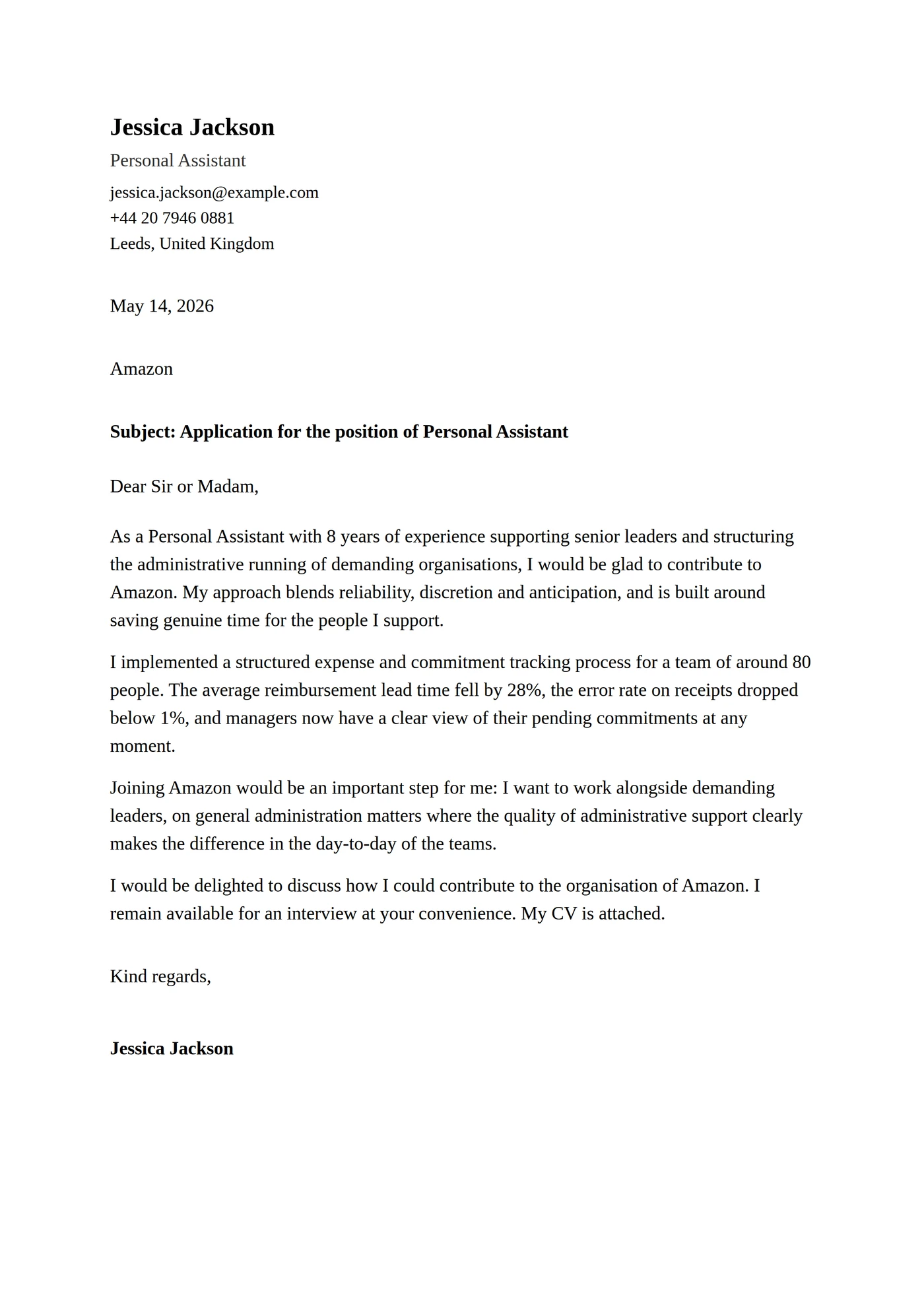
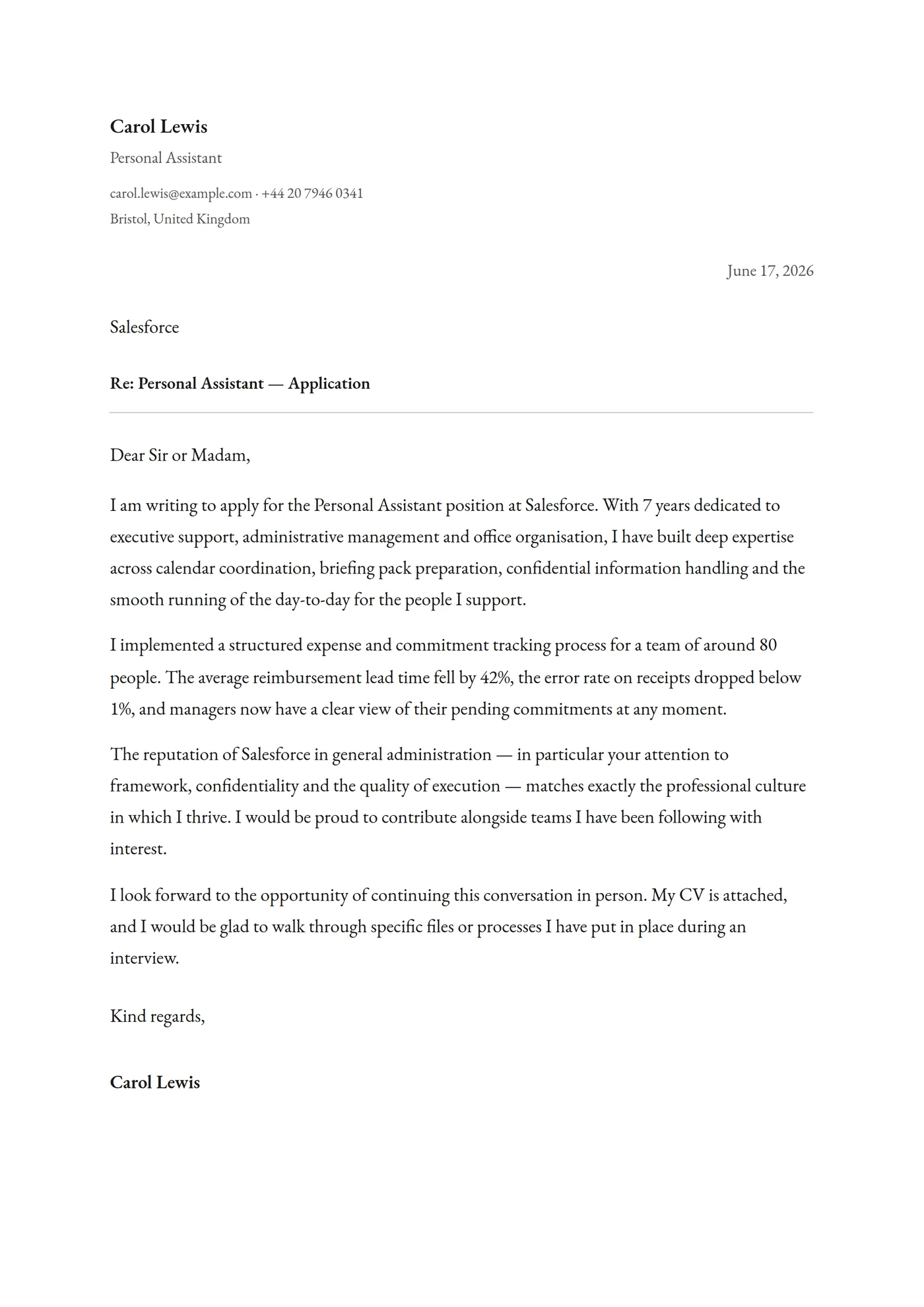
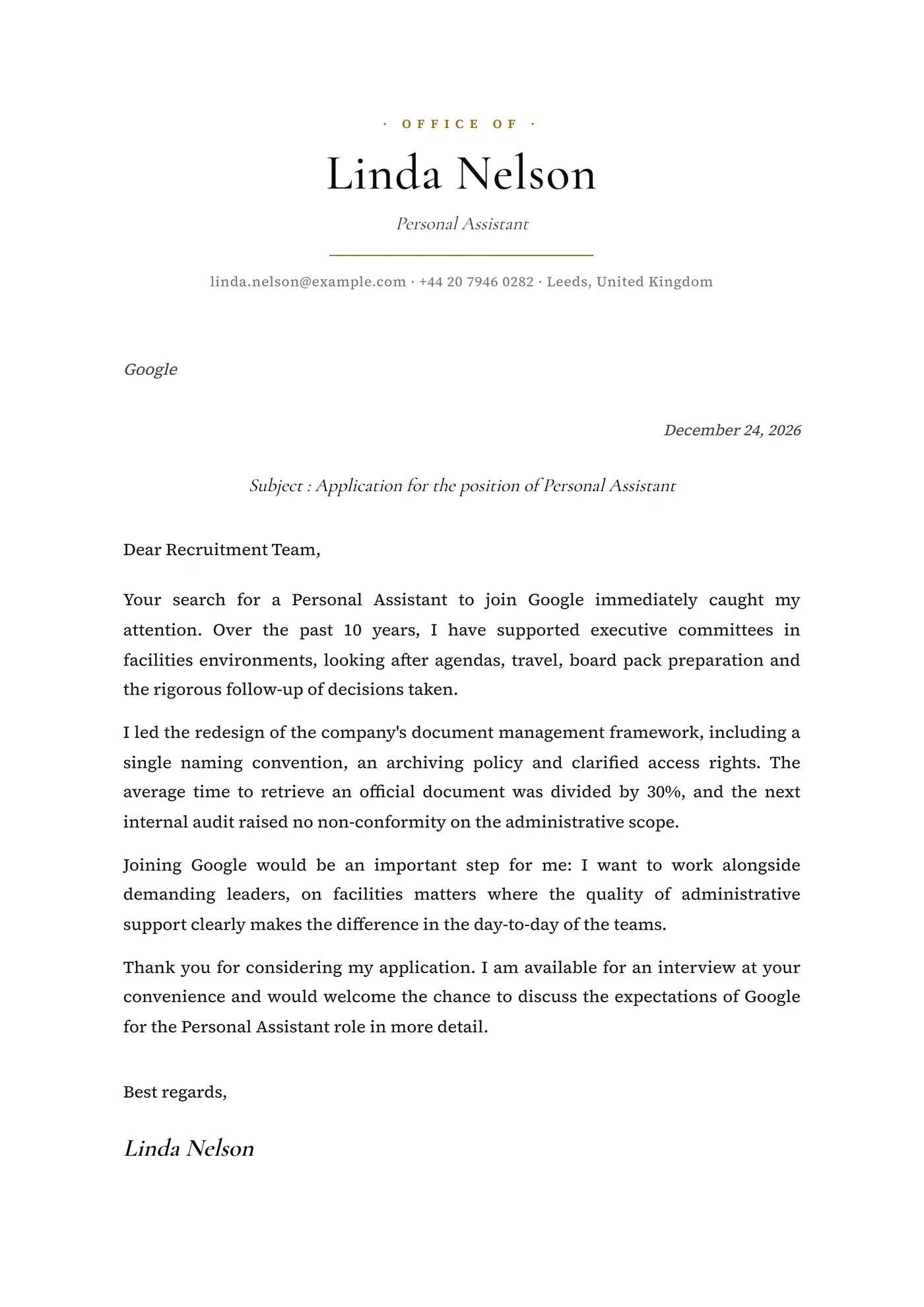
Three templates selected for this role, from junior to senior level. Tap a template to discover its full design and use it in your document.
How to Write a Personal Assistant Cover Letter
Open with a direct statement of the role you're applying for and one specific reason you are drawn to that organization or executive, rather than a generic *I am writing to apply* line. If you know the hiring manager's name, address them directly; otherwise use a professional greeting like Dear Hiring Manager rather than To Whom It May Concern. Avoid opening with your entire work history — save that for the body. Instead, lead with a brief hook: a relevant accomplishment, a shared value with the company, or a clear statement of what makes you well-suited to support busy executives. This signals immediately that you understand the role's demands.
Keep the body to two or three focused paragraphs. The first should connect your background to the core demands of the role — scheduling, travel coordination, confidentiality, or office management — using one or two concrete examples with measurable outcomes, such as managing calendars for 3 executives or cutting scheduling conflicts by 40%. The second paragraph should address soft skills and working style: discretion, adaptability, and how you handle shifting priorities or last-minute changes calmly. Mention familiarity with relevant tools like Microsoft Outlook, Google Workspace, or travel booking platforms where relevant. Close the body by briefly explaining your motivation for this specific role or organization, showing you've researched the company or executive's needs rather than sending a generic letter.
End with a clear, confident call to action — expressing interest in an interview and your availability, such as *I would welcome the opportunity to discuss how I can support your team*. Avoid overly passive closings like *I hope to hear from you* without any proactive tone. Sign off professionally with Sincerely or Best regards, followed by your full name and contact details if not already in the header. Keep this final section brief and avoid repeating your entire resume.
The tone should be polished, warm, and professional — reflecting the discretion and composure expected of someone who will represent an executive. Avoid overly casual language, slang, or excessive enthusiasm that feels unprofessional for a role built on trust and confidentiality. At the same time, avoid sounding stiff or robotic; a touch of personality shows you'll be pleasant to work closely with day to day. Precise, clear language signals the same organizational skills you'll bring to the job itself.
Skills to Mention in Your Personal Assistant Cover Letter
Common Mistakes
A generic cover letter that could apply to any administrative role fails to show the hiring manager you understand the specific demands of supporting *this* executive or organization. Fix this by naming the company, referencing the job posting's specific requirements, and tying your experience directly to their stated needs.
A Personal Assistant cover letter should stay to roughly 250-400 words or one page, since hiring managers for support roles expect concise, well-organized communication. Cut repeated resume details and keep only the two or three strongest, most relevant points.
Simply listing duties like *managed calendars* or *booked travel* without results fails to differentiate you from other candidates. Reframe duties as achievements, such as reduced scheduling conflicts by 30% or coordinated travel for 10+ international trips annually with zero errors.
Avoid decorative fonts, excessive colors, or unconventional layouts that distract from content or break when scanned by ATS software. Save the file as a PDF unless otherwise instructed, use a clear subject line including the job title, and keep formatting consistent with your resume.
Frequently Asked Questions
Yes — because the role relies heavily on trust, discretion, and personal fit, a cover letter helps hiring managers gauge your communication style and motivation beyond what a resume shows. Even when marked optional, including one signals genuine interest and strong written communication skills.
Aim for 250-400 words, fitting comfortably on one page. Hiring managers for this role value conciseness, since it mirrors the efficient communication they expect on the job.
Yes, each letter should reference the specific executive, team, or company and connect your experience to their stated needs. A tailored letter demonstrates the attentiveness and research skills that are core to succeeding as a Personal Assistant.
In the US and UK, a cover letter is commonly expected and can strongly influence shortlisting decisions for support roles. In much of the EU, expectations vary by country, but including one is generally viewed positively and rarely hurts an application.
AI tools can help structure your thoughts or overcome writer's block, but the final letter should be personalized with specific examples and your own voice. Hiring managers for this role value authenticity and attention to detail, so avoid submitting an unedited, generic AI draft.
Use a clean, single-column, reverse-chronological-friendly layout with a standard font, clear headers, and a PDF file format to preserve formatting. Avoid tables, graphics, or multiple columns that can confuse both human readers and ATS systems.
Explore more about