Personal Assistant Resignation Letter Templates

Professional resignation letter templates for Personal Assistant professionals — formal, short, email versions with expert tips.

We currently have 14 Personal Assistant job postings in our database. Write your letter — it's free

When to Use

New Job Opportunity
When leaving for a new opportunity, keep the tone positive and professional, briefly stating you have accepted a new role without disparaging your current employer. Emphasize gratitude for the experience gained and offer to support a smooth handover, since Personal Assistants often hold sensitive scheduling and confidential information. Avoid detailing salary comparisons or specific reasons for choosing the new employer.
Career Change
If resigning to pursue a different career path, frame it as a personal growth decision rather than dissatisfaction with the current role or employer. Thank your manager for the skills and exposure gained, such as executive support, diary management, or stakeholder coordination, and express willingness to assist during the transition. Keep explanations brief and forward-looking to avoid implying the role itself was unsatisfying.
Personal Reasons
For resignations tied to health, family, or burnout, share only what you are comfortable disclosing, such as needing to focus on personal commitments, without going into medical or private detail. A short, respectful explanation paired with appreciation for the employer's understanding is sufficient, and you are never obligated to justify further. Prioritize your wellbeing while maintaining professionalism in tone.
Relocation
When relocating, state the move clearly and include your last working day based on your notice period, since many Personal Assistant roles involve daily in-person coordination that cannot be replicated remotely. If you are open to a remote or hybrid arrangement, mention this as a possibility but let the employer decide rather than assuming it is guaranteed. Offer to help identify or train a successor given the role's reliance on institutional knowledge.

Recommended templates for Personal Assistant

Three templates selected for this role, from junior to senior level. Tap a template to discover its full design and use it in your document.
Junior
ATS Times — Junior

ATS Times

ats

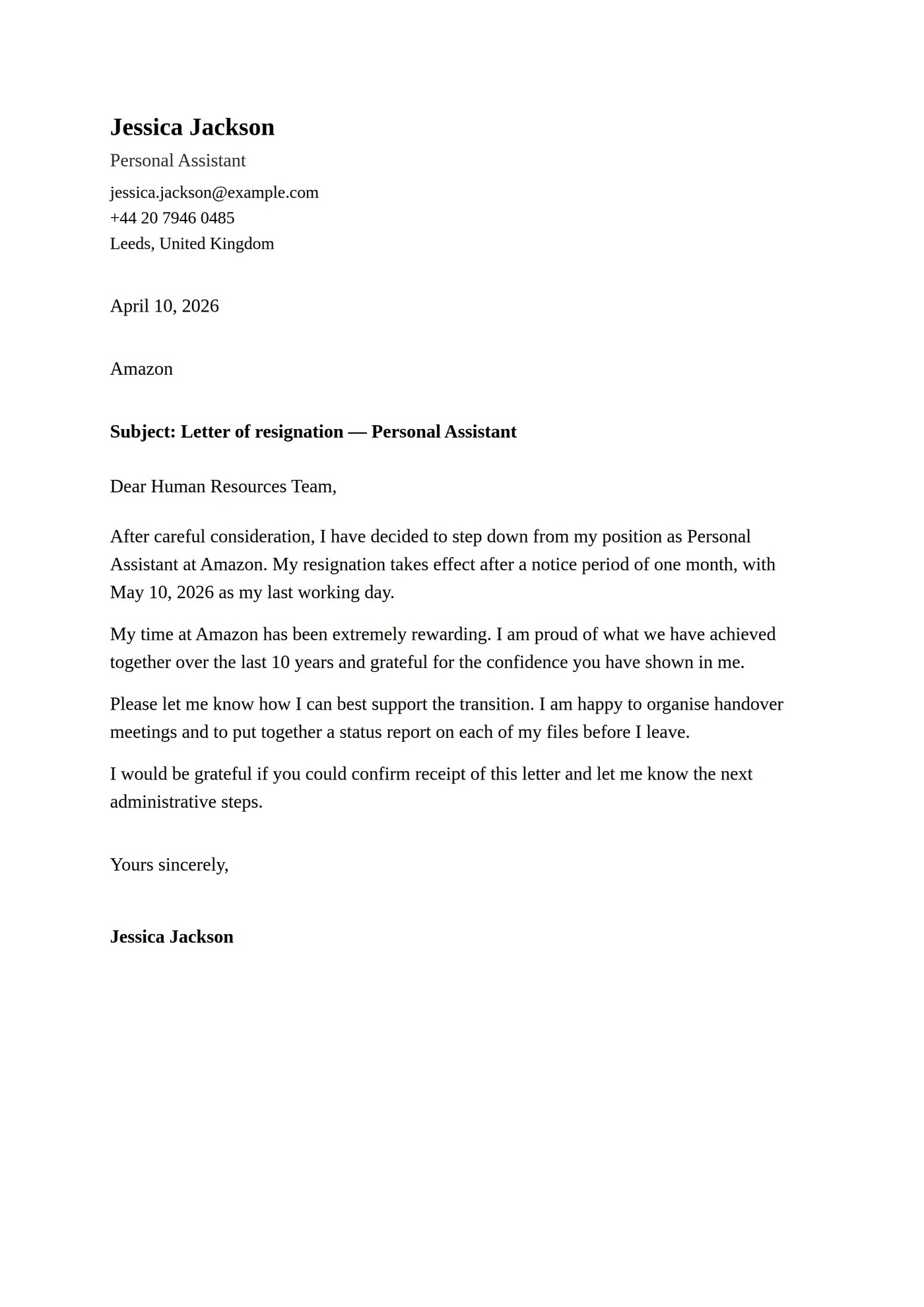
A clean, no-frills format suits a junior Personal Assistant resigning from a first role, keeping the letter concise and respectful without unnecessary formality.

Learn more about this template
Mid-level
Classic — Mid-level

Classic

professional

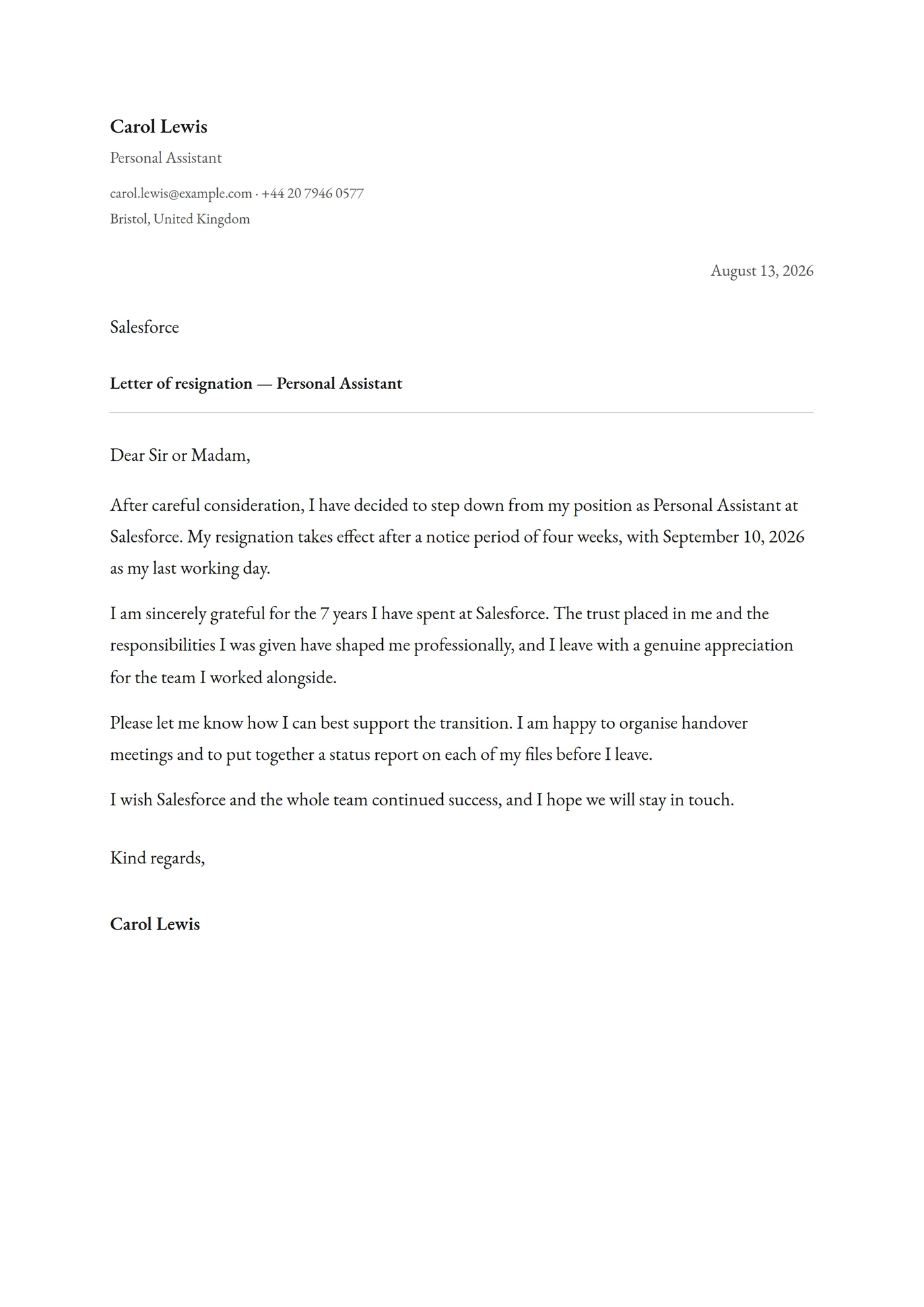
This template balances professional structure with warmth, fitting a mid-level Personal Assistant who wants to express gratitude while maintaining a formal tone.

Learn more about this template
Senior
Presidential — Senior

Presidential

executive

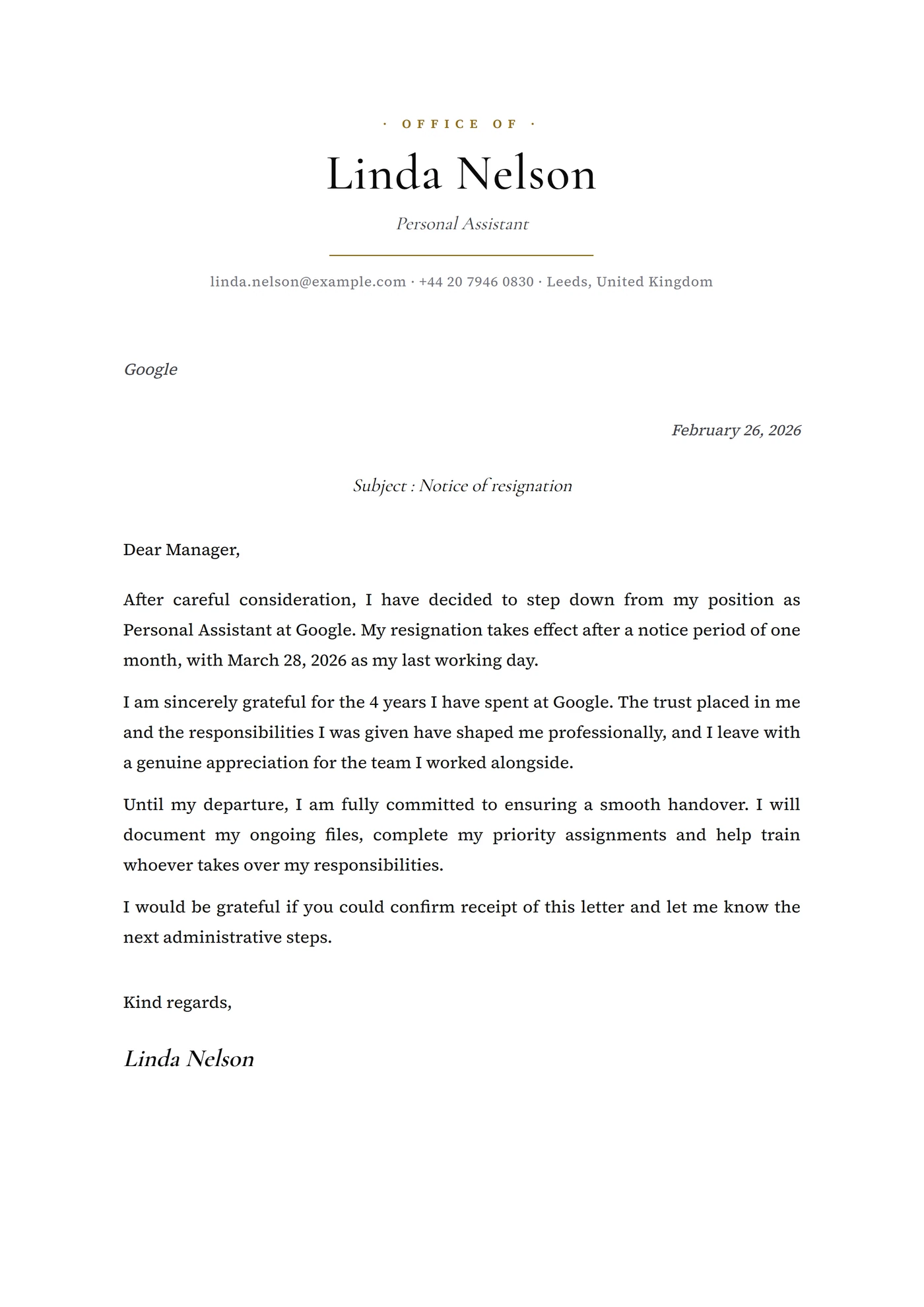
A polished, authoritative design reflects the gravitas expected from a senior Personal Assistant supporting executives, reinforcing a smooth and professional transition.

Learn more about this template

Tips for Resigning

Notice Period
Most Personal Assistants should give at least two to four weeks of notice, though those supporting senior executives or C-suite leaders may be contractually required to provide one month or more due to the complexity of the role. Always check your employment contract, as notice terms are often explicitly stated given the trust and scheduling responsibilities involved.
Tone
Keep the letter warm but formal, thanking your employer for the opportunity and highlighting positive experiences, since Personal Assistants often have close working relationships with their managers. Never criticize your employer, colleagues, or workload in writing, even if frustrations contributed to your decision to leave.
Timing
Choose a time when your manager is not in the middle of a major event, trip, or critical deadline, as Personal Assistants often manage time-sensitive schedules. Resigning early in the week, such as Monday or Tuesday, allows time for an initial conversation and handover planning before the weekend.
Preserving Relationships
Offer to create detailed handover notes covering calendars, contacts, and recurring tasks, since this role relies heavily on institutional knowledge that is easily lost. Maintaining a positive relationship is especially valuable in this field, as references and personal recommendations often carry significant weight for future assistant roles.

Notice Period Rules

United States
In the US, most employment is at-will, meaning there is no legal requirement to give notice, but two weeks is the standard professional courtesy expected across most industries. Personal Assistants supporting executives may have contracts specifying longer notice, particularly if they handle confidential or high-stakes responsibilities.
United Kingdom
In the UK, statutory minimum notice is one week after one month of employment, rising with tenure, but most employment contracts for Personal Assistants specify one to three months, especially in executive support roles. Always check your contract, as it typically overrides statutory minimums when longer.
Canada
In Canada, notice requirements vary by province, with most requiring one to two weeks under employment standards legislation, though reasonable notice under common law can be longer for more senior or specialized assistant roles. Contracts should always be reviewed, as many executive assistants have negotiated specific notice clauses.
Europe
In countries like France and Germany, notice periods are often governed by collective bargaining agreements and can range from one to three months depending on seniority and tenure. Personal Assistants in these markets should check both their employment contract and applicable labor agreements, as statutory minimums are frequently extended by sector-specific rules.

Frequently Asked Questions

Yes, a written resignation letter is strongly recommended even after a verbal conversation, as it creates an official record for HR and protects both parties. Given the trust-based nature of the role, a formal letter also helps ensure a professional, documented transition.

Most Personal Assistants should provide two to four weeks notice, though those supporting senior executives may need to give one month or more as specified in their contract. Reviewing your employment agreement is the best way to confirm the exact requirement.

No, an employer cannot legally refuse a resignation, though they may negotiate the final working date or ask you to reconsider. Once you have clearly communicated your intent to resign in writing, the resignation stands regardless of employer approval.

Email is acceptable, particularly for remote or hybrid roles, but it is best practice to have a verbal conversation with your manager first, followed by a written letter for formal documentation. Given the close working relationship typical of this role, an in-person or video conversation is often more appropriate before sending anything in writing.

Need a personalized resignation letter?

Use our AI to generate a professional, polished letter tailored to your role and situation in minutes.

Write your letter — it's free

Start for free. No credit card required.