
When You Need a Cover Letter for Registered Nurse
A cover letter lets a Registered Nurse applicant show clinical judgment, bedside manner, and alignment with a facility's patient-care philosophy — details a resume table cannot capture. It is the place to explain why you want this unit, this patient population, or this health system specifically, which hiring managers use to gauge cultural and specialty fit.
For a nursing student or new-grad internship, the cover letter should lean on clinical rotations, simulation lab experience, and preceptor feedback rather than paid work history. Emphasize eagerness to learn, patient safety awareness, and specific clinical skills practiced during clinicals, since quantifiable outcomes are limited at this stage.
Nurses transitioning from another healthcare role (e.g., CNA, EMT, or a non-clinical field) should connect transferable skills like patient communication, crisis response, and attention to detail to nursing competencies. Explain the motivation behind the shift and highlight any bridge coursework, clinical hours, or certifications that prove readiness for direct patient care.
When applying for an internal promotion (e.g., Charge Nurse, Nurse Manager), the tone should be confident and collegial, referencing institutional knowledge and specific outcomes achieved on the current unit. Highlight leadership moments, mentorship of new staff, and quality or safety initiatives you drove, since decision-makers already know your clinical baseline.
Recommended templates for Registered Nurse
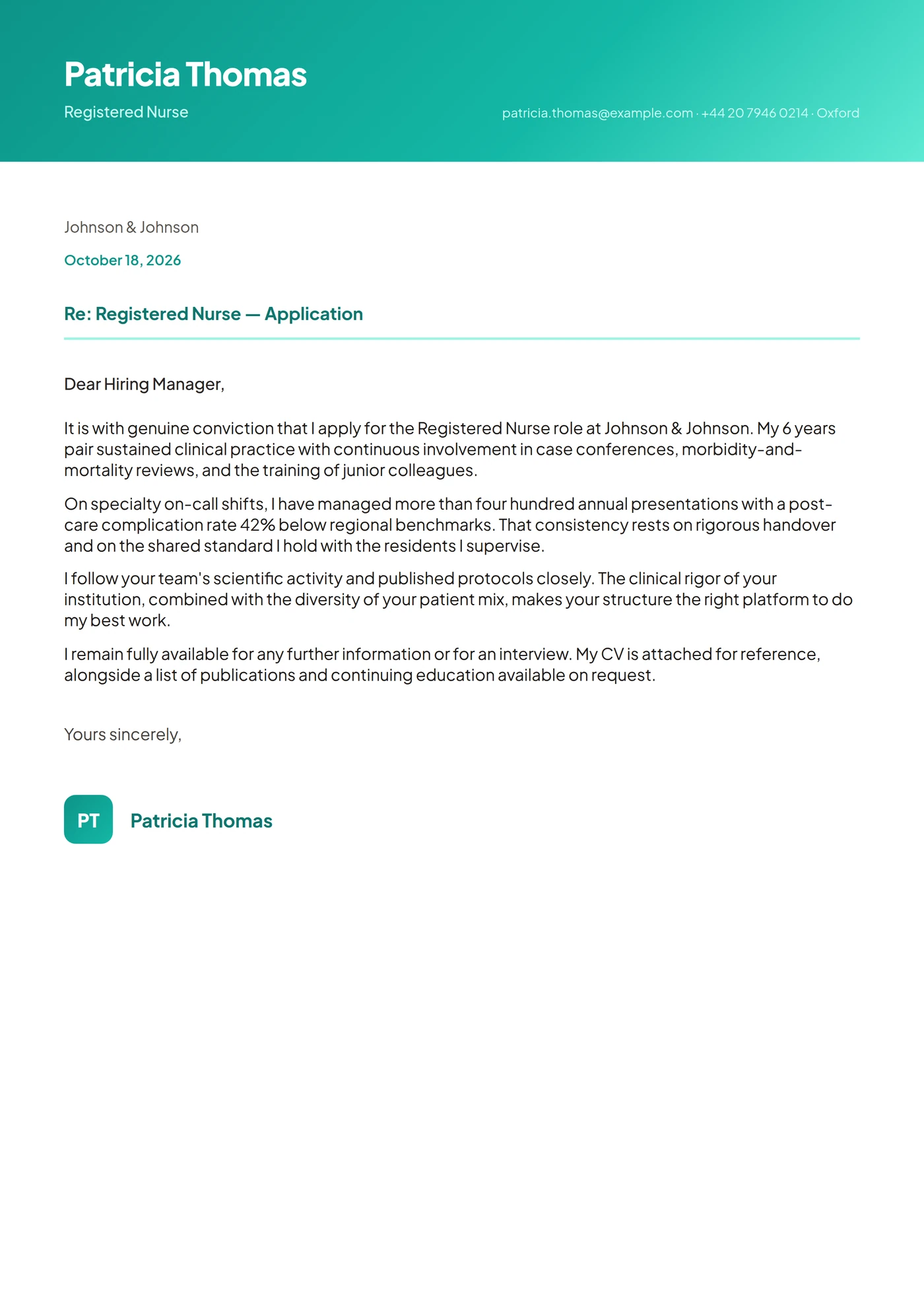
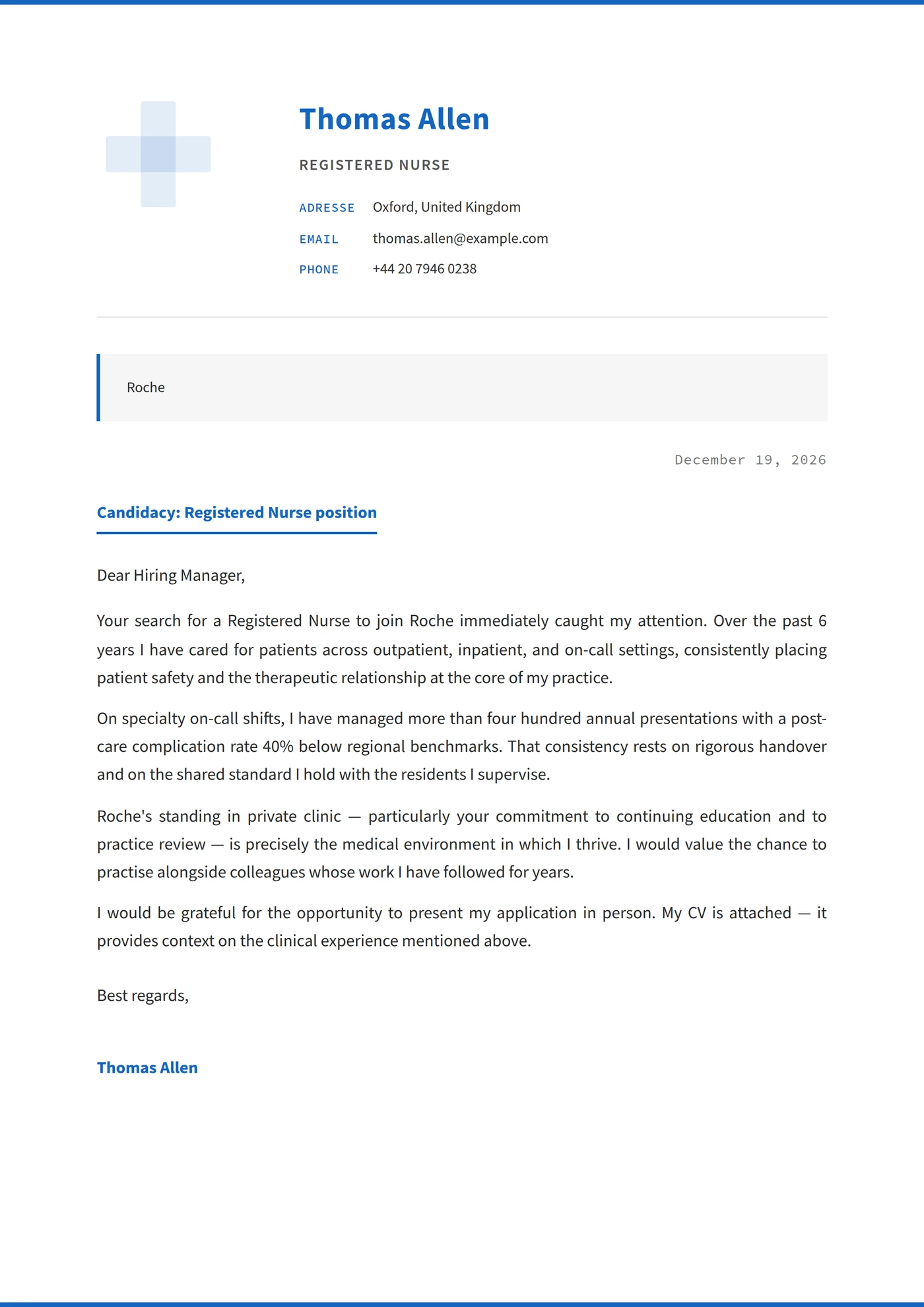
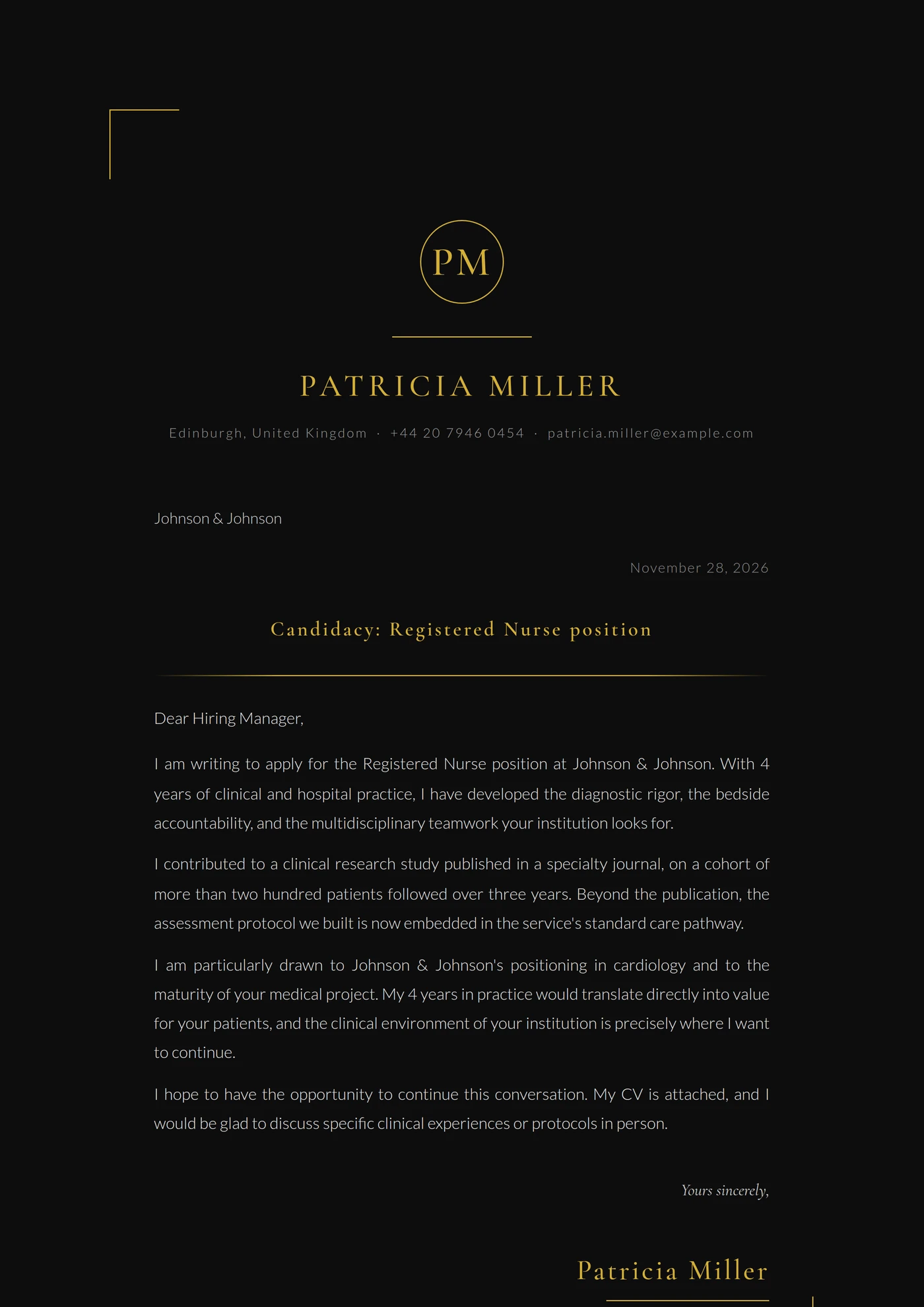
Three templates selected for this role, from junior to senior level. Tap a template to discover its full design and use it in your document.
How to Write a Registered Nurse Cover Letter
Open with a direct statement of the role you are applying for and one compelling reason you are a strong fit — such as years of experience in a specific unit type or a passion for the facility's patient population. Avoid generic openers like 'I am writing to apply for the Registered Nurse position'; instead, lead with something specific, like a shared commitment to the hospital's mission or a recent accomplishment relevant to the unit. Whenever possible, address the hiring manager or nurse recruiter by name rather than 'To Whom It May Concern.' If the name is not listed, a quick check of the job posting, hospital website, or LinkedIn can usually surface it, and using it signals genuine interest and attention to detail. The first two sentences should establish credibility fast: mention your license status (e.g., RN license), relevant specialty, or years of experience, paired with enthusiasm for the specific department or facility you are targeting.
The body should run two to three paragraphs. The first should summarize your clinical background, specialty focus (e.g., ICU, med-surg, pediatrics), and years of experience, while connecting it to the job posting's stated needs. The second paragraph should highlight one or two concrete achievements — such as improving patient satisfaction scores, reducing fall rates, or mentoring new nurses — using numbers wherever possible to show impact rather than just listing duties. A third paragraph, if included, should address why this particular employer or unit appeals to you, referencing their reputation, values, or patient population, which shows the letter was not mass-sent. Balance technical competence (certifications, EHR systems, clinical procedures) with soft skills like empathy, communication under pressure, and teamwork, since nursing roles are evaluated on both clinical skill and bedside manner. Avoid simply restating the resume line by line; instead, use the body to tell a brief narrative of impact, such as a time you advocated for a patient or improved a workflow, which demonstrates judgment and initiative beyond task completion.
Close with a confident, specific call to action — expressing interest in discussing how your skills could benefit the unit or team in an interview, and stating your availability for a conversation. Thank the reader for their time and consideration, and sign off with a professional closing such as 'Sincerely' or 'Respectfully' followed by your full name and credentials (e.g., RN, BSN). Avoid vague or overly casual endings like 'Hope to hear from you soon!' — keep the tone warm but professional, and do not apologize for lack of experience or over-explain gaps; instead, end on a forward-looking, confident note.
The tone should be warm yet professional — nursing is a patient-centered profession, so language that conveys compassion, reliability, and composure under pressure resonates strongly with hiring managers. Avoid overly casual phrasing or slang, but also avoid stiff, jargon-heavy sentences; clear, direct language that reflects clinical confidence and genuine care for patients signals professionalism most effectively. Use active verbs (managed, coordinated, advocated, implemented) rather than passive constructions, and favor concise sentences over long, meandering ones. A tone that balances competence with humanity — showing you are both clinically skilled and emotionally attuned to patients — is what distinguishes a strong nursing cover letter.
Skills to Mention in Your Registered Nurse Cover Letter
Common Mistakes
A generic cover letter that could apply to any hospital or unit signals a lack of genuine interest and effort. Fix this by referencing the specific facility, unit type, or patient population mentioned in the job posting, and connecting your experience directly to their stated needs.
An ideal nursing cover letter stays within one page, roughly three to four concise paragraphs. Cut redundant background details, lengthy clinical rotation lists, or repeated resume content, and keep only the most relevant achievements and motivations.
Simply listing duties like 'administered medications' or 'monitored patients' fails to differentiate you from other qualified applicants. Reframe these into achievements with context and outcome, such as 'Reduced medication errors by 20% through implementing a double-check protocol on a 30-bed unit.'
Common formatting errors include using decorative fonts, submitting in an editable .docx when a PDF is requested, or exceeding one page. Always follow the application instructions precisely, use a clean professional font, and ensure the file is correctly labeled with your name and the position title.
Frequently Asked Questions
Yes, even though some facilities make it optional, a cover letter lets you explain your specialty focus and motivation for that specific unit, which strengthens your application. In competitive hospital systems, a well-written letter can set you apart from equally qualified candidates.
Aim for one page, about three to four paragraphs, focused on your most relevant clinical experience and one or two measurable achievements. Hiring managers and nurse recruiters often review many applications quickly, so concise, targeted content performs best.
Yes, tailoring each letter to the specific unit, patient population, and facility values significantly increases your chances of standing out. Even small adjustments, like naming the department or referencing the hospital's mission, show genuine interest beyond a mass application.
In the US, cover letters are common but sometimes optional, while in the UK and much of the EU, a concise covering letter or personal statement is often expected, especially for NHS or public hospital applications. Regardless of region, including one when the option exists generally reflects positively on your professionalism.
AI tools can be useful for structuring ideas or overcoming writer's block, but the final letter should reflect your authentic voice, specific experiences, and genuine motivation for the role. Hiring managers can often detect generic AI-generated text, so always personalize and fact-check any AI-assisted draft.
Submit your cover letter as a PDF unless the application specifically requests another format, since PDFs preserve formatting across devices and systems. Use a clean, professional font, standard margins, and name the file clearly with your name and the position title.
Explore more about