Registered Nurse Resignation Letter Templates

Professional resignation letter templates for Registered Nurse professionals — formal, short, email versions with expert tips.

We currently have 6 Registered Nurse job postings in our database. Write your letter — it's free

When to Use

New Job Opportunity
When leaving for a new opportunity, keep the tone professional and appreciative, focusing on gratitude for the experience gained and a clear last working day. Avoid mentioning salary, schedule, or management comparisons that could be perceived as criticism of the current employer, and never disparage colleagues or the unit. A brief, positive statement such as pursuing a new professional opportunity is sufficient.
Career Change
When transitioning out of bedside nursing into a new field such as education, informatics, or administration, frame the move as a natural evolution of your skills rather than dissatisfaction with patient care. Keep the explanation brief, emphasize appreciation for the clinical experience gained, and offer to help with a smooth handover of patients and documentation.
Personal Reasons
For resignations due to health, family obligations, or burnout, you are not obligated to disclose details; a simple statement like resigning for personal reasons is appropriate and protected. Keep the tone calm and professional, focus on the transition logistics, and avoid oversharing medical or personal information that could be misused later.
Relocation
If relocating, state your moving date clearly and, if applicable, ask whether a remote or PRN (per diem) arrangement might be possible to maintain the relationship. Include your last physical working day, offer to assist with transferring patient assignments, and keep the letter concise and factual.

Recommended templates for Registered Nurse

Three templates selected for this role, from junior to senior level. Tap a template to discover its full design and use it in your document.
Junior
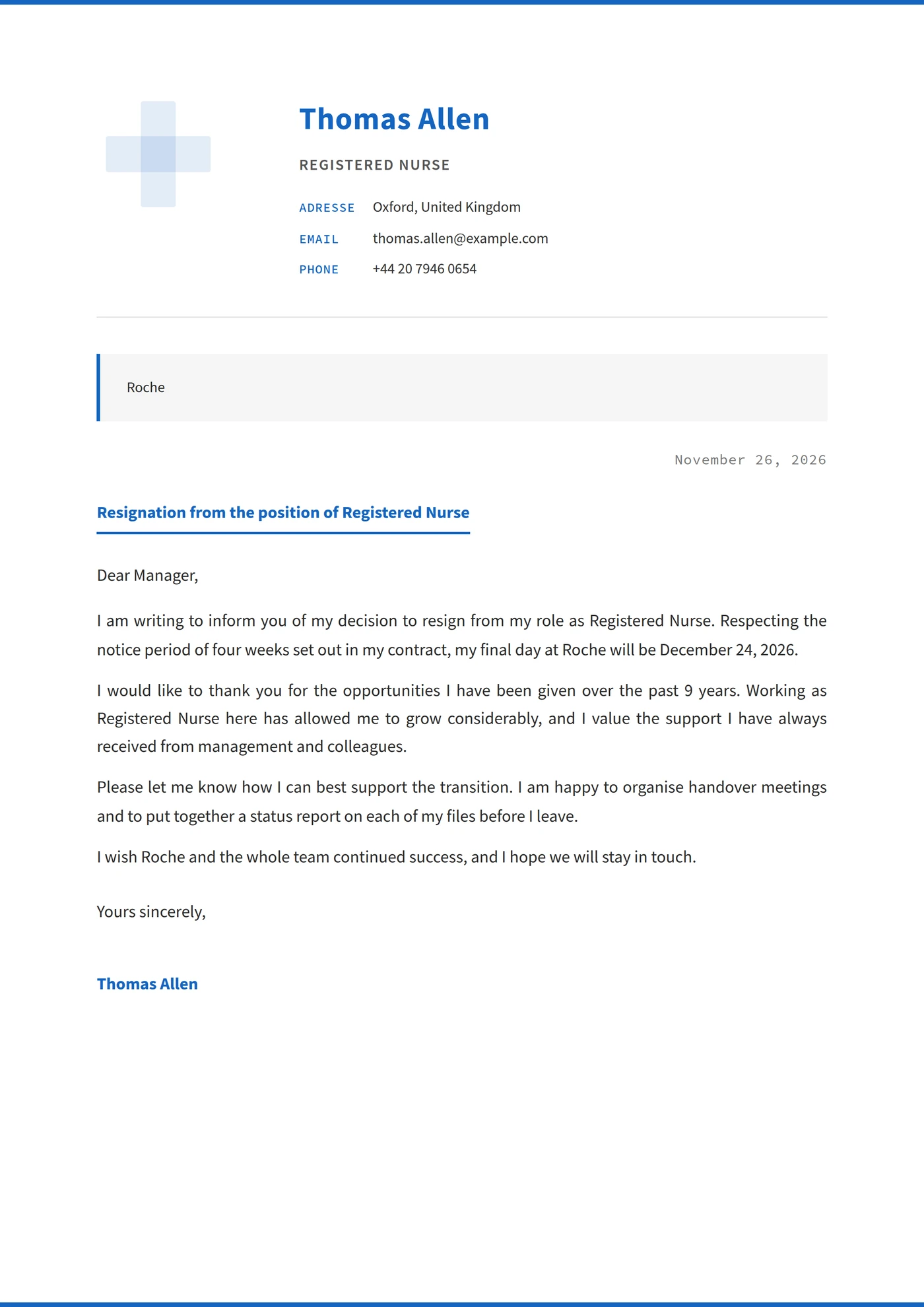
Medical Precision — Junior

Medical Precision

professional

Its clean, clinical-inspired layout suits a junior Registered Nurse resigning from their first unit, conveying respect and clarity without unnecessary formality.

Learn more about this template
Mid-level
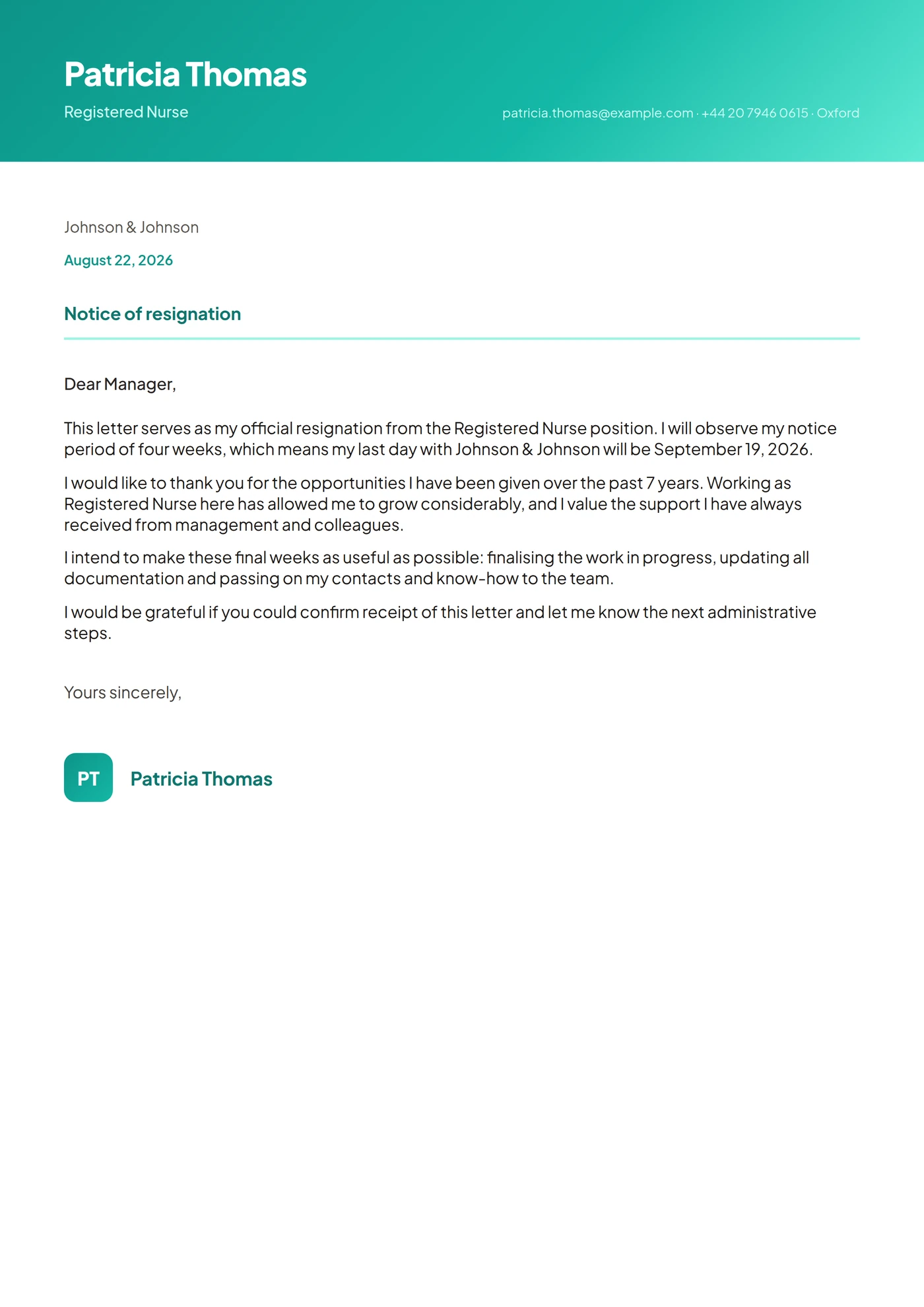
Teal Horizon — Mid-level

Teal Horizon

modern

This modern, balanced design fits a mid-level nurse who wants to express both professionalism and warmth while transitioning to a new role.

Learn more about this template
Senior
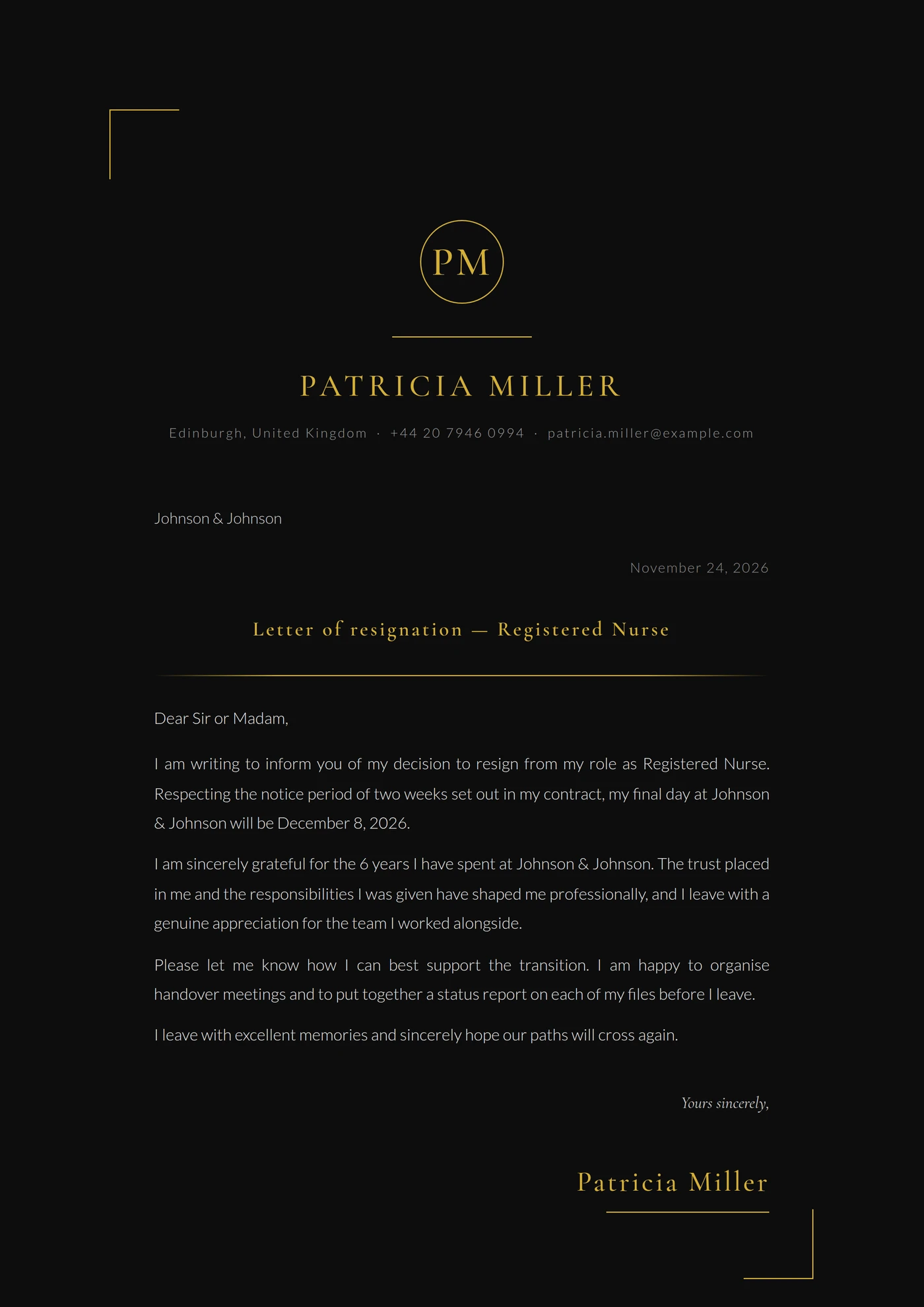
Black Tie — Senior

Black Tie

professional

The formal, polished tone of this template matches a senior nurse or charge nurse offering a structured handover and demonstrating leadership gravitas.

Learn more about this template

Tips for Resigning

Notice Period
Most healthcare facilities expect two to four weeks of notice, and many employment contracts for Registered Nurses specify this explicitly due to staffing and scheduling needs. Always check your facility's HR policy or union agreement, as shorter notice may affect eligibility for rehire or references.
Tone
Keep your resignation letter calm, professional, and grateful, acknowledging the clinical experience and teamwork gained during your tenure. Never use the letter to vent about staffing ratios, management decisions, or interpersonal conflicts, even if those are your real reasons for leaving.
Timing
Submit your resignation after completing a scheduled shift block rather than mid-rotation, and avoid resigning right before a major audit, accreditation survey, or holiday staffing crunch. If you are eligible for a retention bonus or shift differential, confirm vesting dates before finalizing your last day.
Preserving Relationships
Offer to help train your replacement or update care plans before departure, as nursing is a tightly connected professional community where references and rehire eligibility matter greatly. Maintain contact with your nurse manager and colleagues, since many future opportunities in healthcare come through professional referrals.

Notice Period Rules

United States
In the US, most nursing positions are at-will, meaning no legal notice is required, but facilities typically expect two weeks as a professional courtesy outlined in employee handbooks. Some hospitals impose internal policies tying rehire eligibility or final paycheck timing to proper notice, so reviewing your offer letter is essential.
United Kingdom
In the UK, statutory minimum notice is one week after one month of employment, but NHS and most trust contracts require four to eight weeks depending on banding and seniority. Always check your NHS Agenda for Change terms or trust-specific contract for exact notice obligations.
Canada
In Canada, notice requirements vary by province, with most requiring one to two weeks under employment standards legislation, though hospital collective agreements often specify two to four weeks. Unionized nurses should consult their collective bargaining agreement, as it typically overrides general provincial minimums.
Europe
In France, nurses under collective agreements typically owe one to three months notice depending on seniority and contract type (CDI vs CDD). In Germany, statutory notice is generally four weeks to the 15th or end of a calendar month, though hospital-specific Tarifvertrag agreements may extend this period.

Frequently Asked Questions

Yes, a written resignation letter is standard practice in healthcare and creates an official record for HR and licensing purposes. It also helps ensure a smooth handover of patient care responsibilities and protects you if questions about your departure date arise later.

Most facilities expect two to four weeks, though this can vary based on your contract, union agreement, or unit staffing needs. Always confirm your specific notice obligation with HR to avoid affecting your eligibility for rehire or a positive reference.

No, an employer cannot legally force you to stay, but they can request you honor your contractual notice period or risk being marked as not eligible for rehire. In urgent personal circumstances, open communication with your nurse manager can often help negotiate an earlier release.

While a face-to-face conversation with your nurse manager is preferred out of professional courtesy, following up with a written resignation letter via email is both acceptable and necessary for documentation. Always ensure HR and your direct supervisor receive a copy for your personnel file.

Need a personalized resignation letter?

Use our AI to generate a professional, polished letter tailored to your role and situation in minutes.

Write your letter — it's free

Start for free. No credit card required.