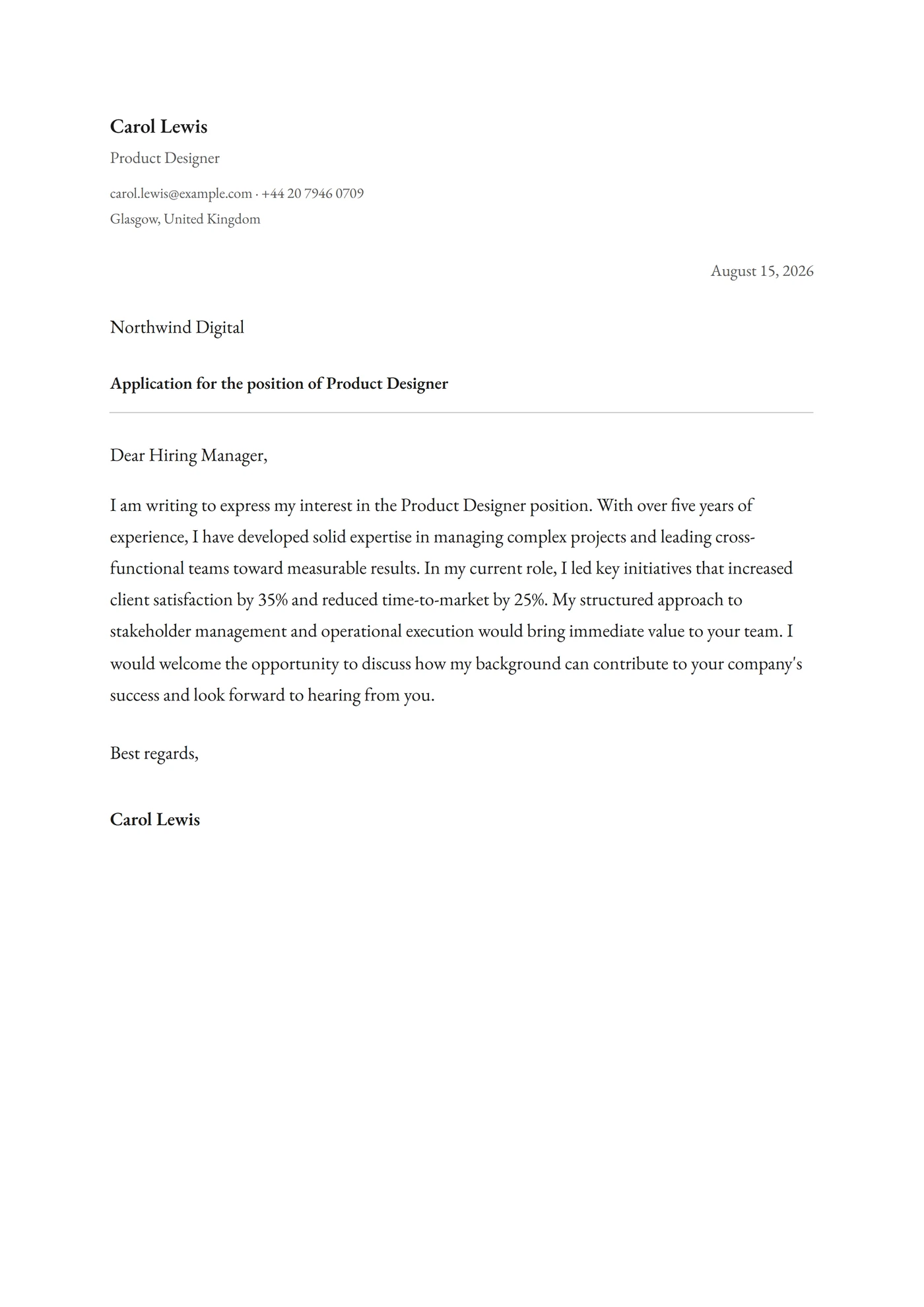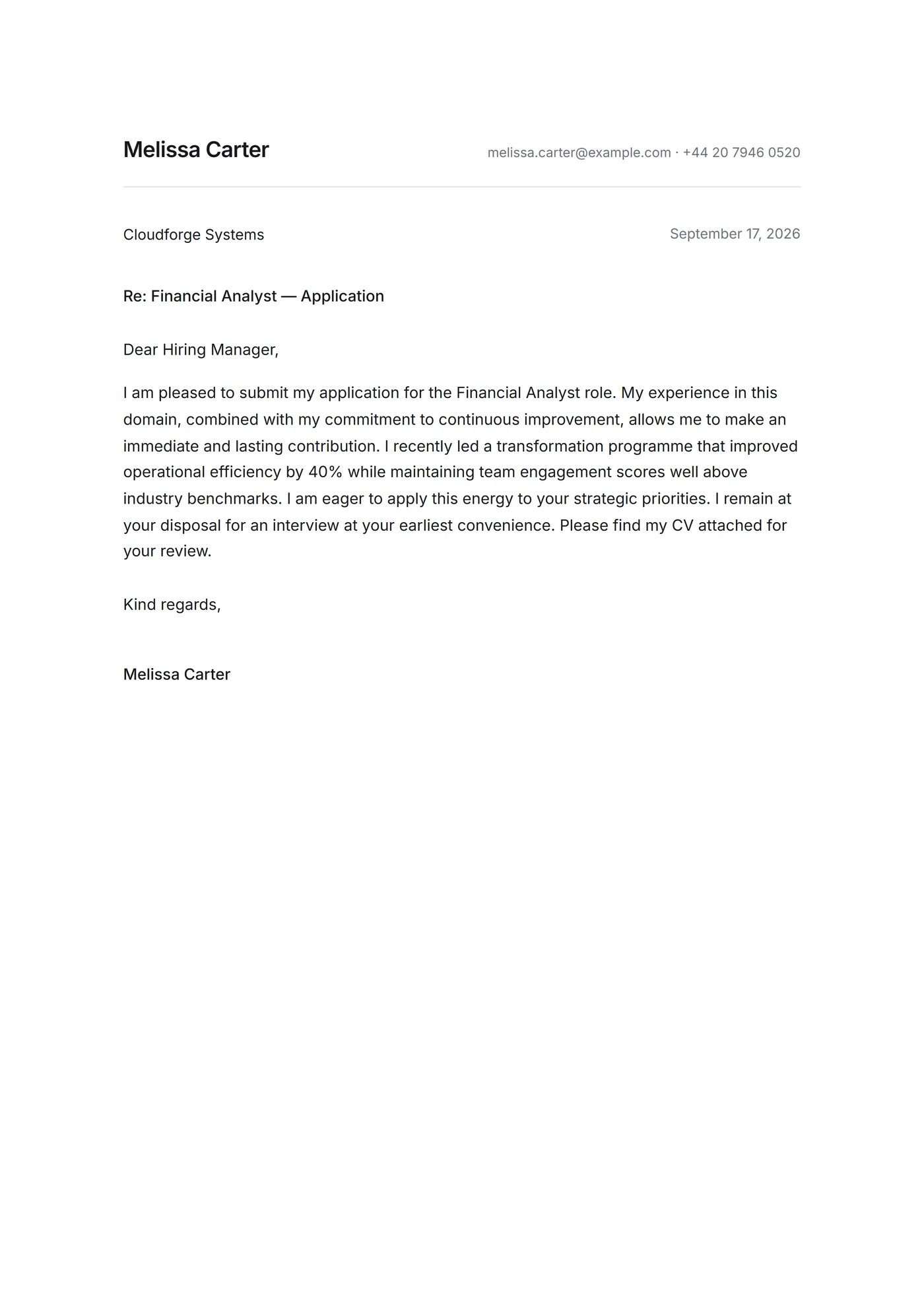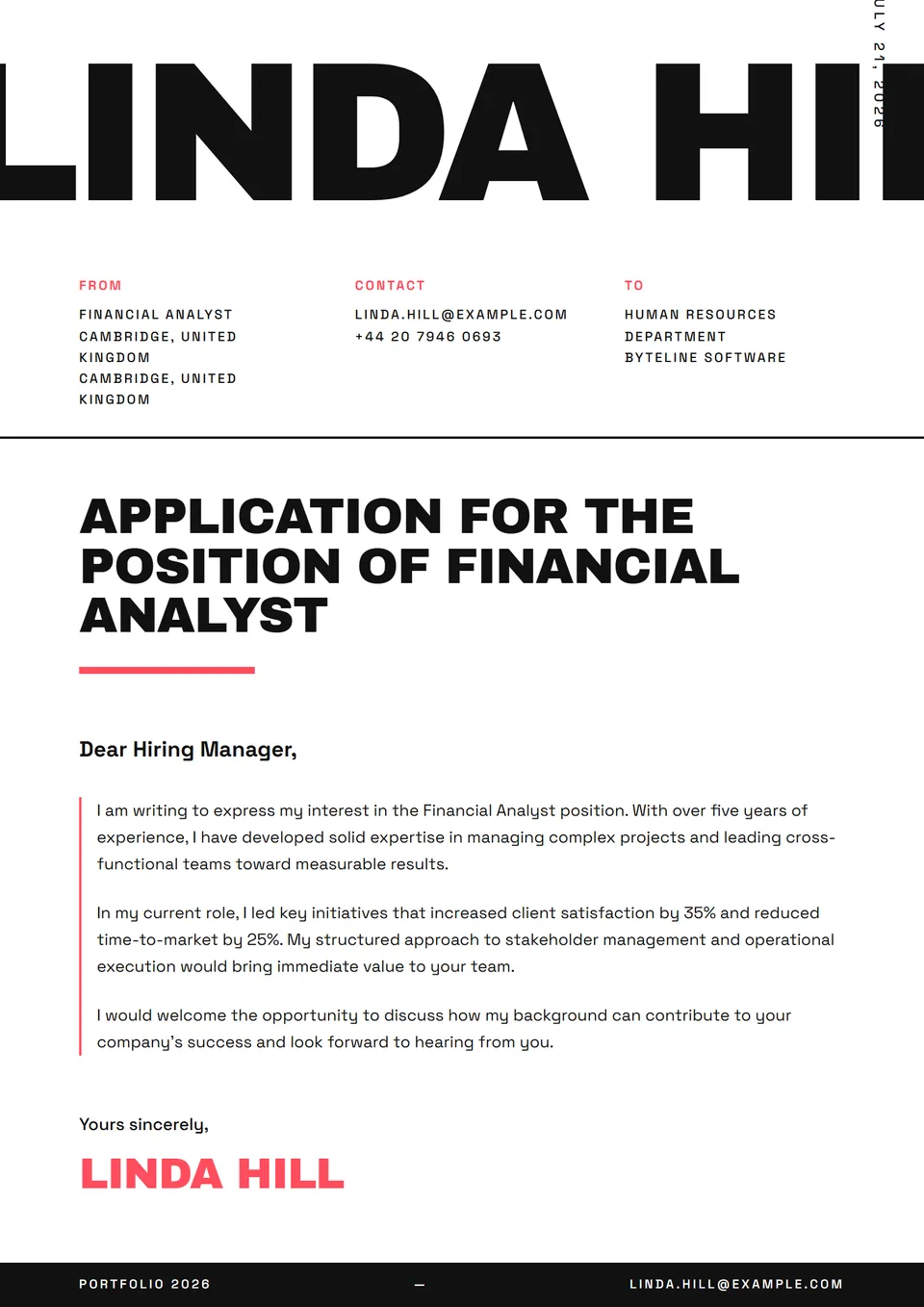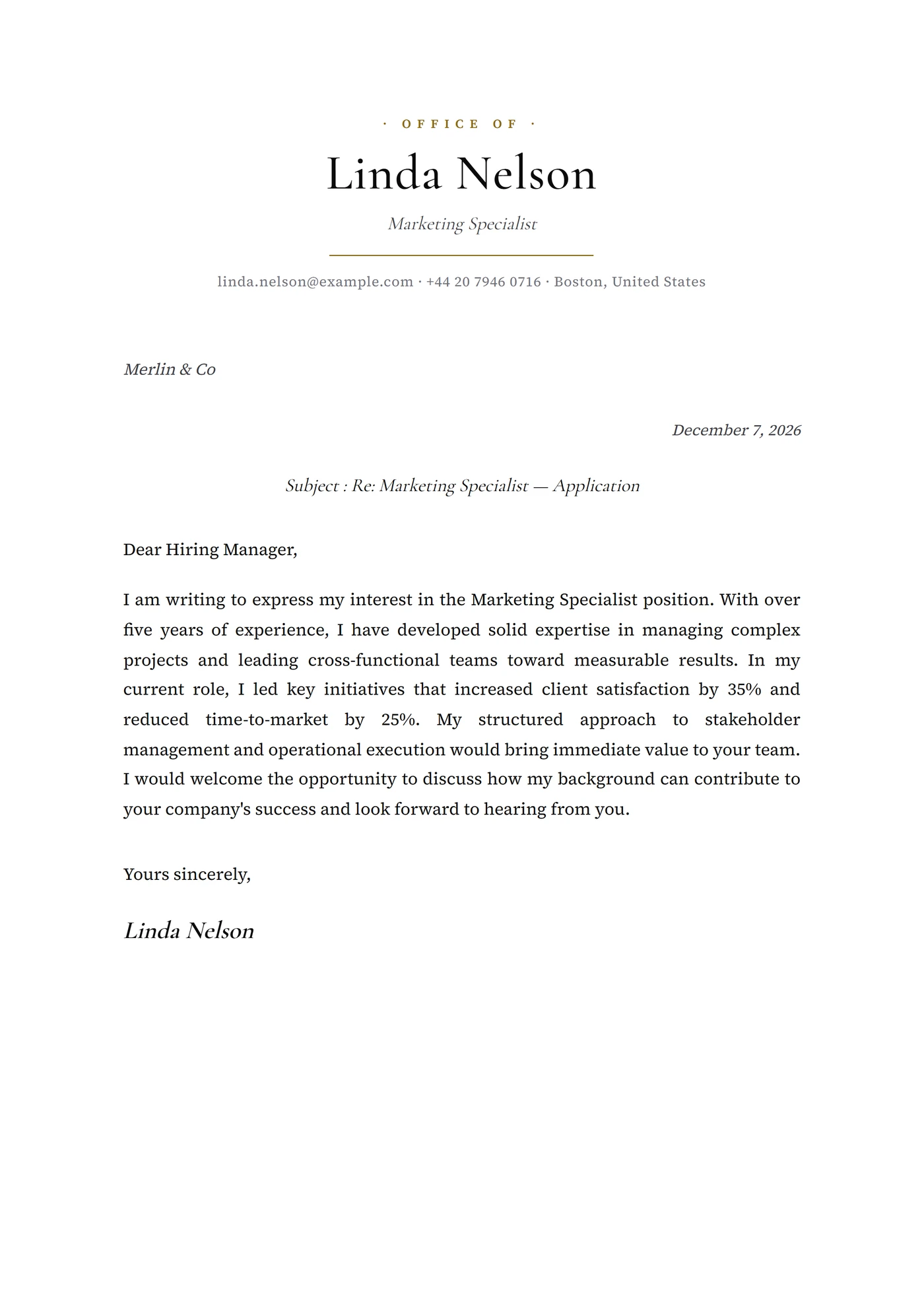
About this template
The Modern Future Lab template is a modern cover letter shaped like a research dossier, with a coded reference number in the corner, JetBrains Mono annotations and a Söhne body. A pale lab-grey ground, a chemical-blue rule — an owned stance that speaks to R&D, deep-tech and applied-research profiles. It parses through research ATS (Workday, Greenhouse) and specialised platforms (HigherEdJobs, AcademicJobsOnline for adjacent academic crossovers, Anthropic Research Hiring).
Who is it for?
It suits applied researchers, post-doctoral R&D engineers in industry (Genentech, Moderna, Pfizer Discovery, Roche Pharma Research), data scientists and AI researchers (Anthropic, OpenAI, DeepMind, Mistral, Hugging Face, Cohere), biotech and medtech specialists, and innovation leads in deep tech (Boom Supersonic, Helion Energy, Commonwealth Fusion, Boston Dynamics, PsiQuantum). Strong fit for industrial chair applications, Marie Skłodowska-Curie postdoctoral mobility and NSF or DARPA fellowships.
How to use it
The applied-research cover letter must frame the scientific problem before the experience: one paragraph to state the technical bottleneck addressed (e.g. "reducing inference latency of large transformer models in production"), one for your contributions (publications, patents, open-sourced models), one for the collaboration angle proposed. Cite publications with DOI and the venue's h5-index or quartile (NeurIPS, ICML, ICLR, ACL, EMNLP for AI; Nature, Cell, Science for life sciences).
Frequently asked questions
Should I attach a publication list?
Yes for senior industrial R&D and tenured-equivalent industry chair applications. Prepare a list with title, co-authors, venue, year, DOI and a one-line abstract. For a junior researcher profile, two or three major publications in the letter suffice — the rest goes to a separate appendix PDF, sent on request.
How do I describe an industry-academia joint role in the letter?
State the status explicitly ("third-year industrial PhD with Roche, thesis defence Q3 2026"), the industrial partner, the host laboratory and the supervisor. For an R&D hiring committee, joint training is read very positively: it proves the ability to navigate between academic rigour and industrial constraints — a rare and valued combination.
Does the lab visual code feel too technical for a biotech application?
On the contrary. Biotechs (Genentech, Moderna, BioNTech, Vertex Pharmaceuticals) value visual codes that signal fluency with scientific protocols. For a corporate non-R&D role at a pharma (Pfizer, Novartis, GSK), prefer a more classical template such as a precision-medical style or Swiss Grid — Future Lab reads as too research-coded for commercial functions.