About this template
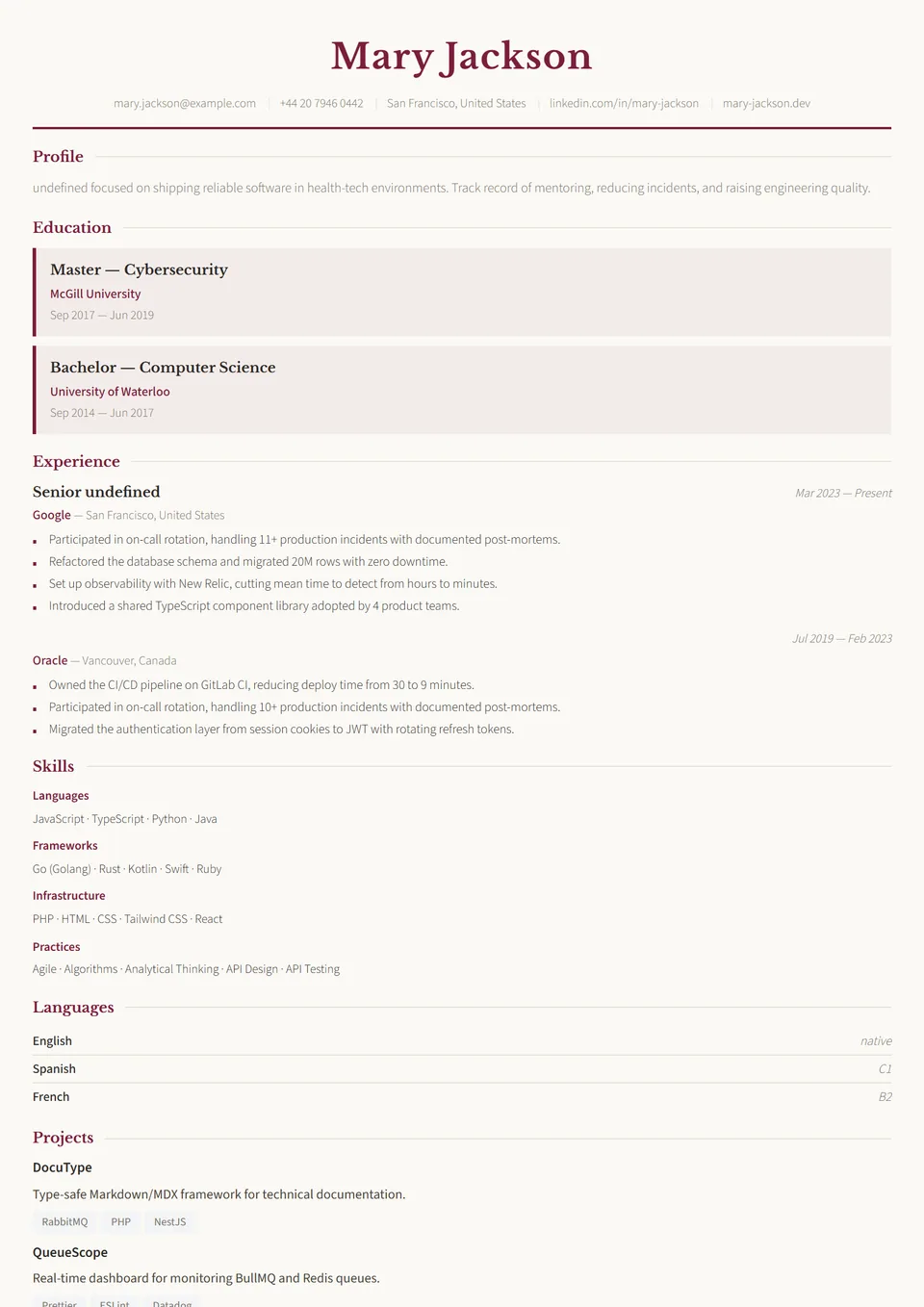
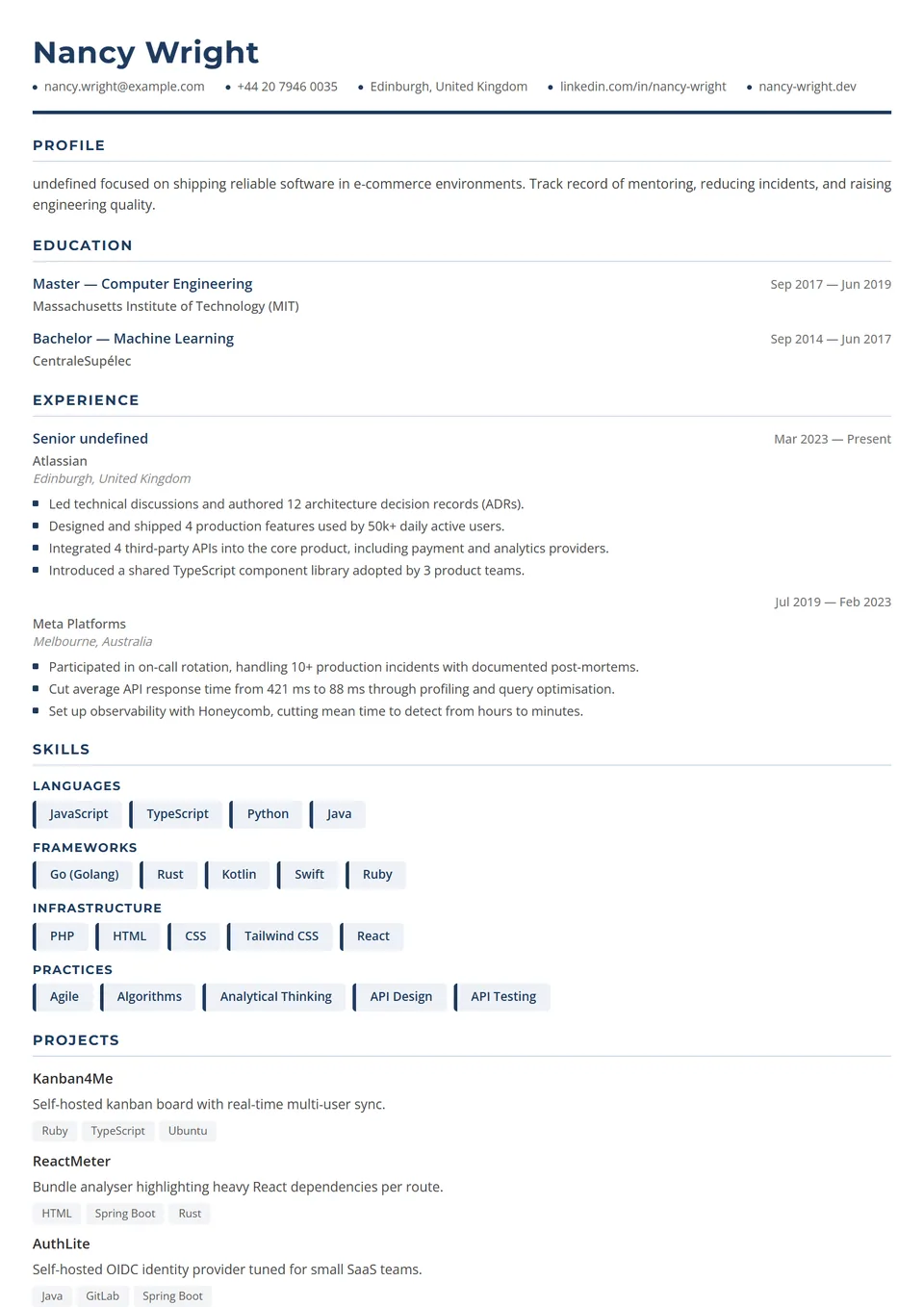
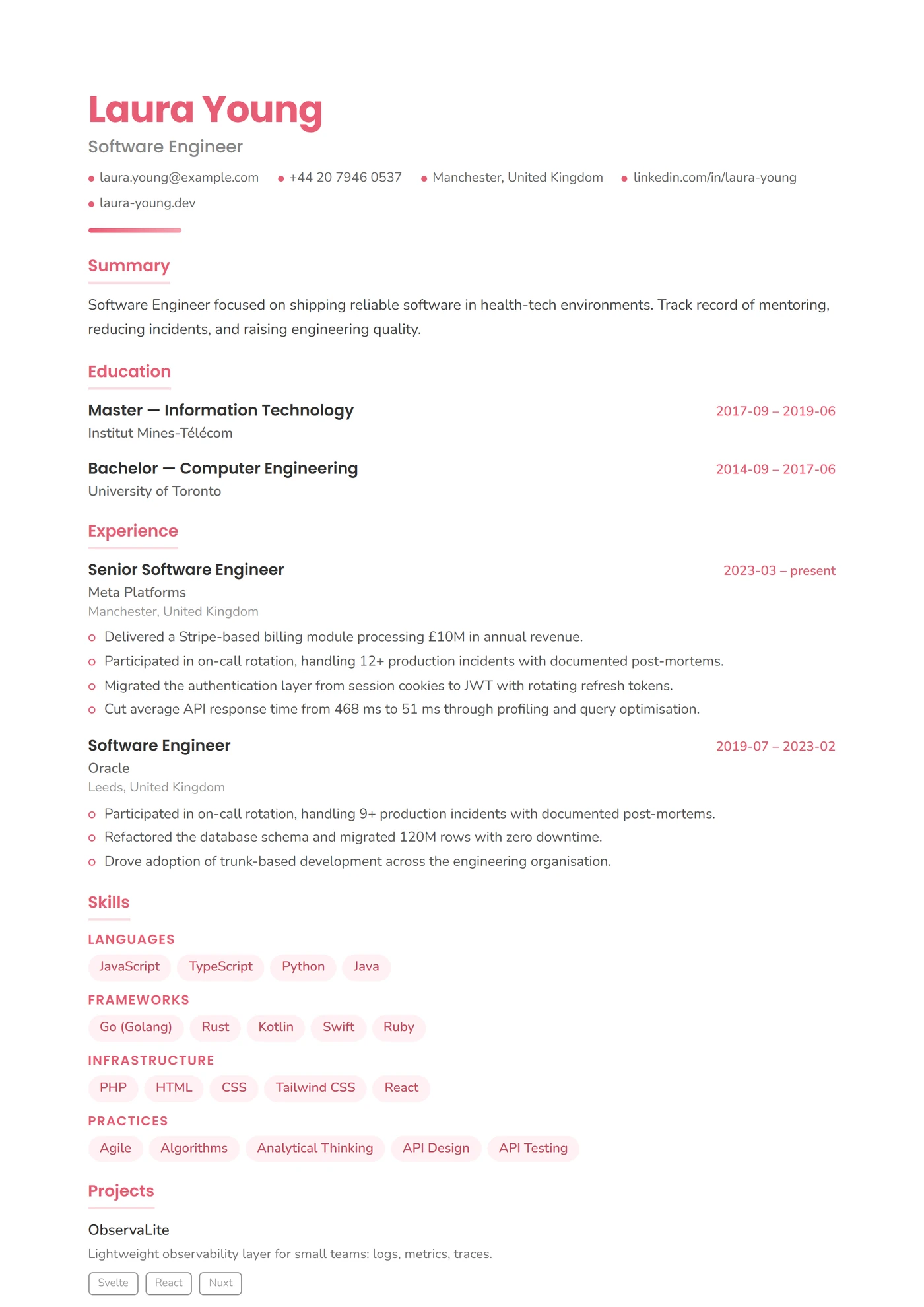
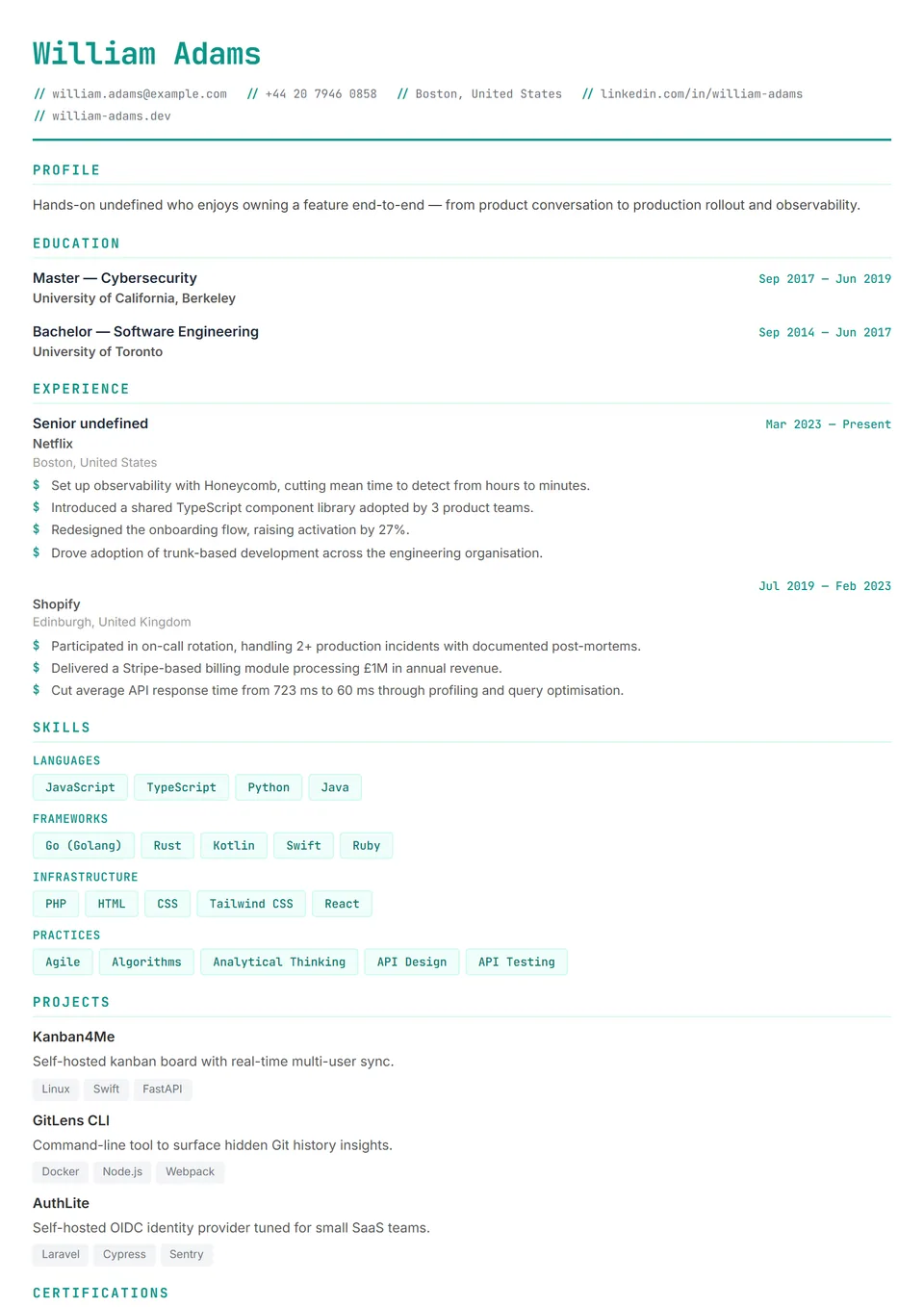
The Finance & Economics template is an academic CV calibrated for scholars in financial economics, monetary econometrics, market microstructure and public economics. Its Merriweather serif typography and deep-green accent signal the sobriety expected by top business school committees (Wharton, Booth, MIT Sloan, LBS, INSEAD, HEC, IESE) and by R1 economics departments. The layout parses cleanly through Workday, Interfolio and AcademicJobsOnline.
Who is it for?
It fits PhD candidates in finance and economics on the AEA, EEA or Royal Economic Society job market, postdocs targeting tenure-track positions in the US or UK, central bank researchers (Federal Reserve, ECB, Bank of England, Bank of Japan) opening a second academic career, and senior economists at think tanks (NBER affiliates, CEPR fellows, Peterson Institute, Bruegel, Brookings) competing for endowed chairs. Also fits Toulouse School of Economics and PSE recruitment and CR/DR CNRS section 37 competitions.
How to use it
Five blocks structure the document — Working papers (with R&R status, conditional accept), Publications in top-ranked journals (AER, QJE, JF, RFS, JFE, JPE), Institutional affiliations (NBER, CEPR, IZA, TSE Fellow), Conference and seminar presentations, Policy advisory work. List the FT 50, RAE/REF or ABS ranking of the journals when applying to UK or European business schools, and the CNRS classification (1, 1*, 2) when applying in France. Useful long-tail queries: 'finance PhD job market CV', 'economics tenure-track resume', 'NBER affiliate CV', 'central bank to academia CV', 'AEA job market candidate CV'.
Frequently asked questions
Should I list R&R status of working papers?
Yes — this is strongly valued on the AEA and EEA job markets. State 'revise and resubmit' explicitly with the journal name (e.g. 'R&R at Journal of Finance'), and indicate the round if you are on the second revision. For a conditionally accepted paper, write 'Conditional accept at AER' with the date. Approximations are immediately spotted by experienced search committees and can hurt credibility.
How should a central-bank career be positioned in an academic CV?
Use a separate Institutional Experience section, distinct from publications. State the exact role (senior economist, principal economist, advisor, head of research), the department (DG Research, DG Financial Stability), and internal publications disseminated externally (ECB working papers, Fed Reserve Bank staff reports, BIS working papers). Business school committees value these careers as a guarantee of real-world application, especially for chairs in macro-finance and monetary policy.
Which journal ranking should I cite: CNRS, REF, FT 50 or ABS?
For France, CNRS section 37 ranking (1, 1, 2, 3, 4) remains the HCERES reference. For the UK, REF 2021 (4, 3, 2, 1*) dominates. For European business schools, add the ABS (Academic Journal Guide) ranking from the Chartered Association of Business Schools. The FT 50 list weighs heavily for US business-school decisions on tenure and promotion. Cite all relevant rankings if you apply across jurisdictions.