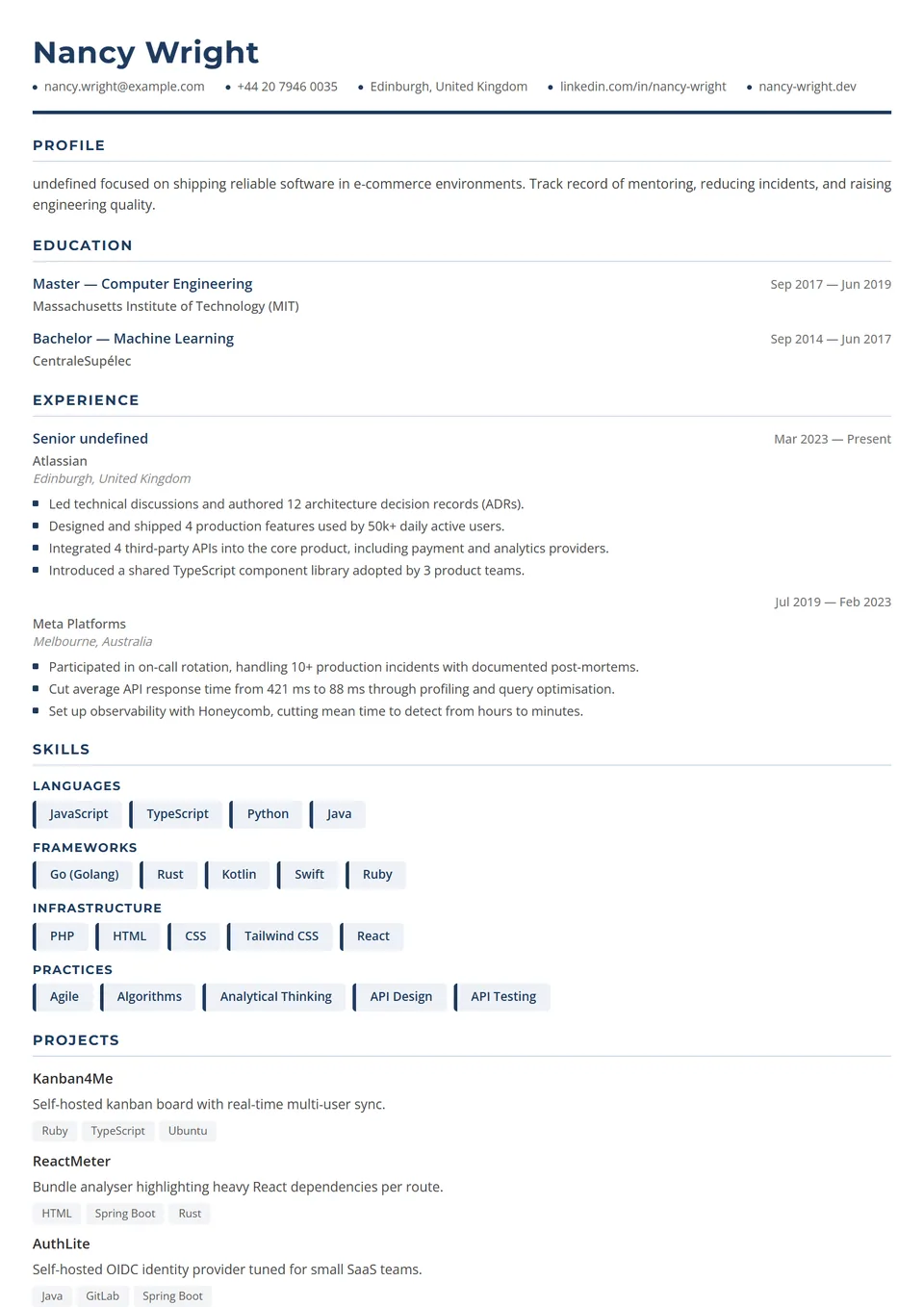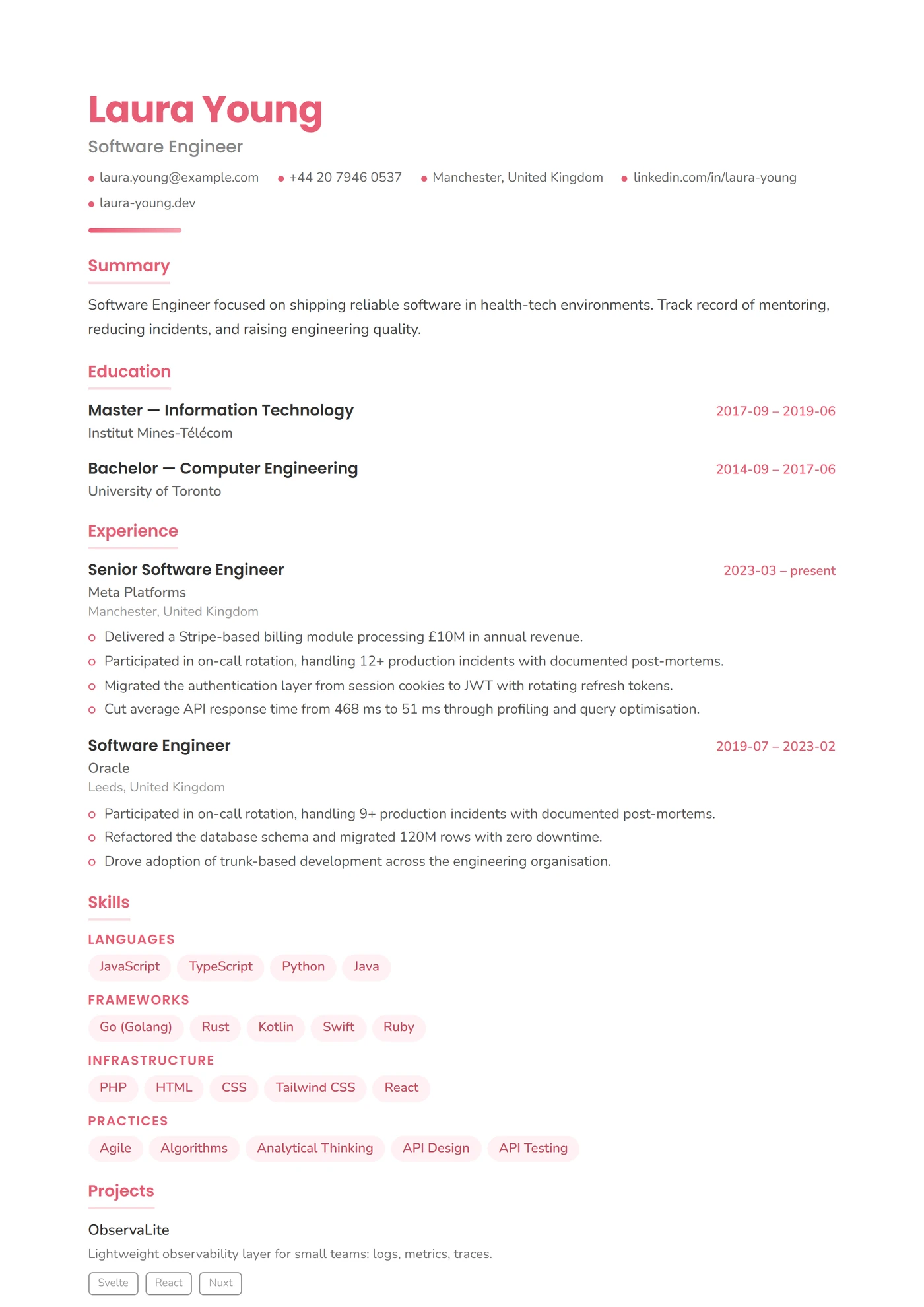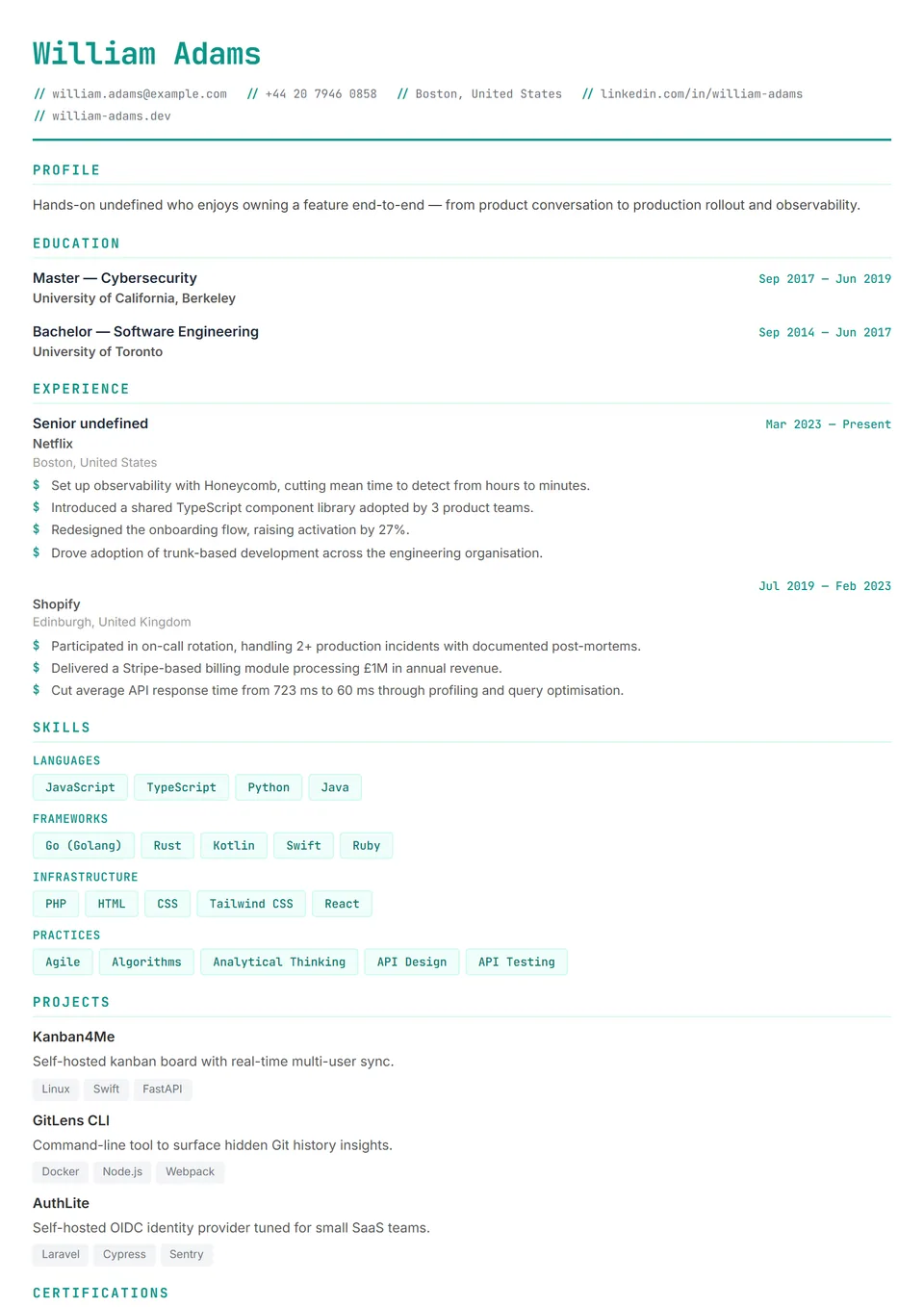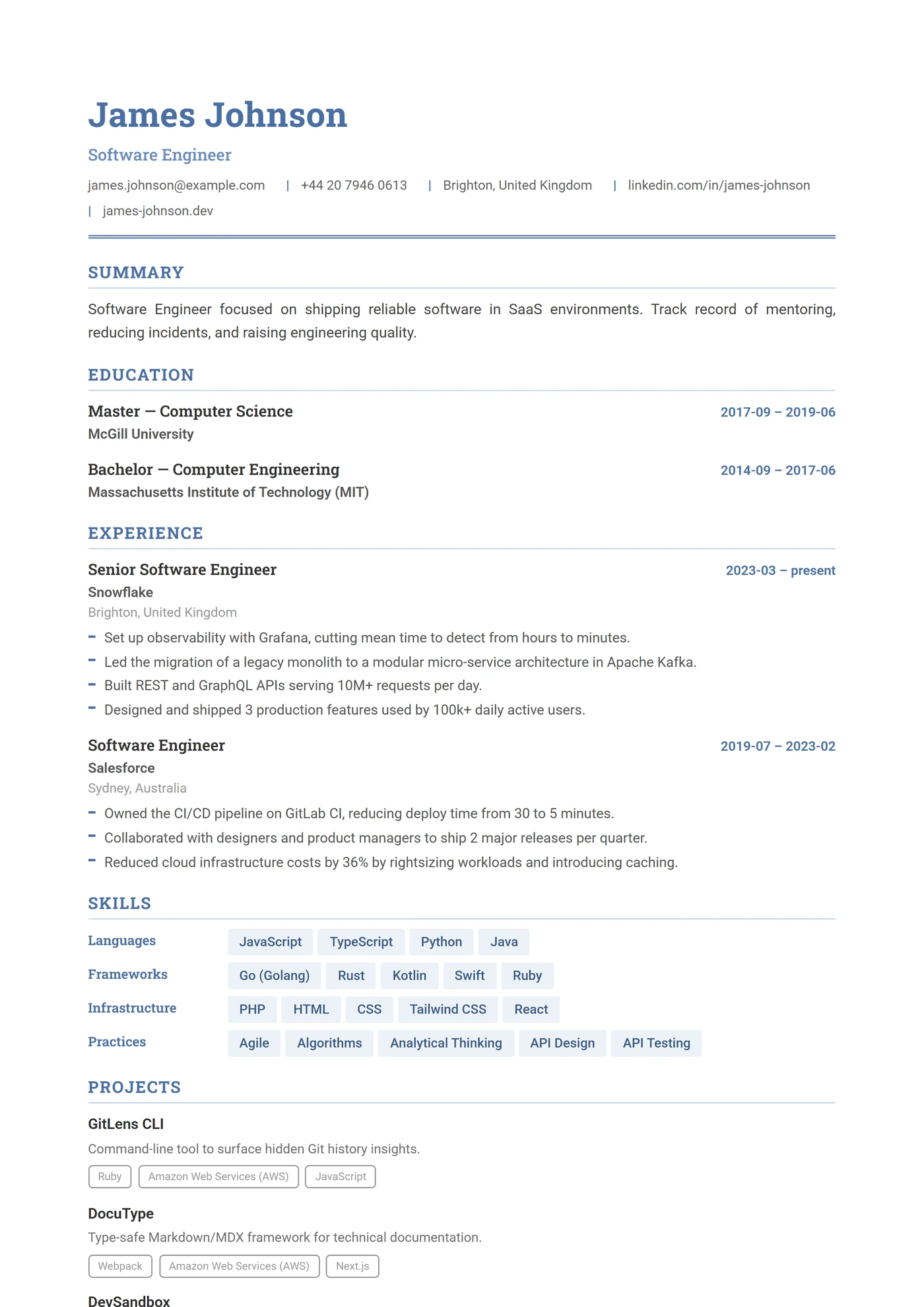
About this template
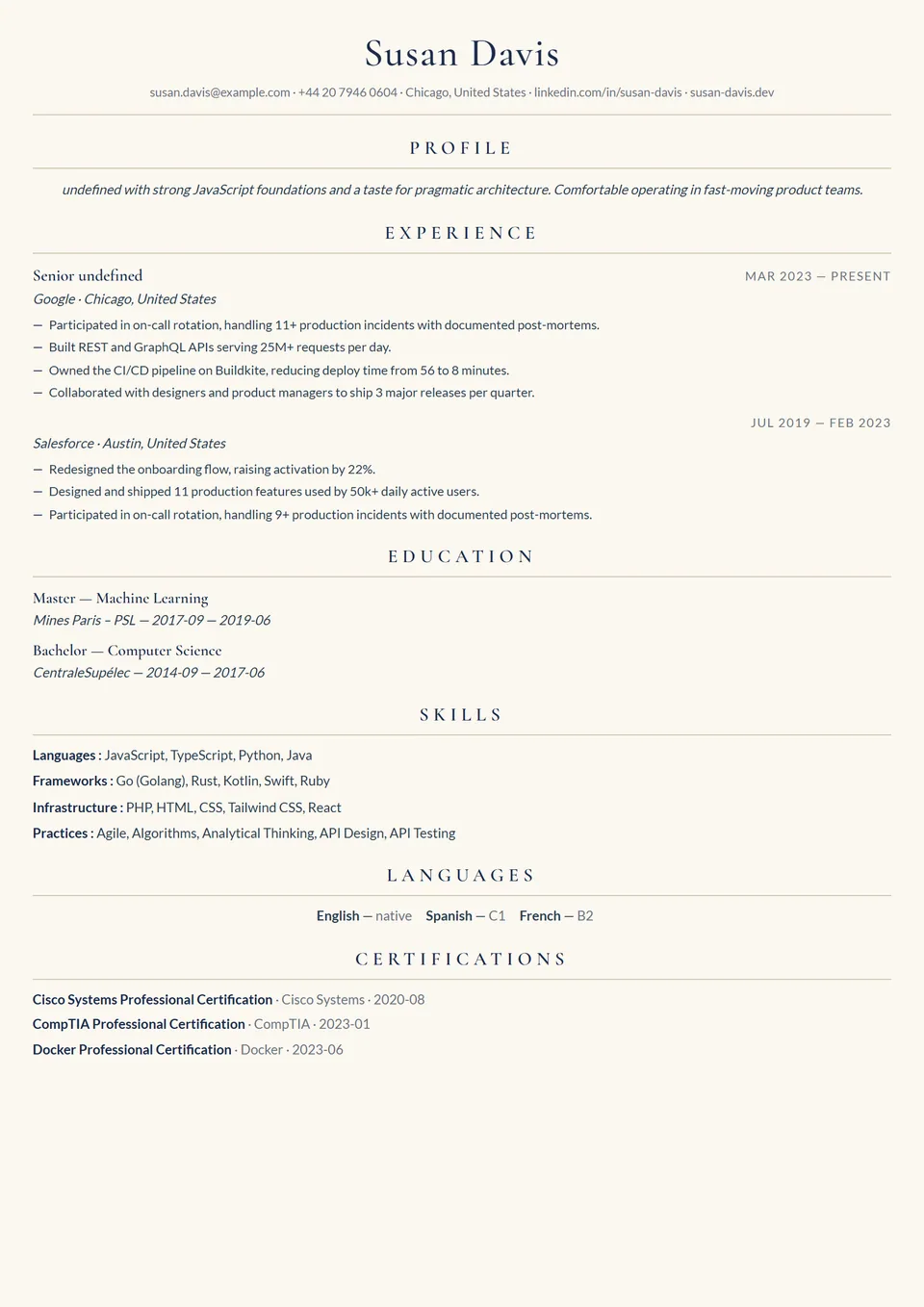
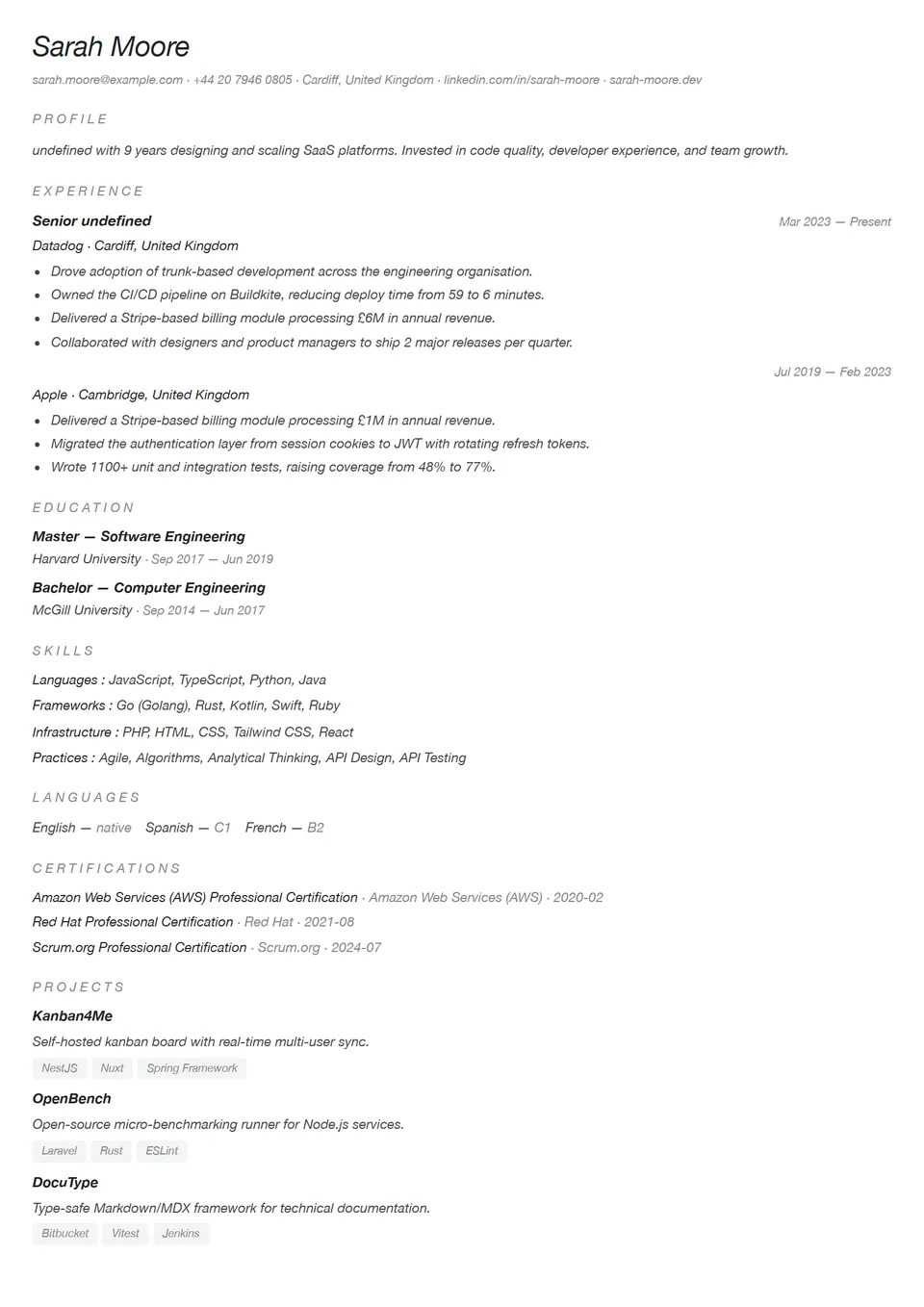
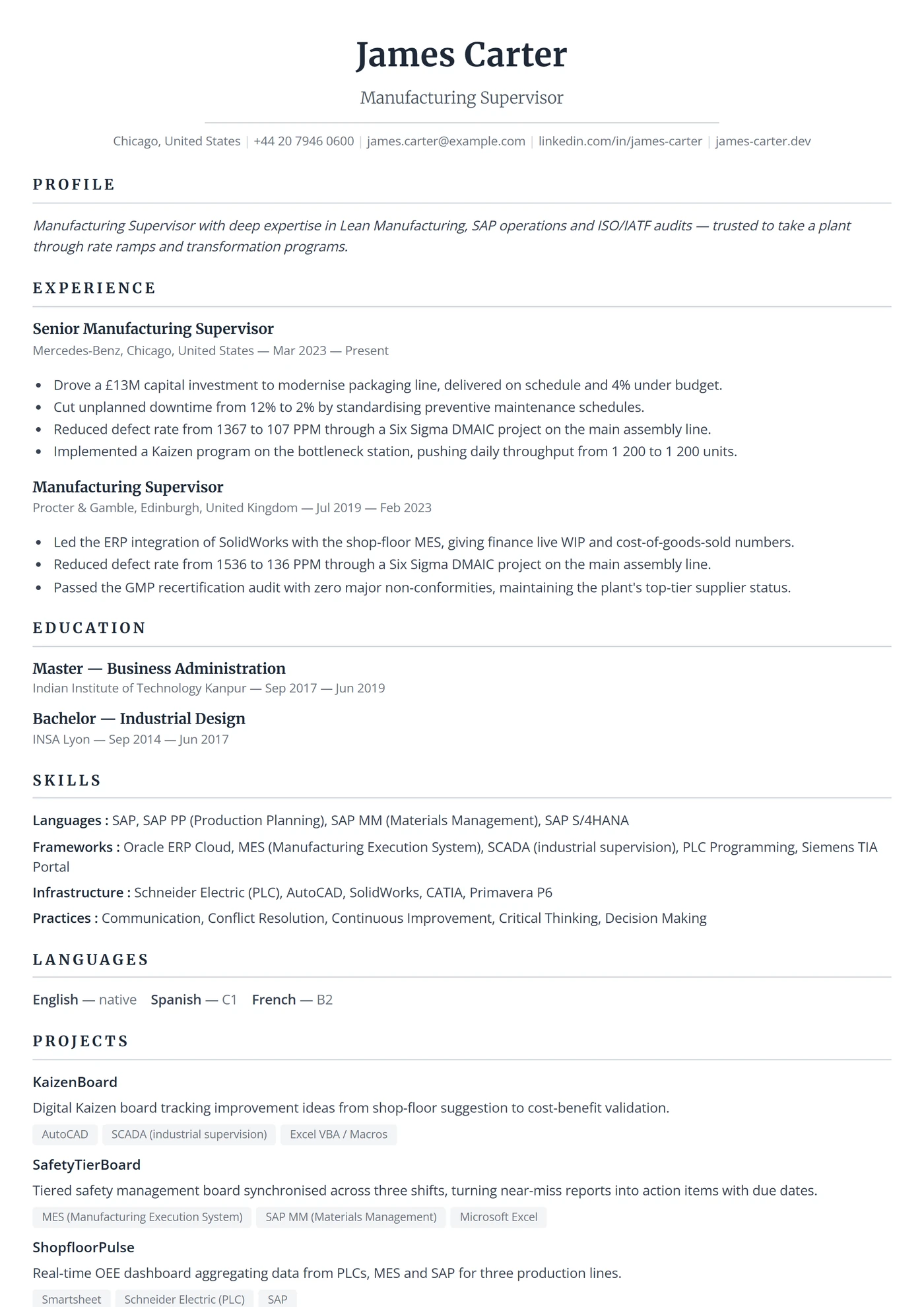
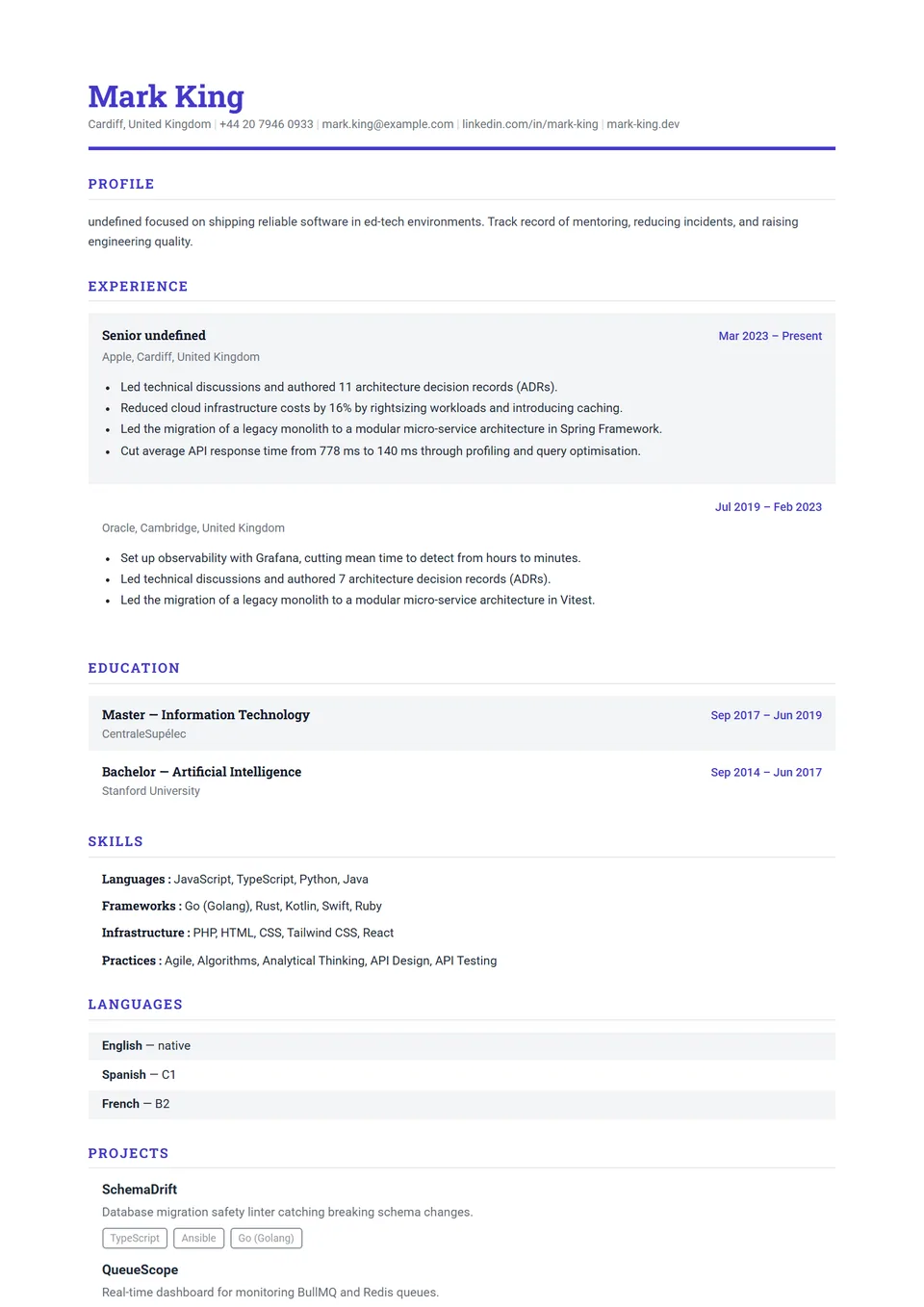
The Scholar template is a formal and structured academic CV in Libre Baskerville with a burgundy accent on an ivory background. Education leads, every line typeset like a peer-reviewed article — the safest choice for traditional academic recruitment across disciplines. The layout parses cleanly through Workday, Interfolio, AcademicJobsOnline and the recruitment platforms of R1 universities (Princeton, MIT, Stanford, Harvard), Russell Group institutions (Oxford, Cambridge, Imperial, UCL), and works equally well for German universities (DFG, Helmholtz, Max Planck) and Swiss federal institutes (ETH Zurich, EPFL).
Who is it for?
It fits PhD candidates and postdocs across all disciplines (hard sciences, humanities, social sciences, life sciences), faculty competing for tenure-track positions or for CNU qualifications, applicants to research grants (ERC Starting/Consolidator/Advanced, Marie Skłodowska-Curie, NSF CAREER, NIH R01, Wellcome Trust, ANR JCJC, FNS), academic administrators (department chairs, deans, vice-rectors), and applicants to journal editorial boards. It is the neutral choice when an application straddles several disciplines or hiring departments.
How to use it
Four blocks structure the document — Education and credentials (with PhD, Habilitation, JD, MD as relevant), Research (thematic axes aligned with the host lab), Publications (peer-reviewed journals with HCERES, REF or ABS classification), Teaching and supervision. For disciplines with stable journal rankings (economics, medicine), state JCR or Scimago quartile. For humanities, foreground passage through a recognised university press (Cambridge UP, Oxford UP, Harvard UP, Princeton UP, Routledge). Useful long-tail SEO: 'academic researcher CV template', 'PhD all disciplines resume', 'tenure-track candidate CV', 'ERC Starting Grant applicant CV', 'Marie Curie postdoc resume', 'university faculty job market CV'.
Frequently asked questions
How long should this generalist academic CV be?
Two pages maximum for early-career profiles (postdoc, lecturer, assistant professor applications). Three pages for senior profiles or chair applications. For US R1 tenure-track applications, also prepare a separate long CV (5-8 pages) with the exhaustive list of publications, presentations and grants obtained, as North American convention requires — the short CV remains your primary showcase that committees read first.
How does the template work for hard-science profiles?
Without skeleton modification. Simply add a 'Grants obtained' section with amount, agency (ERC, NSF, NIH, DFG, Wellcome Trust, ANR) and role (PI, co-PI, partner). For experimental sciences, you can also insert a 'Equipment and methods mastered' section that speaks to industry-academia recruiters. The template remains readable by the ATS pipelines of all scientific countries — including the strictest US and German hiring portals.
How should I balance a French CNU qualification with international applications?
The French CNU qualification is a strong signal for French committees but little known abroad. Mention it in a 'Qualifications and credentials' section with the number and section, with a short English gloss ('French qualification for the position of Maître de conférences / Associate Professor'). For non-French applications, devote no more than one line — the international committee will judge primarily on publications, grants obtained and recommendation letters from peer institutions.