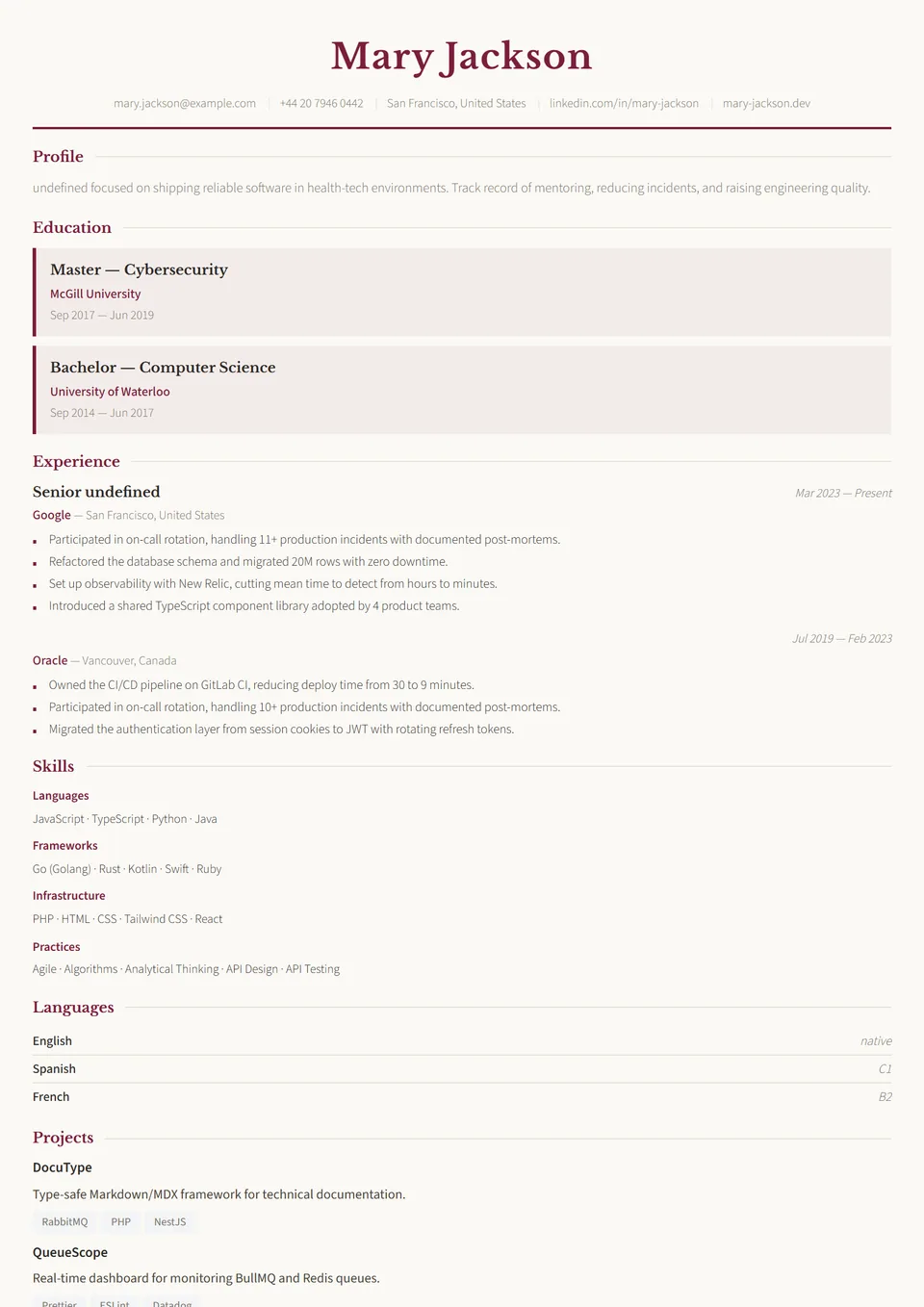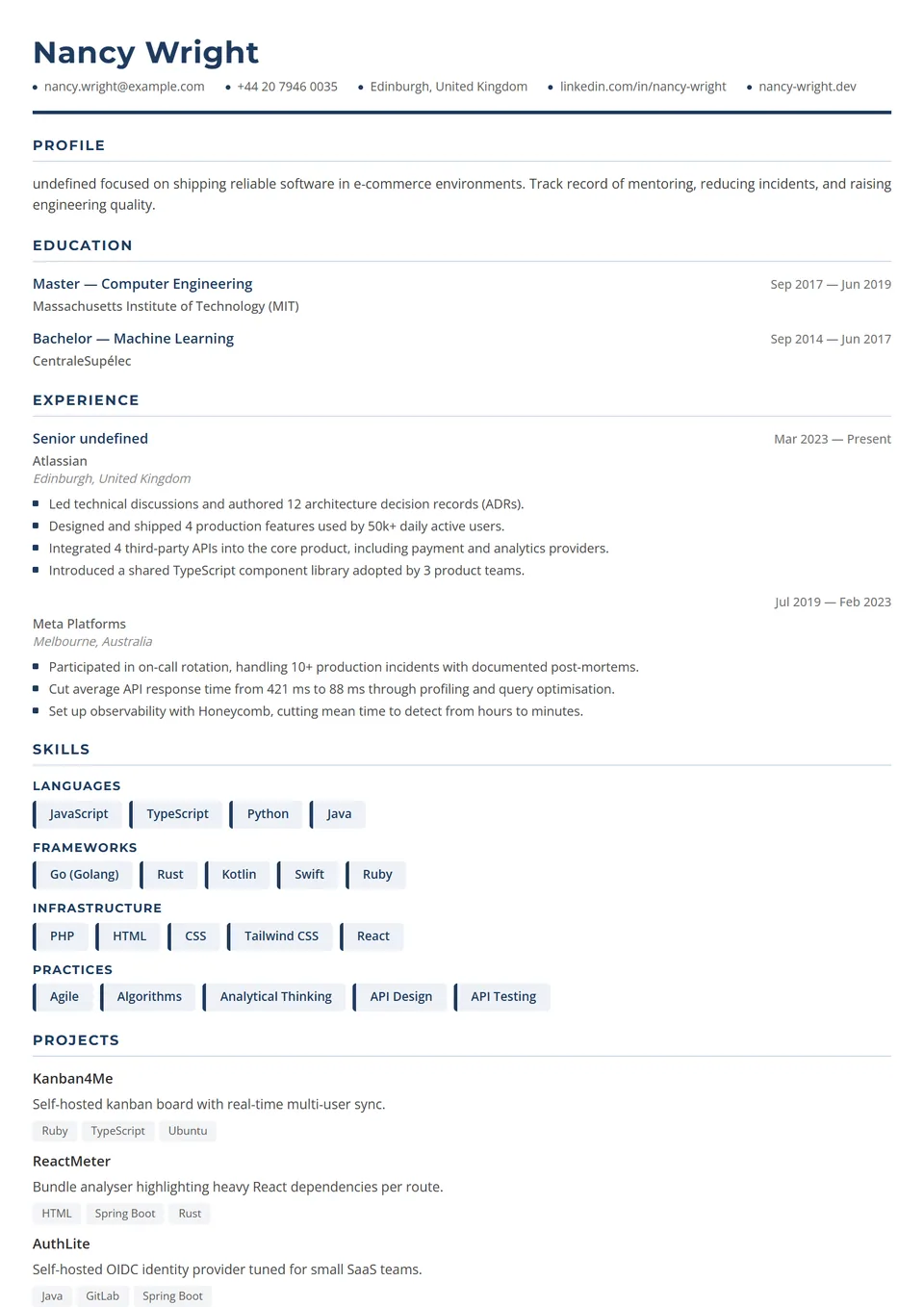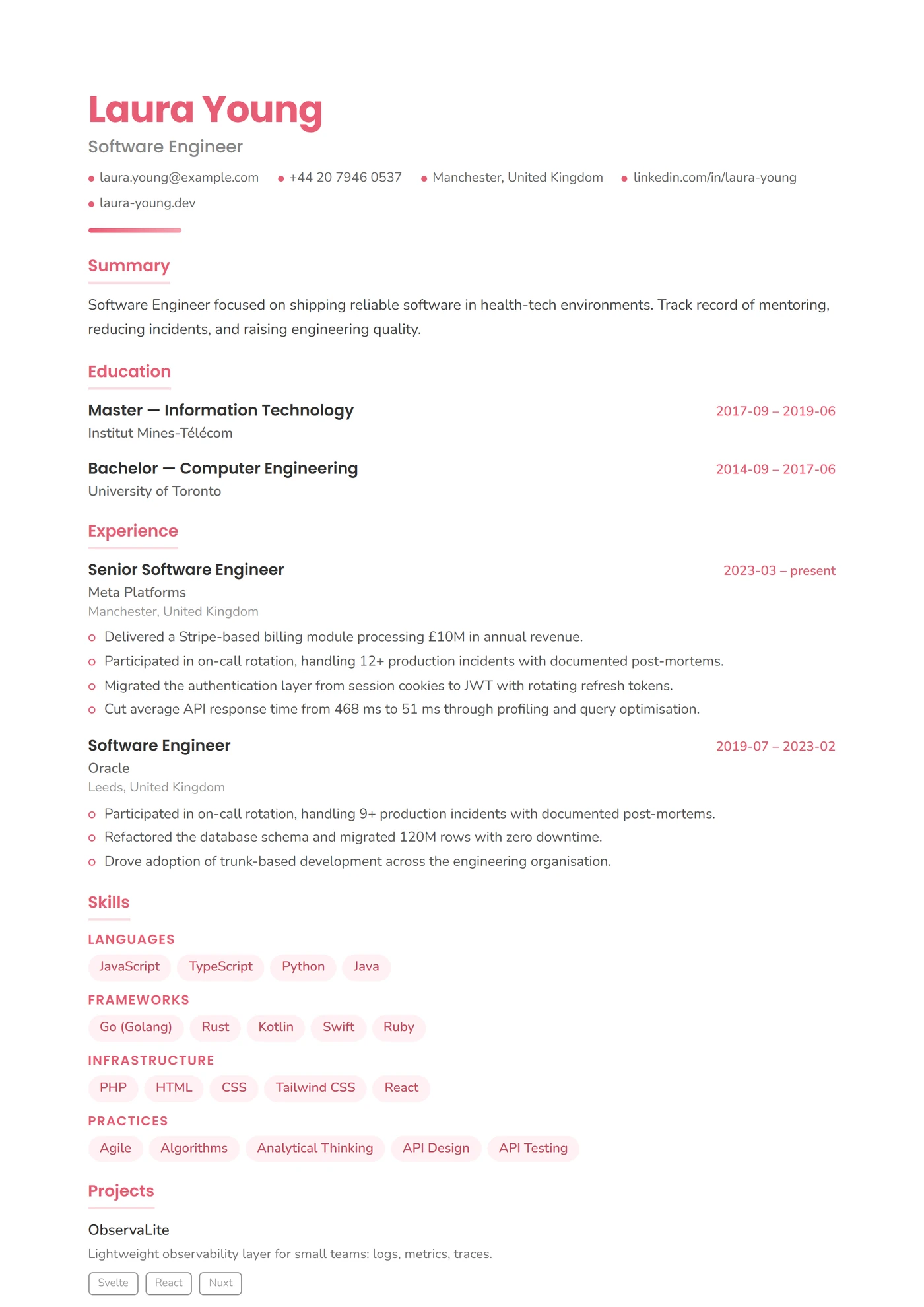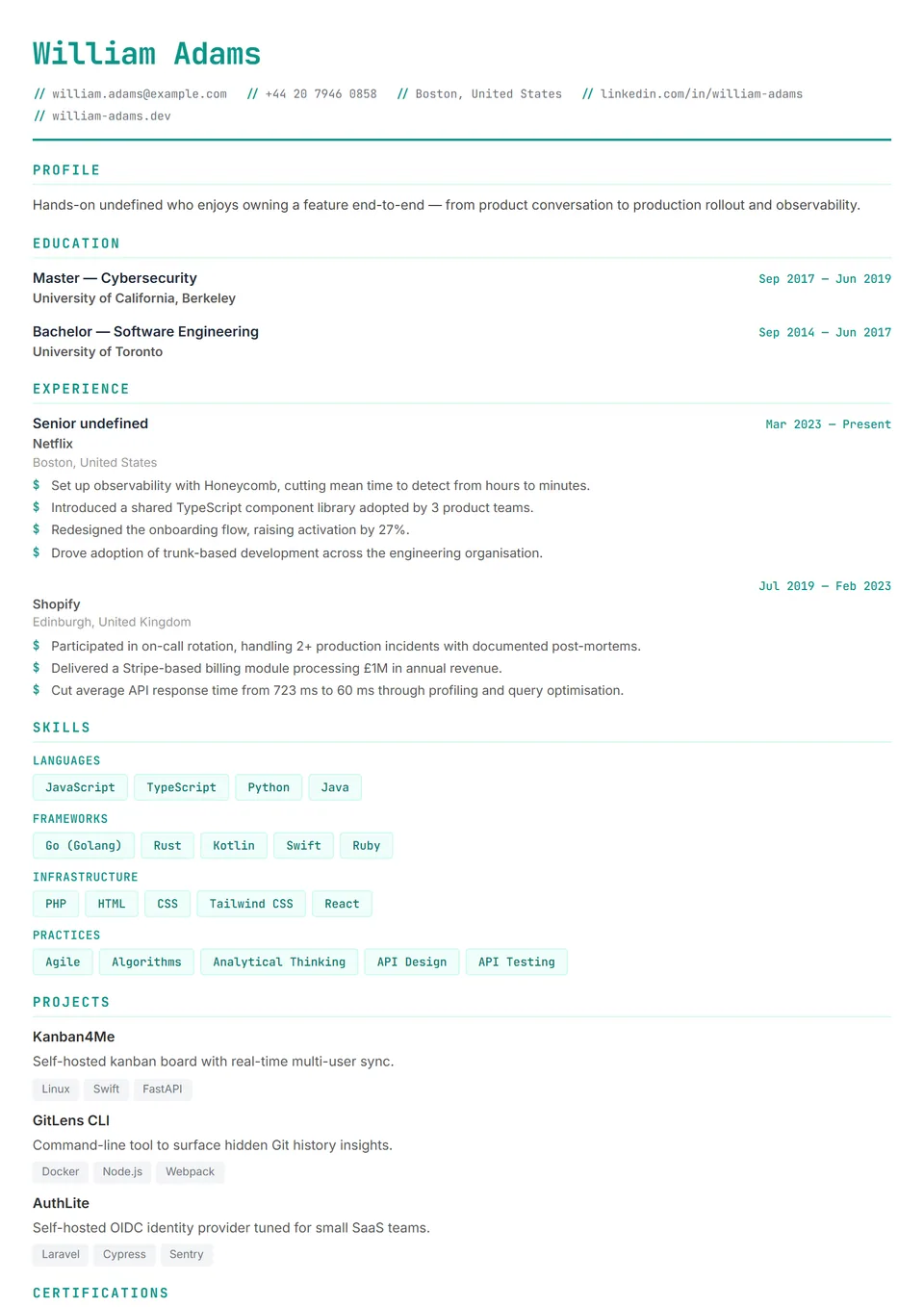
About this template
The Engineering template is an academic CV designed for profiles spanning university labs and industrial R&D: PhD candidates, postdocs, faculty and senior engineers in mechanical, electrical, civil, aerospace, control or embedded-systems engineering. Its Roboto Slab typography and steel-blue accent signal the technical rigour expected by thesis committees and industrial selection boards alike.
Who is it for?
It fits late-stage PhD candidates targeting tenure-track positions in engineering schools (MIT, Stanford, ETH, EPFL, TU Delft, Imperial), postdocs applying to industrial R&D labs (Airbus, Siemens, ABB, Bosch, Boeing, GE Research), and senior engineers moving into faculty roles or industrial chair leadership. It also serves CR/DR CNRS competitions, INRIA permanent positions and Marie Skłodowska-Curie postdoctoral mobility.
How to use it
Five sections structure the document — Technical Projects, Patents, Publications (IEEE Transactions, ACM, Elsevier, Springer Nature), Conference Talks (with A* venue distinction such as SIGGRAPH, IROS, CVPR vs workshops) and Competitions. List the journal quartile or impact factor when relevant, and always distinguish granted patents (B1, B2) from pending applications (A1). Technical characters (µ, Ω, Δ, ²) render in native Unicode and parse cleanly through both academic and industrial ATS pipelines.
Frequently asked questions
Should I list journal impact factor or quartile?
For applications in countries where impact factor remains a proxy (France, China, Spain, Italy), add it in parentheses after the journal name. For US R1, UK Russell Group, German Helmholtz/Max Planck and Swiss ETH/EPFL applications, the Scimago quartile (Q1, Q2) is better received and more stable over time. List both if you apply across jurisdictions.
How do I list pending versus granted patents?
Always distinguish the legal status. For a granted patent, give the full number per EPO/USPTO conventions (e.g. EP3456789 B1, US10123456 B2). For a pending application, use the publication number followed by A1 and add 'pending examination'. Industrial R&D recruiters routinely verify each number on Espacenet or USPTO Patent Center, so any approximation is immediately visible.
How should I describe NDA-bound industrial projects?
Describe the technical scope without naming the industrial partner: 'Design and validation of a 48V motor control module for premium electric vehicles (battery management, HIL simulation, EMC validation)'. Add economic context like 'Tier-1 European automotive supplier' or 'Aerospace prime contractor'. Experienced R&D recruiters value contractual integrity as a positive signal.