
When You Need a Cover Letter for Warehouse Manager
A cover letter lets a Warehouse Manager candidate show how they reduced costs, improved throughput, or led teams in ways a resume's bullet points cannot fully explain. It gives context to numbers like inventory accuracy rates or order fulfillment speed and demonstrates communication skills that matter for coordinating staff, vendors, and logistics partners. Use it to connect your specific experience to the employer's operational priorities.
For an internship or entry-level warehouse supervisory role, the cover letter should emphasize transferable skills like organization, attention to detail, and any part-time or academic exposure to logistics, inventory, or team coordination. Since formal experience is limited, highlight willingness to learn safety protocols, use of tools like Excel or basic WMS software, and any leadership roles in school, sports, or part-time jobs.
When moving into warehouse management from another field such as retail, military logistics, or manufacturing, the letter should translate prior experience into warehouse-relevant language — inventory control, team supervision, process improvement, or safety compliance. Focus on quantifiable results from your previous role and explain your motivation for the shift clearly, showing you understand the operational demands of a warehouse environment.
An internal promotion cover letter should adopt a confident, familiar tone that references your tenure and known contributions within the company, such as improved pick rates or successful team training initiatives. Highlight readiness for expanded responsibility, leadership growth, and specific examples of initiative that justify advancing from a supervisory or associate role to full Warehouse Manager.
Recommended templates for Warehouse Manager
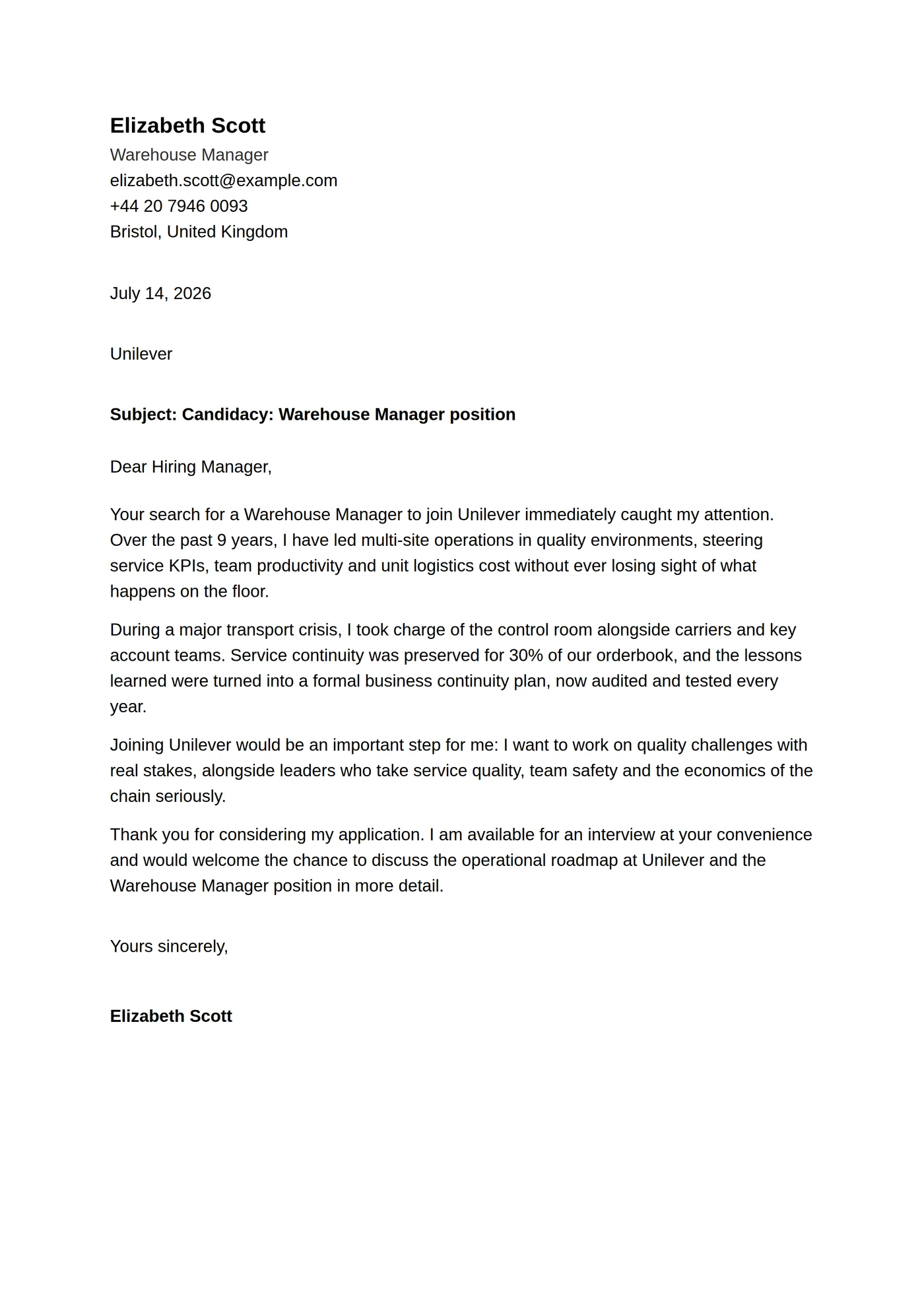
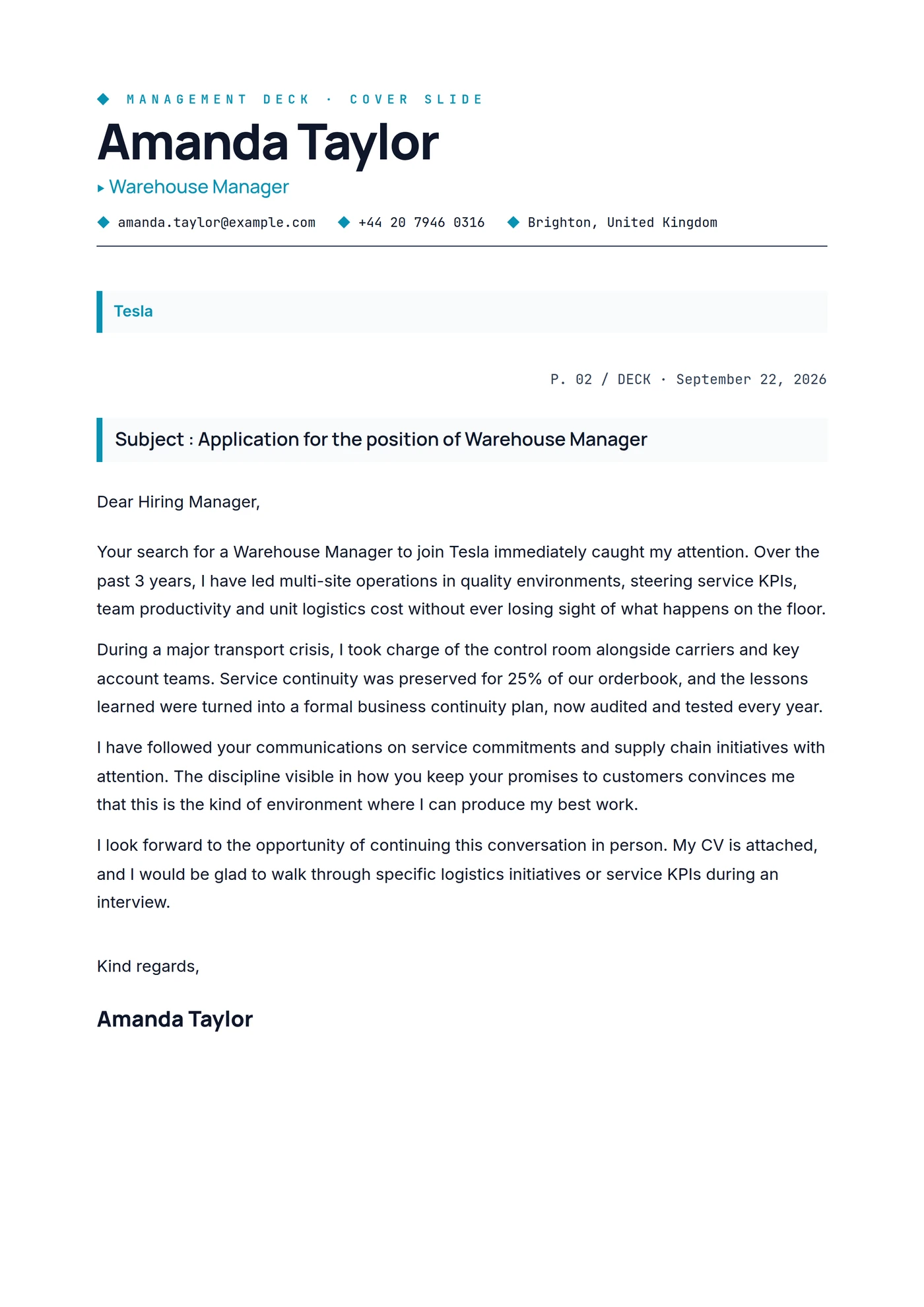
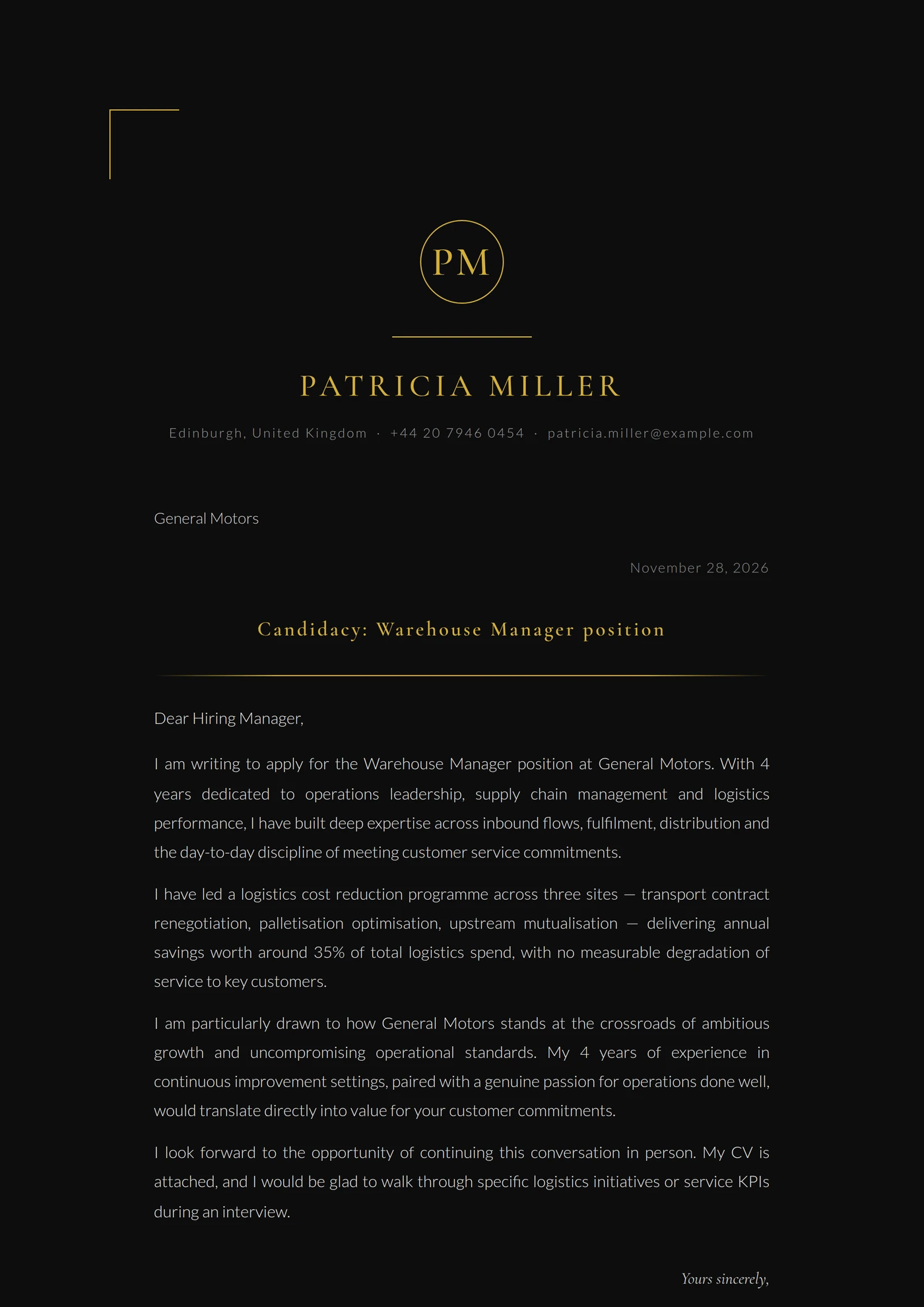
Three templates selected for this role, from junior to senior level. Tap a template to discover its full design and use it in your document.
How to Write a Warehouse Manager Cover Letter
Open with a strong, specific statement that references the company name and the exact role, avoiding generic lines like To Whom It May Concern. Mention a key achievement or number in the first two sentences — for example, improving order accuracy by 15% — to immediately establish credibility. Whenever possible, address the hiring manager by name, which shows you researched the company and are not sending a mass application. Avoid starting with your job title alone or a restatement of your resume. Instead, lead with a compelling hook tied to the company's specific needs, such as their growth, expansion, or known operational challenges, to show genuine interest and strategic thinking from the outset.
The body should typically span two to three paragraphs. The first should connect your core qualifications — such as experience managing inventory systems, safety compliance, or staff scheduling — directly to the job posting's requirements. The second paragraph should highlight one or two quantifiable achievements, like reducing order processing time by 20% or cutting shrinkage by 10%, to prove impact rather than just list duties. A third paragraph can address your leadership philosophy or approach to problem-solving, particularly how you handle team management, vendor coordination, or process optimization under pressure. Balance hard skills like WMS software proficiency with soft skills like communication and conflict resolution, and always tie motivation back to how you can contribute value to this specific employer.
Close with a clear call to action, such as expressing interest in discussing how your experience aligns with the team's goals in an interview. Reiterate enthusiasm for the role concisely without repeating earlier points, and thank the reader for their time and consideration. Use a professional sign-off like Sincerely or Best regards, followed by your full name. Avoid overly casual closings or desperate language such as I really need this job, which can undermine the confident, competent tone expected of a management-level candidate.
Skills to Mention in Your Warehouse Manager Cover Letter
Common Mistakes
A generic cover letter that could apply to any logistics role fails to show the employer why you specifically fit their warehouse's needs. Avoid copy-pasted language and instead reference the company's products, scale, or challenges, connecting your specific experience in inventory control or team leadership to their operation.
Cover letters should stay within three to four paragraphs and fit on a single page, ideally 250-400 words. Cut repetitive resume content and focus only on the most compelling achievements and motivations relevant to the specific role.
Simply listing duties like managed inventory or supervised staff without results fails to differentiate you from other candidates. Reframe these into achievements, such as reduced inventory discrepancies by 12% through improved cycle counting procedures, to show measurable impact.
Avoid unusual fonts, excessive colors, or complex formatting that could confuse ATS systems or distract from content. Submit the letter as a PDF unless otherwise specified, use a standard business letter format, and ensure a clear, professional subject line when emailing.
Frequently Asked Questions
Yes, even when not explicitly required, a cover letter helps you stand out by providing context for your achievements and showing genuine interest in the specific company. It's especially valuable when you have quantifiable results, like improved efficiency rates or cost savings, that deserve more explanation than a resume bullet allows.
Aim for a single page, roughly 250-400 words, organized into three to four concise paragraphs. Hiring managers typically skim quickly, so prioritize your strongest achievements and most relevant skills.
Yes, tailoring each letter to reference the specific company, its operations, and the job posting's keywords significantly increases your chances of standing out. Generic letters are easy for hiring managers to spot and often get discarded quickly.
In the US and UK, a cover letter is commonly expected or at least appreciated, particularly for management-level roles. In many EU countries, especially Germany and France, a tailored cover letter is often considered a standard and sometimes mandatory part of the application package.
AI tools can be helpful for structuring your letter or overcoming writer's block, but the final content should reflect your genuine experience and voice. Always personalize AI-generated drafts with specific achievements, numbers, and details about the company to avoid sounding generic.
A clean, single-column PDF format is generally preferred since it preserves formatting across devices and is easily parsed by most ATS systems. Use a standard, readable font and a professional file name that includes your name and the job title.
Related Job Titles
Explore more about