Warehouse Manager Resume Example & Guide

Learn how to write a standout Warehouse Manager resume with expert tips, sample bullet points, and ATS optimization advice.

We currently have 8 Warehouse Manager job postings in our database. Apply now — it's free

A Warehouse Manager oversees daily operations of storage and distribution facilities, including inventory control, staff supervision, shipping and receiving, and safety compliance. Employers look for proven leadership experience, data-driven decision making, and familiarity with warehouse management systems (WMS) and lean inventory practices. Strong candidates stand out by quantifying efficiency gains, cost reductions, and safety improvements rather than listing generic duties. Typical experience ranges from 3-5 years for mid-level roles to 8+ years for senior positions overseeing multiple facilities, with salaries scaling based on team size and operational complexity.

What Makes a Great Warehouse Manager Resume

A strong Warehouse Manager resume leads with measurable operational results — reduced shipping errors, improved order fulfillment rates, lowered labor costs, or increased throughput. Recruiters want to see concrete numbers tied to inventory accuracy, safety records, and team productivity rather than vague descriptions of responsibilities. The format should be clean and scannable, using a reverse-chronological structure that highlights promotions and growing scope of responsibility over time. Content should prioritize leadership and systems expertise: how many employees were supervised, which WMS or ERP platforms were used, and what safety or compliance standards were maintained. Including specific certifications like OSHA 30 or Six Sigma signals credibility to both ATS systems and hiring managers. Tone should be direct, results-oriented, and professional, avoiding overly casual language. Bullet points should start with strong action verbs such as Streamlined, Reduced, Supervised, or Implemented, and each should ideally tie back to a business outcome like cost savings, time saved, or accuracy improvement.

Key Skills Needed

Inventory managementWarehouse management systems (WMS)Staff supervision and trainingLogistics coordinationSafety compliance (OSHA standards)Budget managementProcess improvementSupply chain coordinationLean inventory practicesConflict resolutionShipping and receiving operationsData analysis and reportingVendor managementForklift and equipment operations oversight

Typical Experience Level

Entry-level candidates typically move into Warehouse Manager roles after 2-3 years as a warehouse supervisor, team lead, or logistics coordinator, demonstrating basic inventory and staff management skills. Mid-level managers usually have 3-7 years of experience overseeing larger teams, multiple shifts, and more complex inventory systems, often with a track record of measurable efficiency improvements. Senior Warehouse Managers generally bring 8+ years of experience, frequently managing multiple facilities, regional logistics networks, or large-scale distribution operations. At this level, recruiters expect evidence of strategic planning, budget ownership, cross-functional collaboration with supply chain executives, and mentorship of junior managers.

ATS Keywords for This Role

Warehouse ManagerInventory controlWarehouse management systemWMSSupply chain managementLogistics operationsShipping and receivingOSHA complianceLean manufacturingSix SigmaStaff supervisionOrder fulfillmentDistribution centerForklift operationsSafety managementProcess improvementKPI trackingBudget managementVendor relationsCycle counting

Recommended templates for Warehouse Manager

Three templates selected for this role, from junior to senior level. Tap a template to discover its full design and use it in your document.
Junior
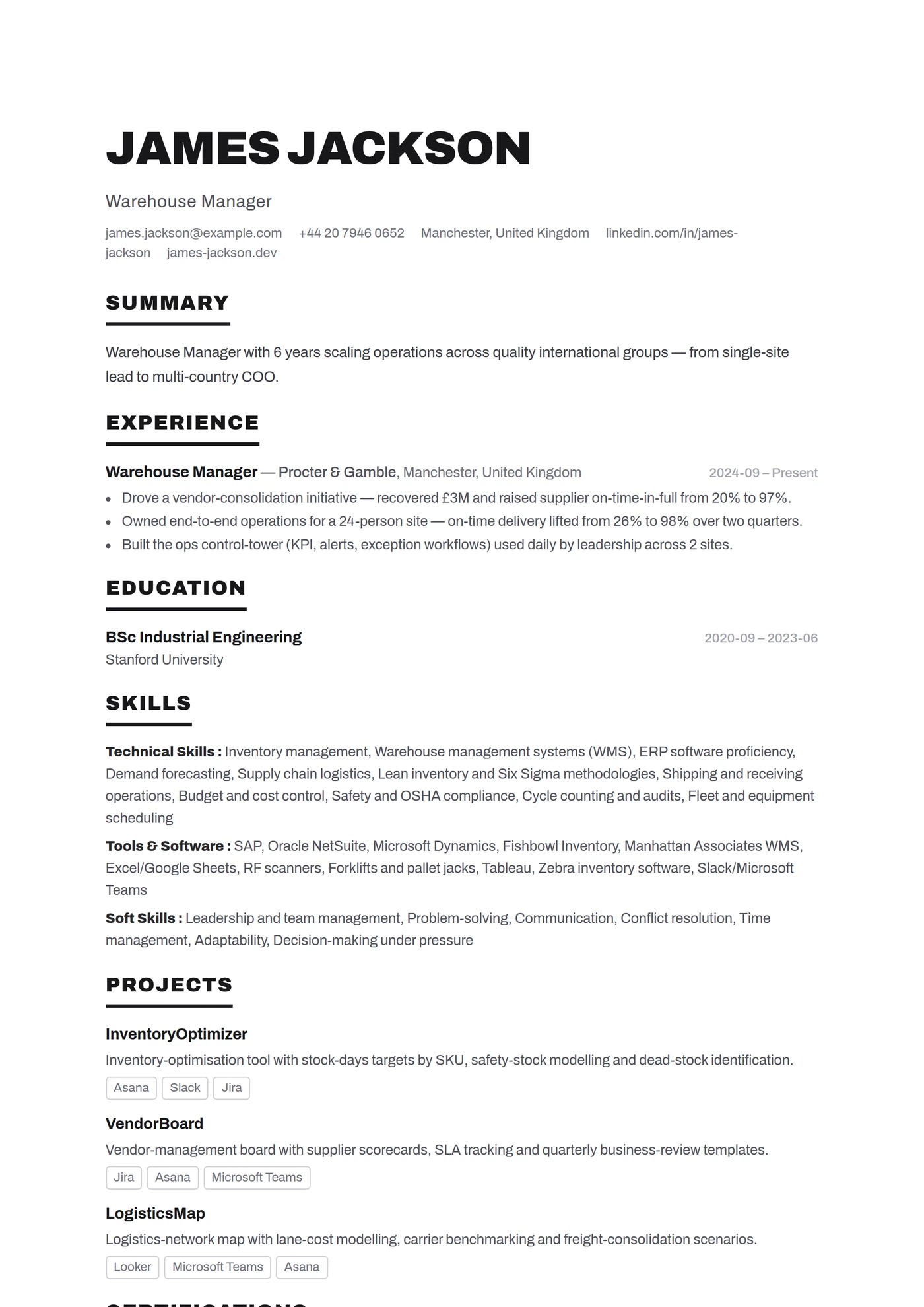
ATS Bold Headers — Junior

ATS Bold Headers

ats

Clear section headers and a clean single-column layout make it easy for ATS systems and hiring managers to quickly find relevant experience and skills for an early-career Warehouse Manager.

Learn more about this template
Mid-level
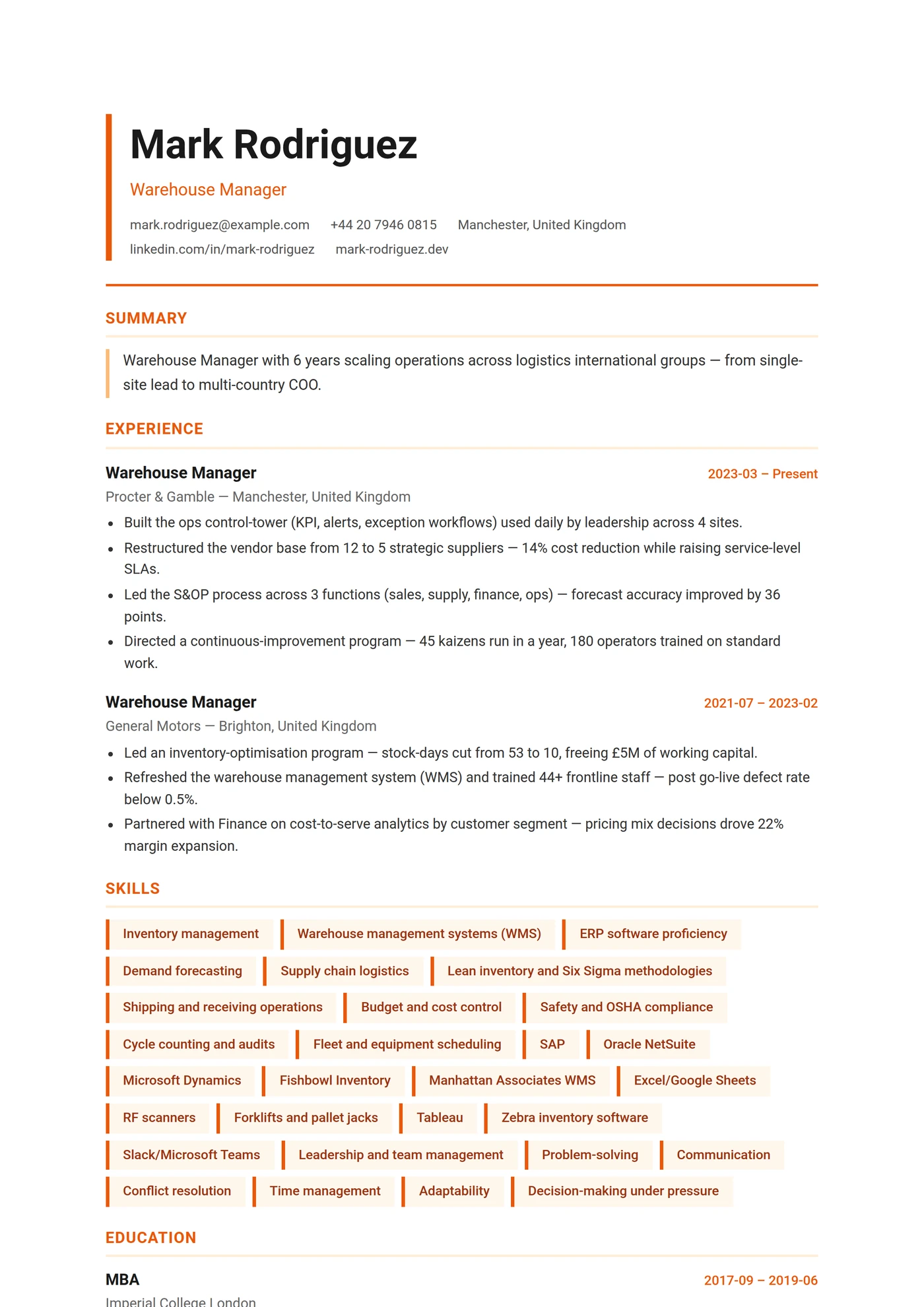
ATS Logistics — Mid-level

ATS Logistics

professional

This template's professional, industry-aligned design highlights operational achievements and logistics metrics, ideal for showcasing growth from supervisor to mid-level manager.

Learn more about this template
Senior
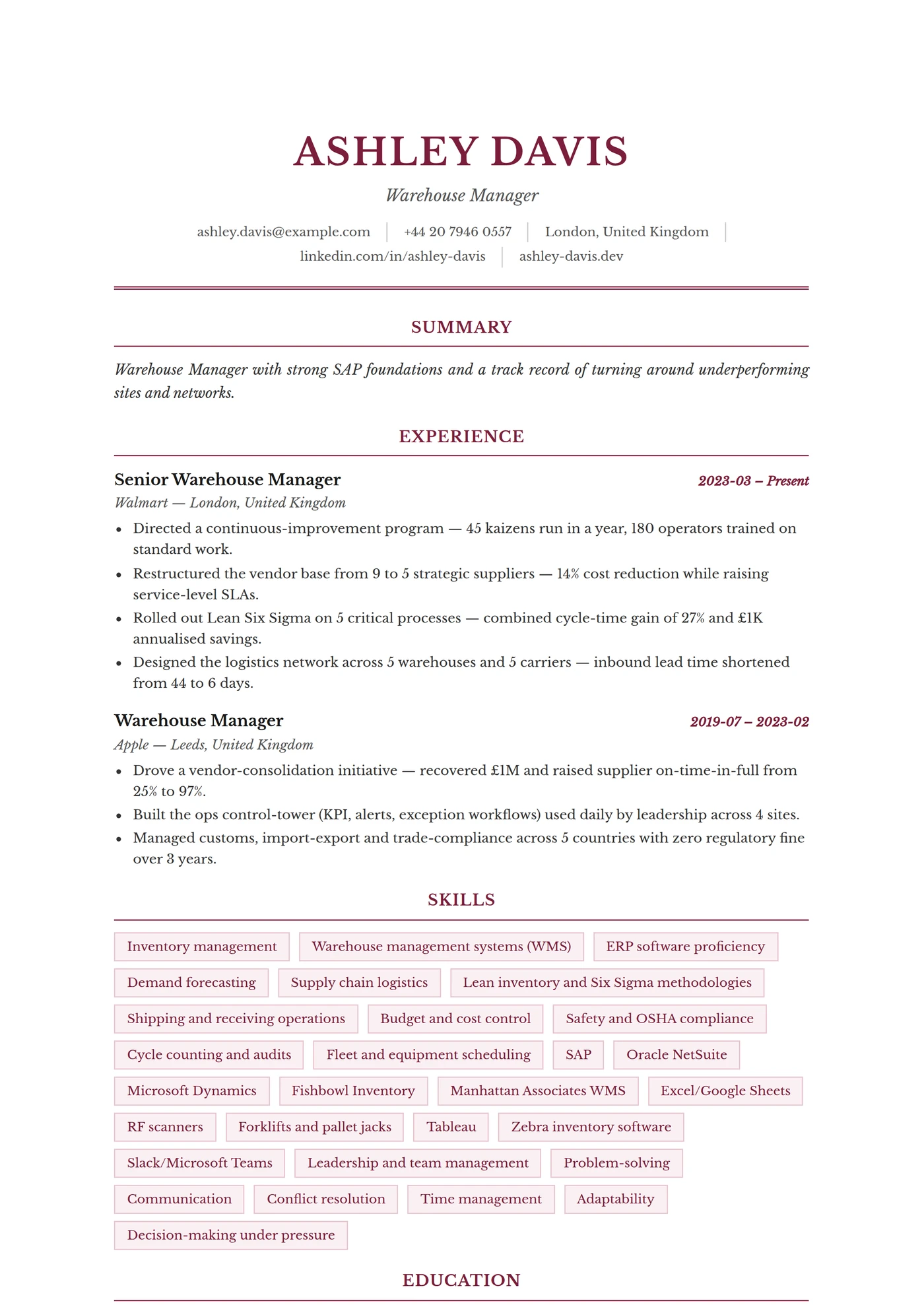
ATS Legal — Senior

ATS Legal

ats

The polished, formal structure conveys executive credibility, making it well-suited for senior Warehouse Managers presenting multi-site leadership and strategic accomplishments.

Learn more about this template

Skills for Warehouse Manager

Hard Skills

Inventory managementWarehouse management systems (WMS)ERP software proficiencyDemand forecastingSupply chain logisticsLean inventory and Six Sigma methodologiesShipping and receiving operationsBudget and cost controlSafety and OSHA complianceCycle counting and auditsFleet and equipment scheduling

Soft Skills

Leadership and team managementProblem-solvingCommunicationConflict resolutionTime managementAdaptabilityDecision-making under pressure

Tools & Software

SAPOracle NetSuiteMicrosoft DynamicsFishbowl InventoryManhattan Associates WMSExcel/Google SheetsRF scannersForklifts and pallet jacksTableauZebra inventory softwareSlack/Microsoft Teams

ATS Keywords

Warehouse operationsInventory accuracyLogistics managementOrder fulfillmentDistribution center managementSafety complianceKPI reportingStaff schedulingProcess optimizationSupply chain coordinationCost reductionWMS implementationOSHA 30 certificationLean Six Sigma

Writing Tips for Warehouse Manager

Best Format to Use

The reverse-chronological format works best for Warehouse Manager resumes because it clearly shows career progression, increasing responsibility, and operational scale over time. A hybrid format combining a skills summary at the top with chronological work history can work well for candidates transitioning from related roles like logistics coordinator or operations supervisor. Avoid functional formats that hide employment history, as recruiters and ATS systems in logistics and supply chain hiring prioritize clear timelines and measurable, role-specific achievements.

Common Mistakes

Listing duties instead of achievements — describe outcomes like reduced shipping errors by 20% rather than just daily tasks
Omitting specific software and systems experience, such as WMS or ERP platforms used
Failing to quantify team size, inventory volume, or budget managed
Using vague language like responsible for operations without specifying scope or results
Neglecting safety and compliance achievements, which are critical in warehouse environments
Including outdated or irrelevant certifications instead of current, recognized ones like OSHA 30
Writing overly long resumes beyond two pages for non-executive roles

How to Pass ATS

Mirror keywords from the job description, such as specific WMS platforms or certifications
Use standard section headings like Experience, Skills, and Certifications to ensure proper parsing
Avoid tables, images, and columns that can confuse ATS parsing software
Include both the acronym and full term, e.g. WMS (Warehouse Management System)
Quantify achievements using numbers and percentages to match data-driven search filters
Save and submit resumes in .docx or PDF format as specified by the employer
List relevant certifications explicitly, such as OSHA 30 or Six Sigma

How to Stand Out

Quantify every achievement, such as inventory accuracy rates, cost savings, or productivity increases
Highlight cross-functional collaboration with procurement, sales, or transportation teams
Showcase leadership growth, such as promotions from supervisor to manager roles
Include specific technology expertise, like automation tools or advanced WMS systems
Mention safety record improvements, such as reduced incident rates
Add a concise professional summary tailored to the specific warehouse environment (e.g. e-commerce, cold storage, manufacturing)
Use industry-specific metrics like order accuracy, on-time shipment rate, or turnover reduction

Frequently Asked Questions

A Warehouse Manager resume should typically be one page for early-career candidates and up to two pages for mid-to-senior level professionals with extensive multi-site experience. Focus on quality over quantity, emphasizing measurable achievements rather than listing every task performed.
Prioritize skills like inventory management, WMS proficiency, staff supervision, safety compliance, and process improvement. Balancing hard skills with leadership and communication abilities shows employers you can manage both operations and people effectively.
Use exact keywords from the job posting, include recognized certifications like OSHA 30, and avoid complex formatting such as tables or graphics. Stick to standard section headers and submit in .docx or PDF format unless otherwise specified.
Most companies require at least 3-5 years of warehouse or logistics experience, often starting as a supervisor or team lead before advancing. Senior roles overseeing multiple facilities typically require 8+ years of progressive leadership experience.
Yes, a tailored cover letter can help you explain specific achievements, such as cost savings or safety improvements, in more detail than a resume allows. It also demonstrates communication skills, which are essential for managing teams and cross-functional stakeholders.
Certifications like OSHA 30, Six Sigma, and Certified Supply Chain Professional (CSCP) are highly valued by employers. These credentials demonstrate expertise in safety compliance, process efficiency, and supply chain management best practices.

Ready to build your resume?

Use our AI Resume Builder to create a tailored, ATS-optimized resume in minutes.

Build my resume

Start for free. No credit card required.