Butcher Resume Example & Guide

Learn how to write a standout Butcher resume with expert tips, sample bullet points, and ATS optimization advice.

We currently have 14 Butcher job postings in our database. Apply now — it's free

A Butcher prepares, cuts, trims, and packages meat products for retail, wholesale, or food service customers while ensuring compliance with food safety and sanitation standards. Employers look for hands-on knife skills, knowledge of meat cuts and yields, and a strong safety record, combined with customer service ability in retail settings. Strong candidates highlight measurable results like reduced waste percentages, inventory accuracy, and certifications such as ServSafe or HACCP. Typical experience ranges from entry-level apprenticeships to 10+ years for master butchers or shop managers, with salaries varying widely by region and specialization (whole-animal butchery, charcuterie, retail counter work).

What Makes a Great Butcher Resume

A strong Butcher resume leads with a clear, reverse-chronological work history that emphasizes hands-on technical skills — cutting techniques, meat identification, portion control, and food safety compliance. Recruiters want to see concrete numbers: pounds processed per shift, waste reduction percentages, inventory accuracy, or sales growth at the deli counter. Clean, single-column formatting works best since many grocery and food-service employers use ATS software to screen applicants before a human ever reads the resume. The tone should be direct and practical rather than overly formal — this is a trade where demonstrated skill and reliability matter more than flowery language. Include a short skills section near the top listing certifications like ServSafe and HACCP, plus specific cutting specialties (primal breakdown, sausage making, dry-aging). For senior or master butcher roles, add a brief section on training apprentices or managing a department to show leadership beyond the cutting board.

Key Skills Needed

Meat cutting and trimming techniquesCarcass breakdown and primal cutsKnife sharpening and maintenanceFood safety and sanitation complianceInventory and stock managementPortion control and yield optimizationCustomer service and product recommendationsVacuum sealing and packagingSausage making and curingWeighing and pricing productsAttention to detailPhysical stamina and dexterityTime management under high volumeTeam coordination in a fast-paced environment

Typical Experience Level

Entry-level butchers typically start as apprentices or counter assistants, learning knife skills, sanitation protocols, and basic cuts under supervision for 1-2 years before working independently. Mid-level butchers with 3-7 years of experience handle full carcass breakdown, custom cuts, inventory ordering, and often train newer staff, while specializing in areas like charcuterie or whole-animal butchery. Senior or master butchers with 8+ years of experience typically manage a department or shop, oversee purchasing relationships with suppliers, ensure regulatory compliance, and mentor junior staff. At this level, resumes should emphasize leadership, cost control, and vendor management alongside technical mastery.

ATS Keywords for This Role

meat cuttingcarcass breakdownprimal cutsfood safetyHACCPServSafe certificationsanitation standardsinventory managementportion controlyield optimizationknife skillsbutcherycharcuteriemeat processingcustomer serviceUSDA regulationspackaging and labelingstock rotationdeli counter operationsquality control

Recommended templates for Butcher

Three templates selected for this role, from junior to senior level. Tap a template to discover its full design and use it in your document.
Junior
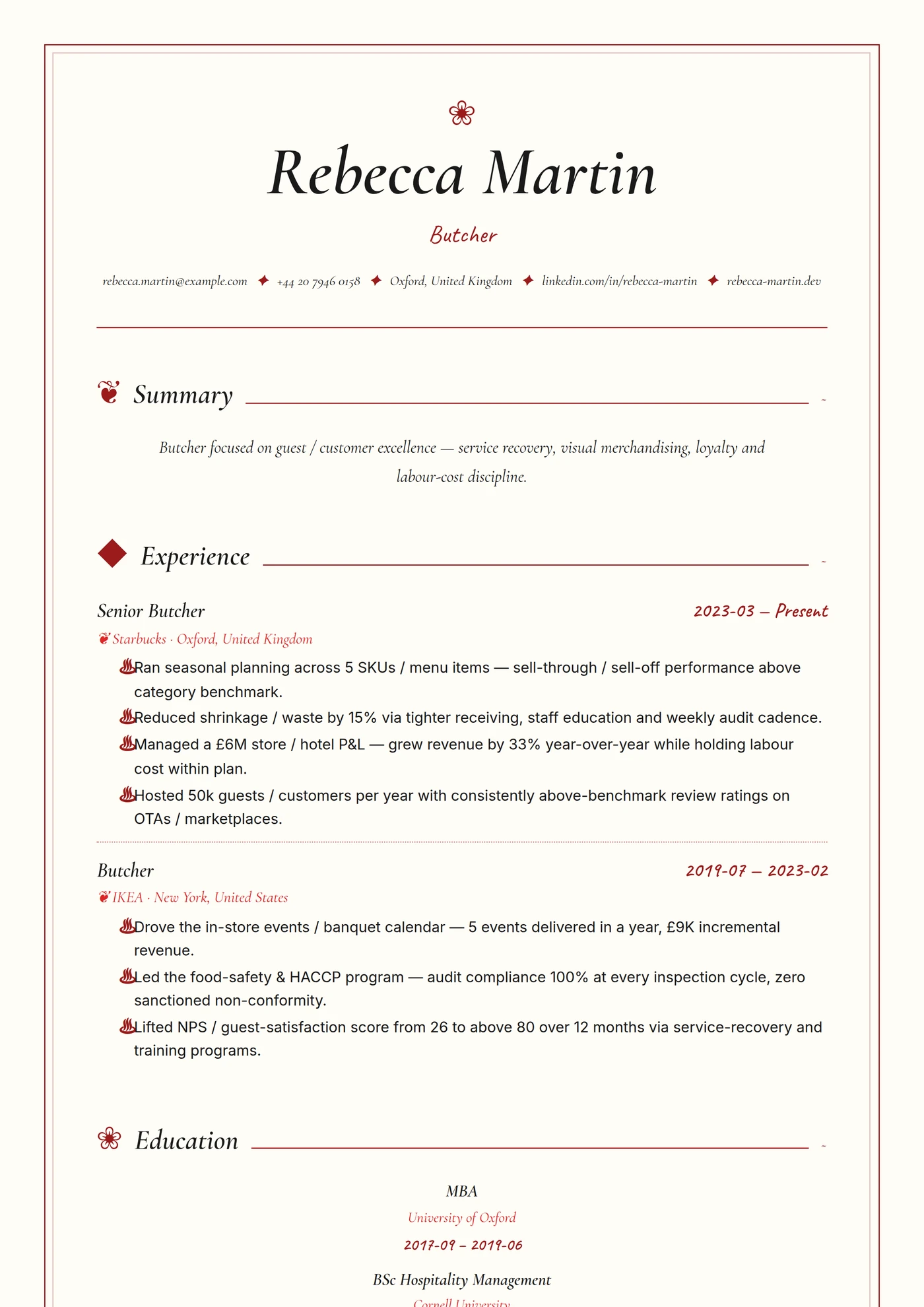
ATS Retail — Junior

ATS Retail

creative

A clean, ATS-friendly layout ensures entry-level butchers pass automated screening at grocery chains while keeping the focus on core skills and food safety training.

Learn more about this template
Mid-level
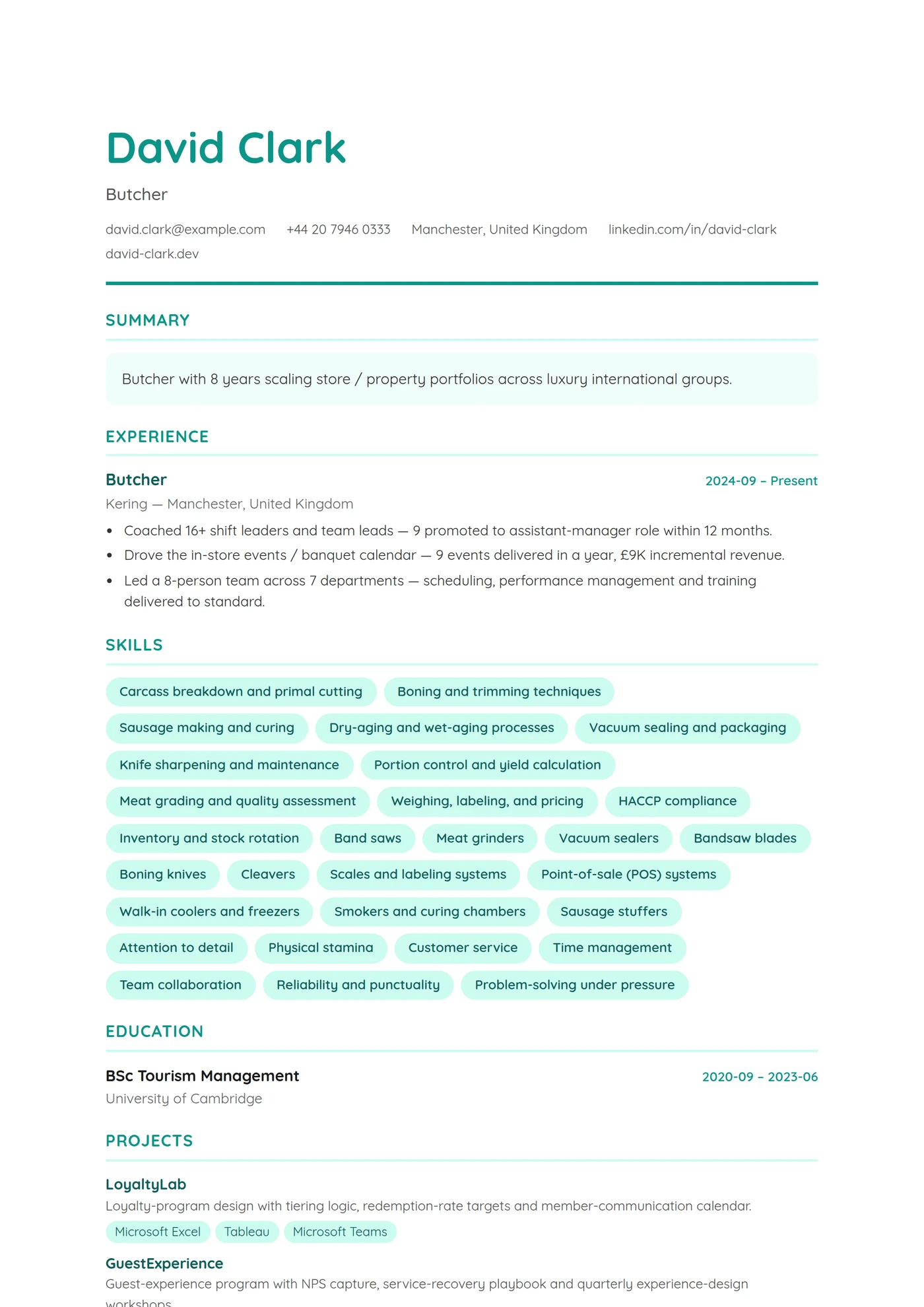
Profession — Restaurant Service — Mid-level

Profession — Restaurant Service

industry

This industry-styled template balances professional polish with practical layout, ideal for mid-career butchers highlighting cutting specialties and customer-facing achievements.

Learn more about this template
Senior
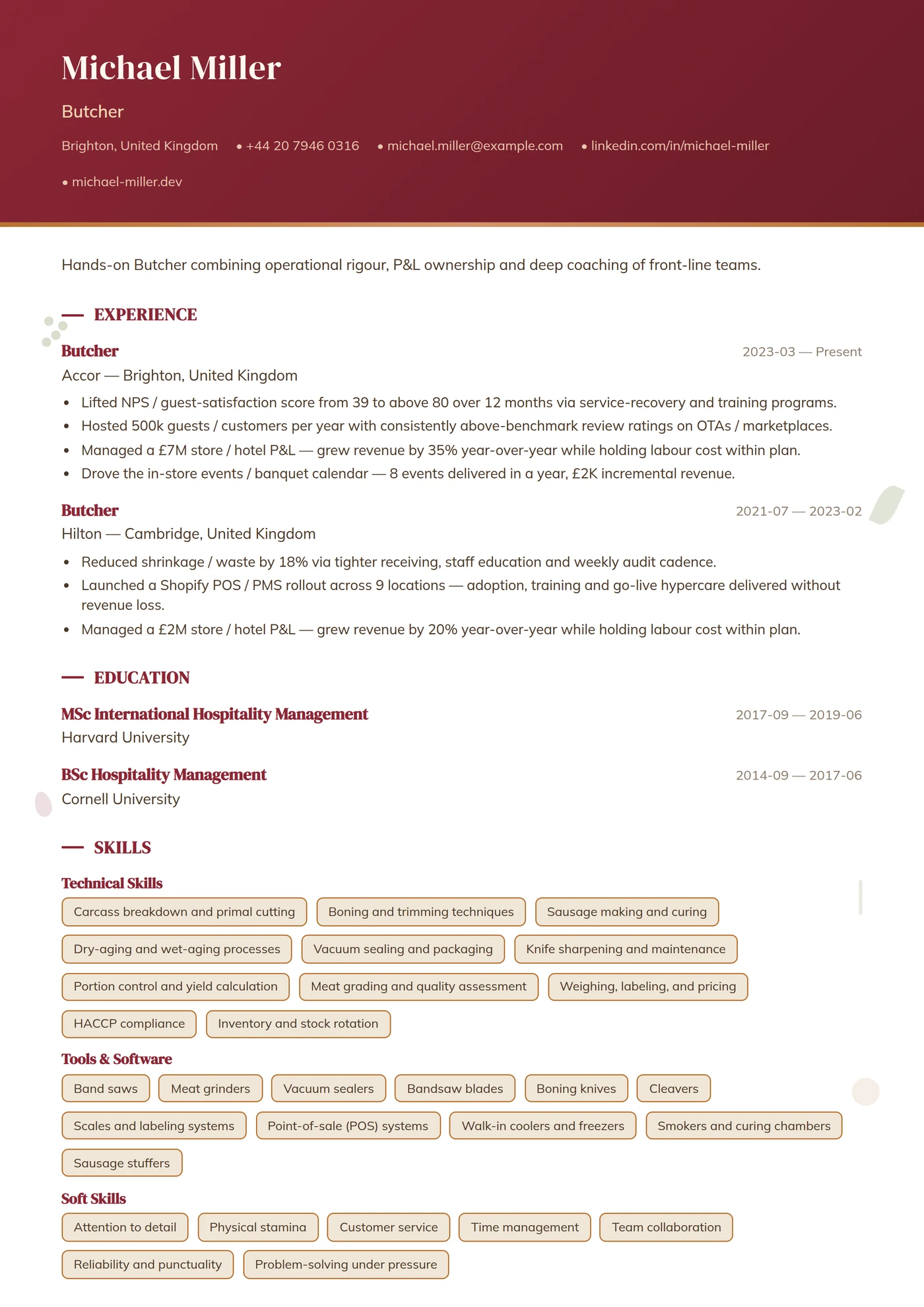
Industry — Culinary Chef — Senior

Industry — Culinary Chef

industry

A premium, culinary-focused design suits master butchers and department managers who need to showcase leadership, vendor relationships, and advanced technical expertise.

Learn more about this template

Skills for Butcher

Hard Skills

Carcass breakdown and primal cuttingBoning and trimming techniquesSausage making and curingDry-aging and wet-aging processesVacuum sealing and packagingKnife sharpening and maintenancePortion control and yield calculationMeat grading and quality assessmentWeighing, labeling, and pricingHACCP complianceInventory and stock rotation

Soft Skills

Attention to detailPhysical staminaCustomer serviceTime managementTeam collaborationReliability and punctualityProblem-solving under pressure

Tools & Software

Band sawsMeat grindersVacuum sealersBandsaw bladesBoning knivesCleaversScales and labeling systemsPoint-of-sale (POS) systemsWalk-in coolers and freezersSmokers and curing chambersSausage stuffers

ATS Keywords

meat cuttingbutcherycarcass breakdownHACCPServSafefood safetyportion controlinventory managementcharcuterieUSDA standardssanitation protocolscustomer servicequality controlmeat processing

Writing Tips for Butcher

Best Format to Use

The reverse-chronological format works best for most Butcher resumes since it clearly shows career progression from apprentice to skilled or master butcher. This format is easiest for both hiring managers and ATS software to parse, and it highlights growth in responsibility, specialization, and technical ability over time. A hybrid format can work well for career changers entering butchery from culinary or food-service backgrounds, allowing a skills summary up top before the work history. Avoid purely functional formats, as employers want to see concrete, dated experience with specific employers and measurable results.

Common Mistakes

Listing duties instead of achievements — write "reduced meat waste by 12%" rather than just "cut meat daily."
Omitting food safety certifications like ServSafe or HACCP, which many employers require or strongly prefer.
Using overly generic language that could apply to any retail job instead of butchery-specific terms.
Failing to quantify volume handled, such as pounds processed per shift or number of custom orders fulfilled.
Ignoring customer-facing skills when applying to retail butcher roles, which also require strong service ability.
Using complex formatting with tables or graphics that confuse ATS parsing software.
Not tailoring the resume to the specific employer type — wholesale, retail, or farm-to-table have different priorities.

How to Pass ATS

Mirror keywords from the job posting, such as "primal cuts," "HACCP," or "inventory management."
Use standard section headers like "Work Experience" and "Skills" rather than creative titles.
Save and submit the resume as a .docx or PDF file as specified in the job posting.
Avoid images, icons, or text boxes that ATS systems may fail to read correctly.
Include both the full certification name and acronym, e.g. "ServSafe Food Handler Certification (ServSafe)".
List specific meat types and cuts handled (beef, pork, poultry, game) to match searchable terms.
Keep formatting simple with standard fonts and clear bullet points for consistent parsing.

How to Stand Out

Quantify every achievement possible — waste reduction percentages, sales increases, or volume processed per week.
Highlight specialized skills like whole-animal butchery, dry-aging, or custom sausage recipes that set you apart.
Mention any training or mentoring of junior staff to show leadership potential.
Include customer service wins, such as building repeat clientele or increasing counter sales.
Add relevant certifications prominently, including OSHA safety training if applicable.
Showcase any supplier or vendor relationship management experience for senior-level roles.
Use a short, impactful summary statement that signals your specialty and years of experience immediately.

Frequently Asked Questions

A one-page resume is ideal for most Butcher roles, especially for entry-level or mid-career candidates. Senior butchers managing departments or multiple locations may extend to two pages if leadership and vendor management experience adds real value.
Focus on technical cutting skills, food safety knowledge like HACCP compliance, and inventory management abilities. Pair these with soft skills such as attention to detail and customer service, since many butcher roles involve direct customer interaction.
Use simple formatting with standard headers, avoid graphics or tables, and mirror keywords directly from the job description. Always list certifications by full name and acronym, such as "ServSafe Food Handler Certification (ServSafe)" to maximize keyword matches.
Entry-level positions often require little to no prior experience, with training provided on the job over 1-2 years. Advancing to specialized or managerial butcher roles typically requires 3-7 years of hands-on experience plus demonstrated technical mastery.
Yes, a short cover letter can help explain your specialty skills, such as charcuterie or whole-animal butchery, and show enthusiasm for a specific employer. It is especially useful for career changers or those applying to specialty or artisanal shops.
ServSafe Food Handler Certification and HACCP training are the most widely recognized and often required by employers. Additional credentials like OSHA 10 or OSHA 30 safety certifications can further strengthen a resume, particularly for larger facilities.

Ready to build your resume?

Use our AI Resume Builder to create a tailored, ATS-optimized resume in minutes.

Build my resume

Start for free. No credit card required.