About this template
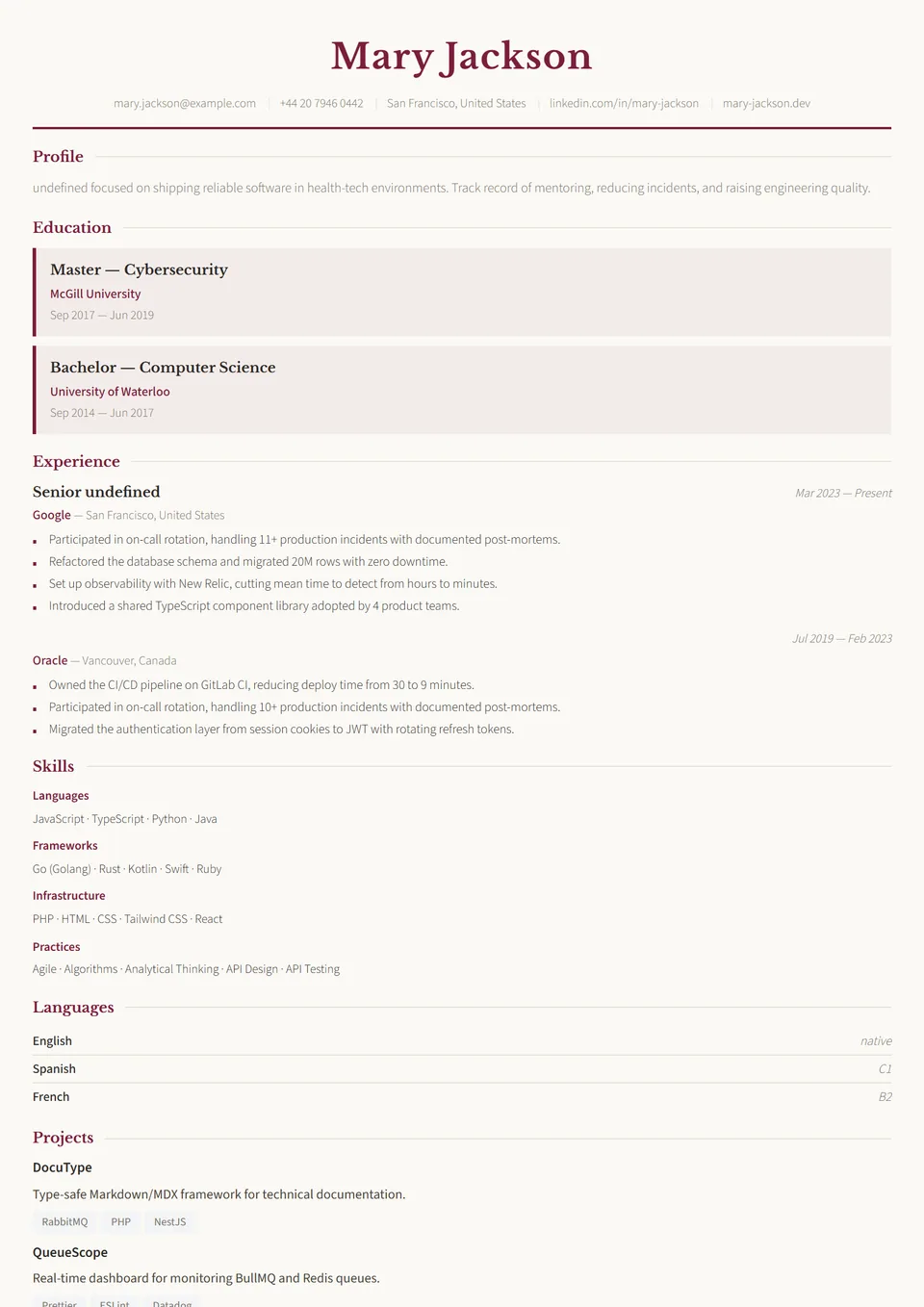
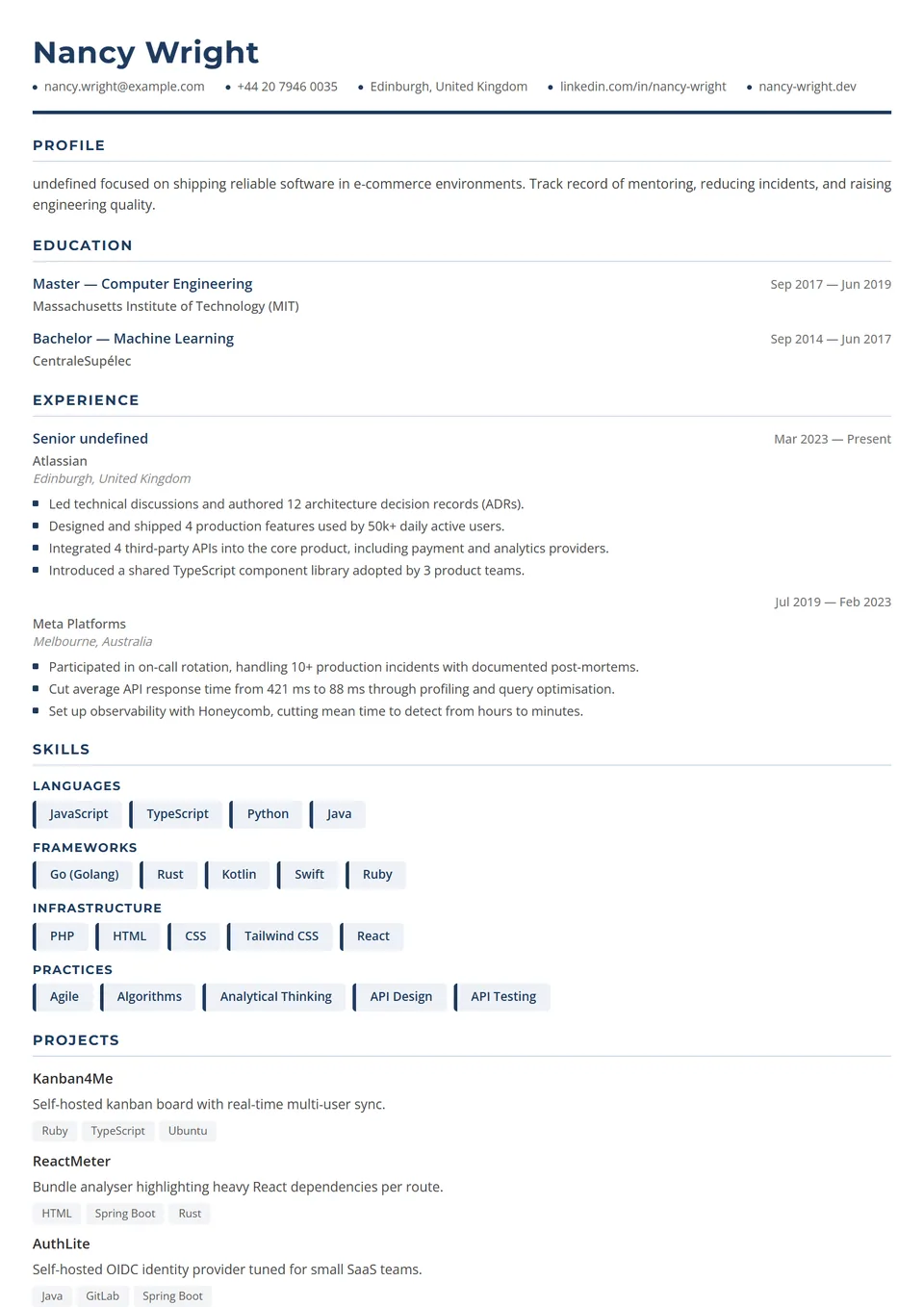
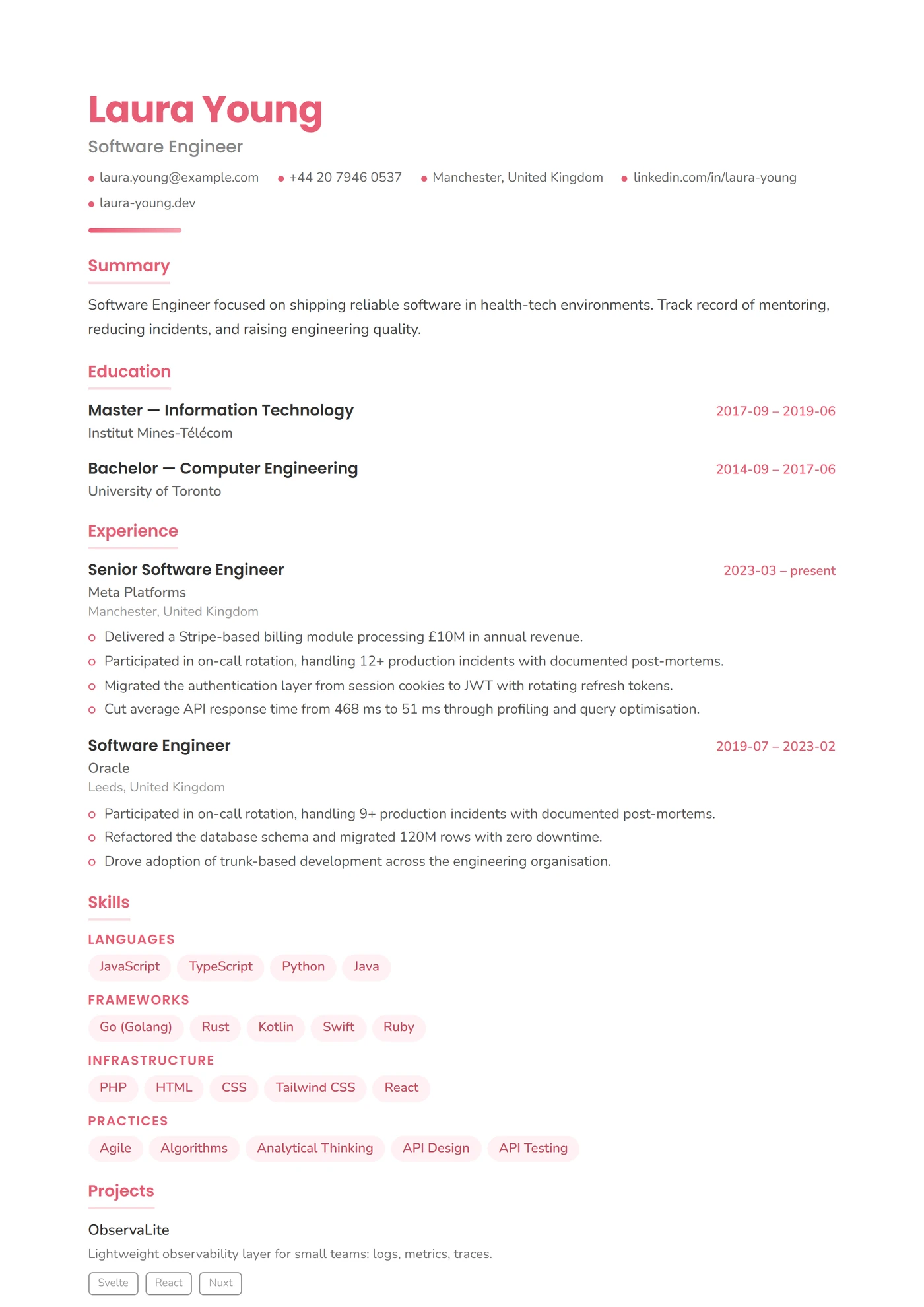
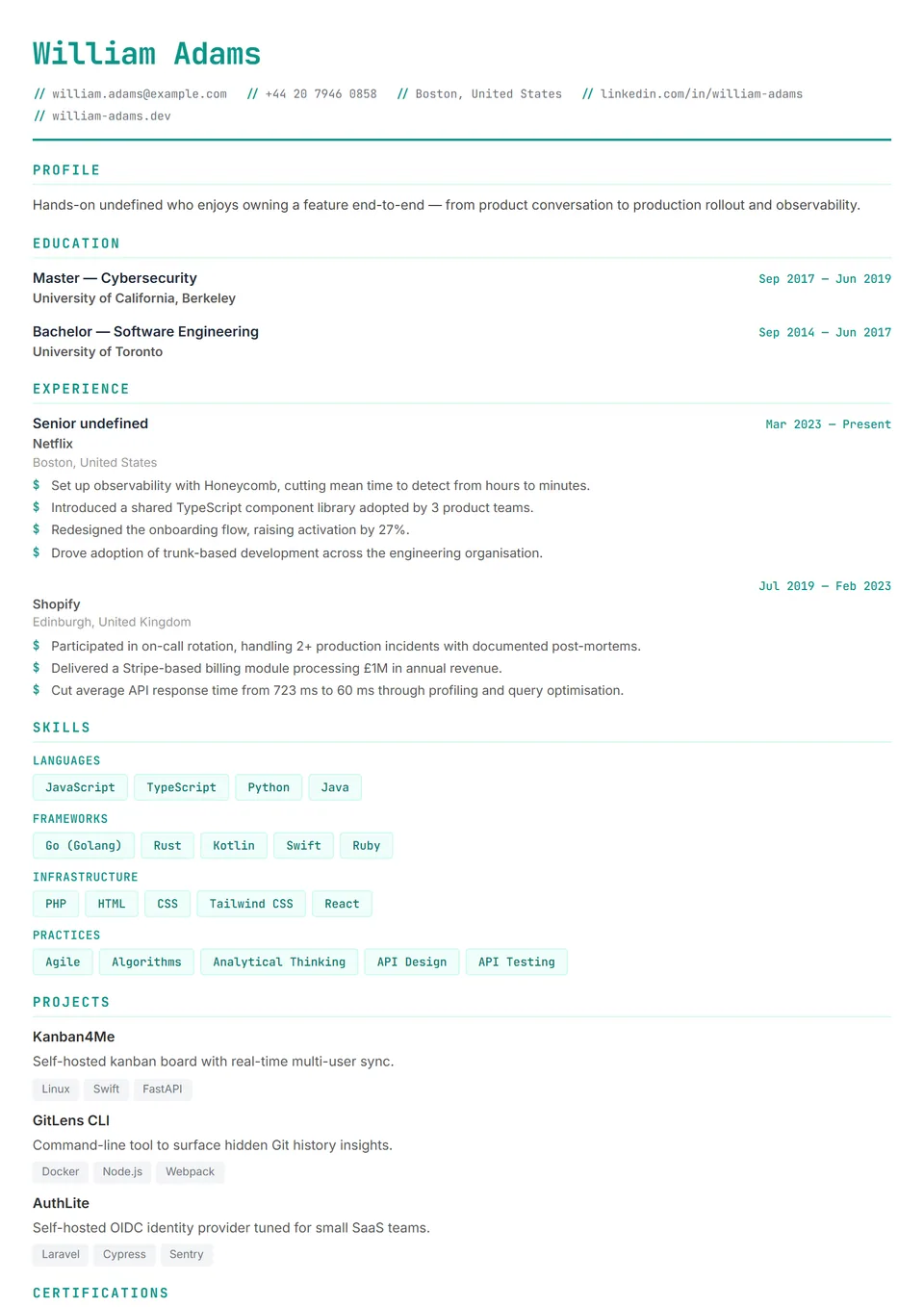
The ATS Scientist template uses a layout in IBM Plex Sans with a research-green accent — built for STEM researchers. Sections are organised around publications, grants, lab affiliations and conference presentations, all parsed cleanly through corporate ATS pipelines. Compatible with the ATS pipelines used by global industrial R&D groups (Workday at Pfizer R&D, SAP SuccessFactors at Merck, Greenhouse at Recursion) and biotech/medtech scale-ups.
Who is it for?
It addresses STEM researchers applying to industrial R&D departments: pharma (Pfizer, Merck, BMS, AstraZeneca, Eli Lilly, Novartis), biotech (Moderna, Recursion, Vertex, BioNTech, Genentech), semi-conductors (Intel, TSMC, NVIDIA, Qualcomm Research), energy (ExxonMobil Research, Shell, NREL, ORNL), aerospace (NASA JPL, Boeing R&T, Lockheed Skunk Works) where HR sits in front of the CV. Bridge between academic credentials and industry science team keyword expectations.
How to use it
Structure the CV in six blocks: Education (with thesis topic, defence committee, granting university), Research experience (postdocs and industrial collaborations), Publications (with JCR quartile, h-index, citation count), Patents, Funding obtained (with PI/co-PI/WP leader role), Conferences. For profiles transitioning from academia to industry, add a 'Technical skills' section with experimental techniques (Western Blot, qPCR, FACS, scRNAseq, CRISPR, NGS, cryo-EM, MS/MS) and computational skills (R, Python, bioinformatics pipelines).
Frequently asked questions
Should I mention h-index and citation count?
Yes for profiles transitioning to pharma/biotech industry. State the h-index and total citation count (sources: Google Scholar, Scopus, Web of Science) with the update date. For a postdoc, h-index of 5-12 is expected; for a senior researcher seeking industry pivot, 15-30+ is valued. List the number of first-author papers and corresponding-author papers separately as these matter differently to academic and industry recruiters.
How do I present an industry-funded PhD?
Industry-funded PhDs (CIFRE in France, EngD in the UK, KTP in the UK, NSF IUCRC fellowships in the US) are highly valued in industry. State clearly 'Industry-funded PhD — partnership academic [lab] / industrial [company] — funded by [agency/fellowship]'. Specify the topic, defence committee, and especially the industrial valorisation (patents filed, technology transfers, post-PhD contracts). Recruiters in R&D filter these as indicators of academia-industry collaboration fit.
How do I present funding obtained?
Create a 'Funding obtained' section with project code, funder (NIH, NSF, ERC, Wellcome, MRC, DOE, BMBF, ANR, H2020/Horizon Europe), amount (in USD or EUR), role (PI, co-PI, WP leader) and duration. Example: 'NIH R01-CA123456 — $2.1M — PI — 2023-2028'. R&D directors filter these acronyms as markers of scientific competitiveness and translatability.