About this template
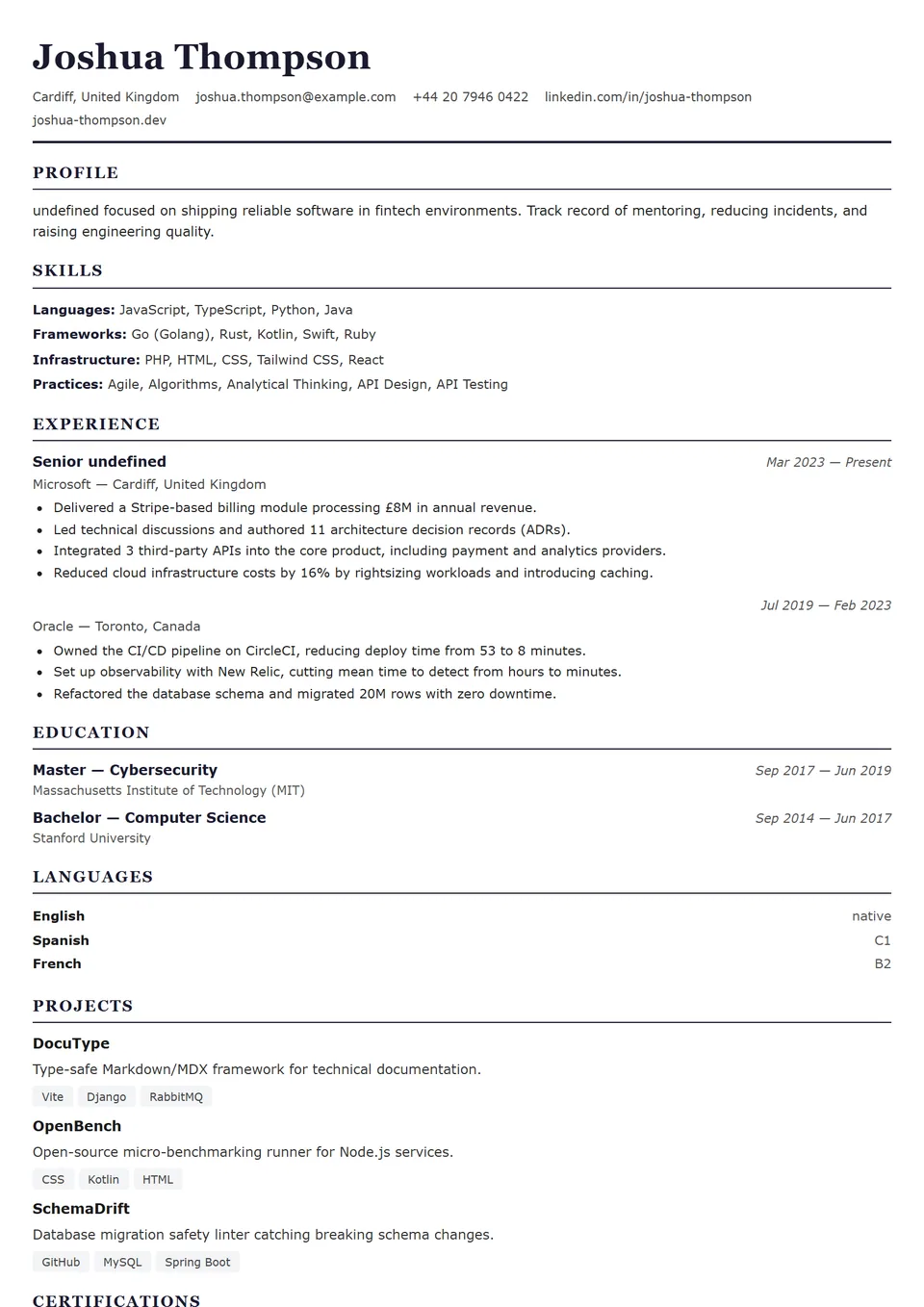
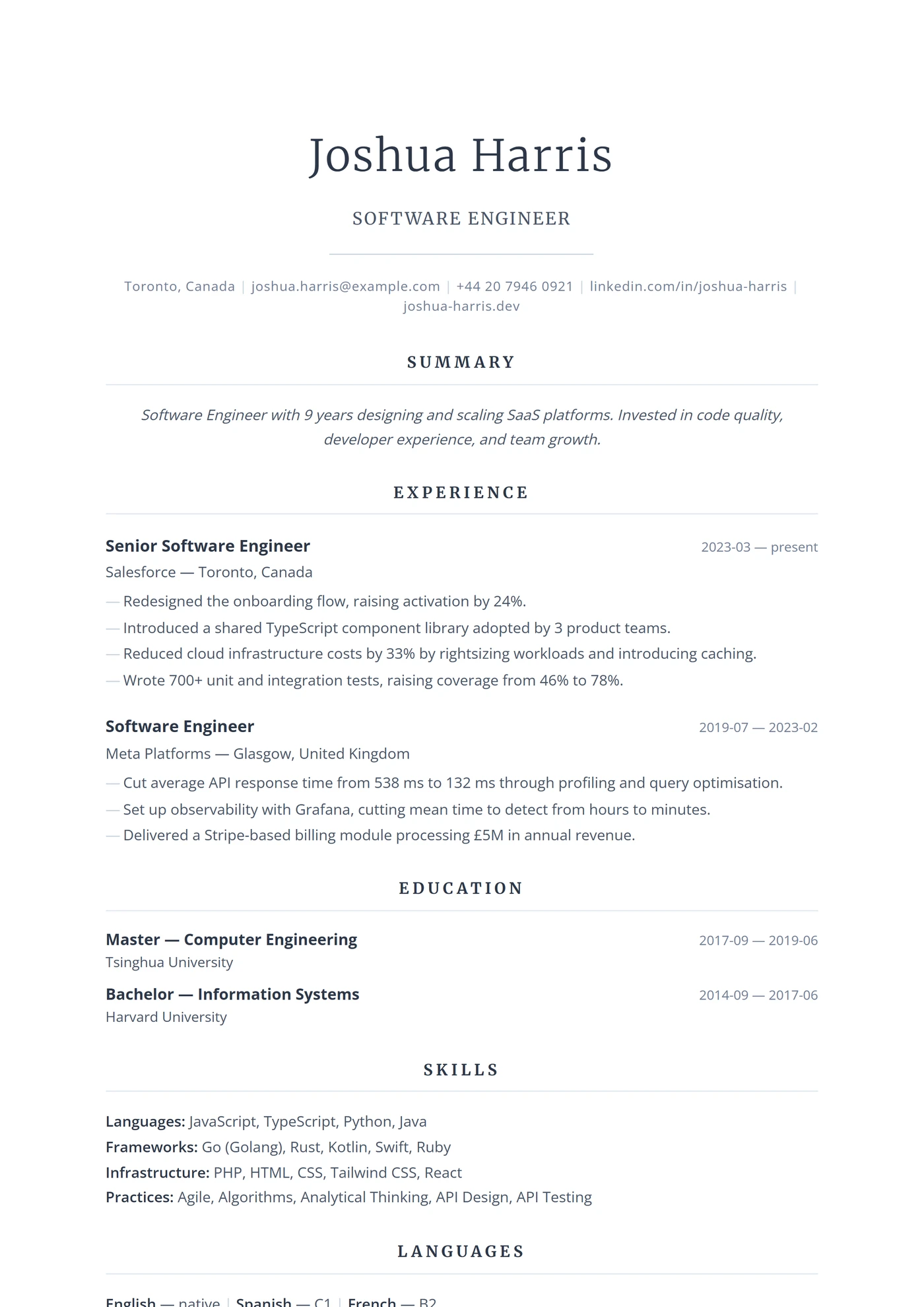
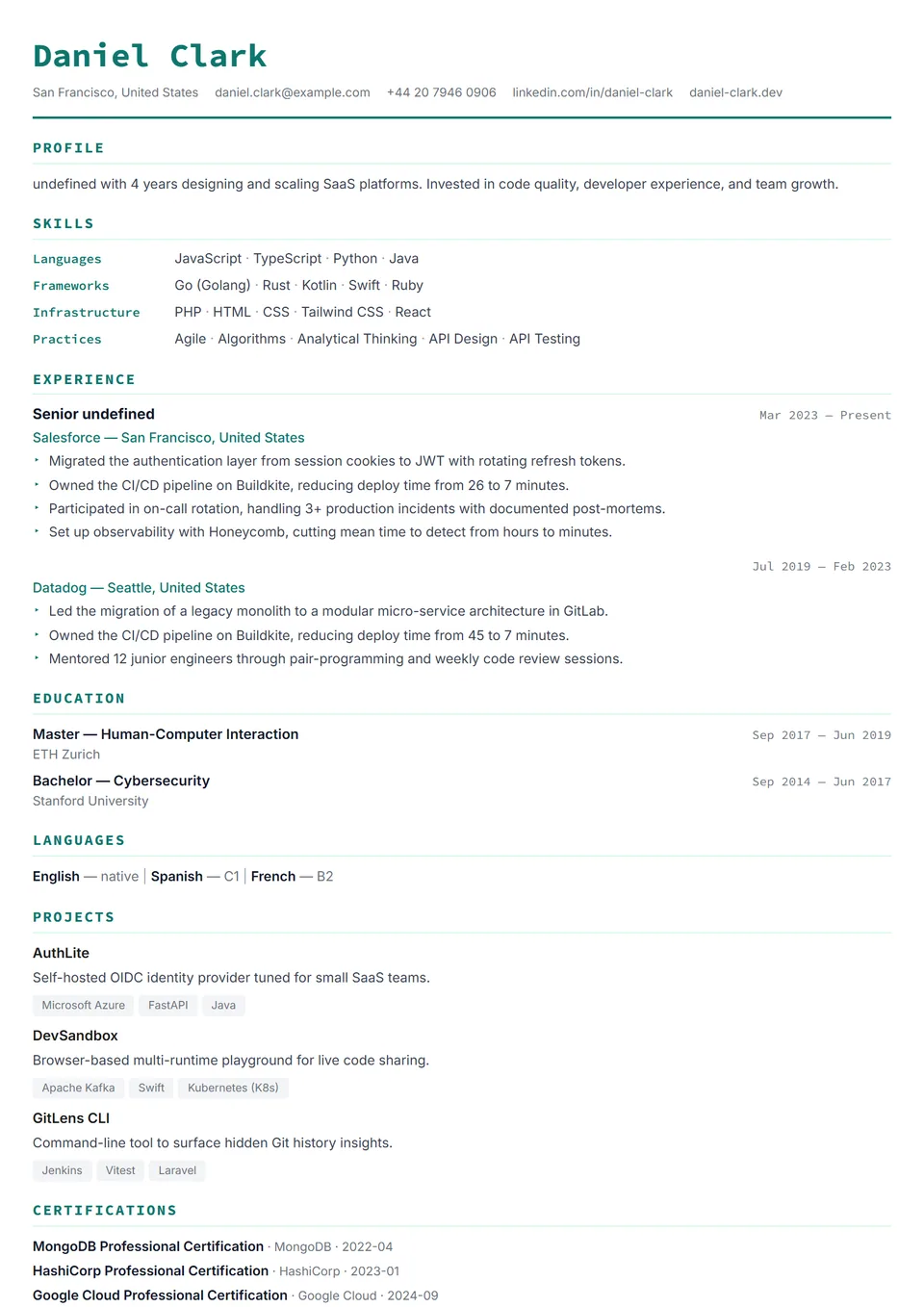
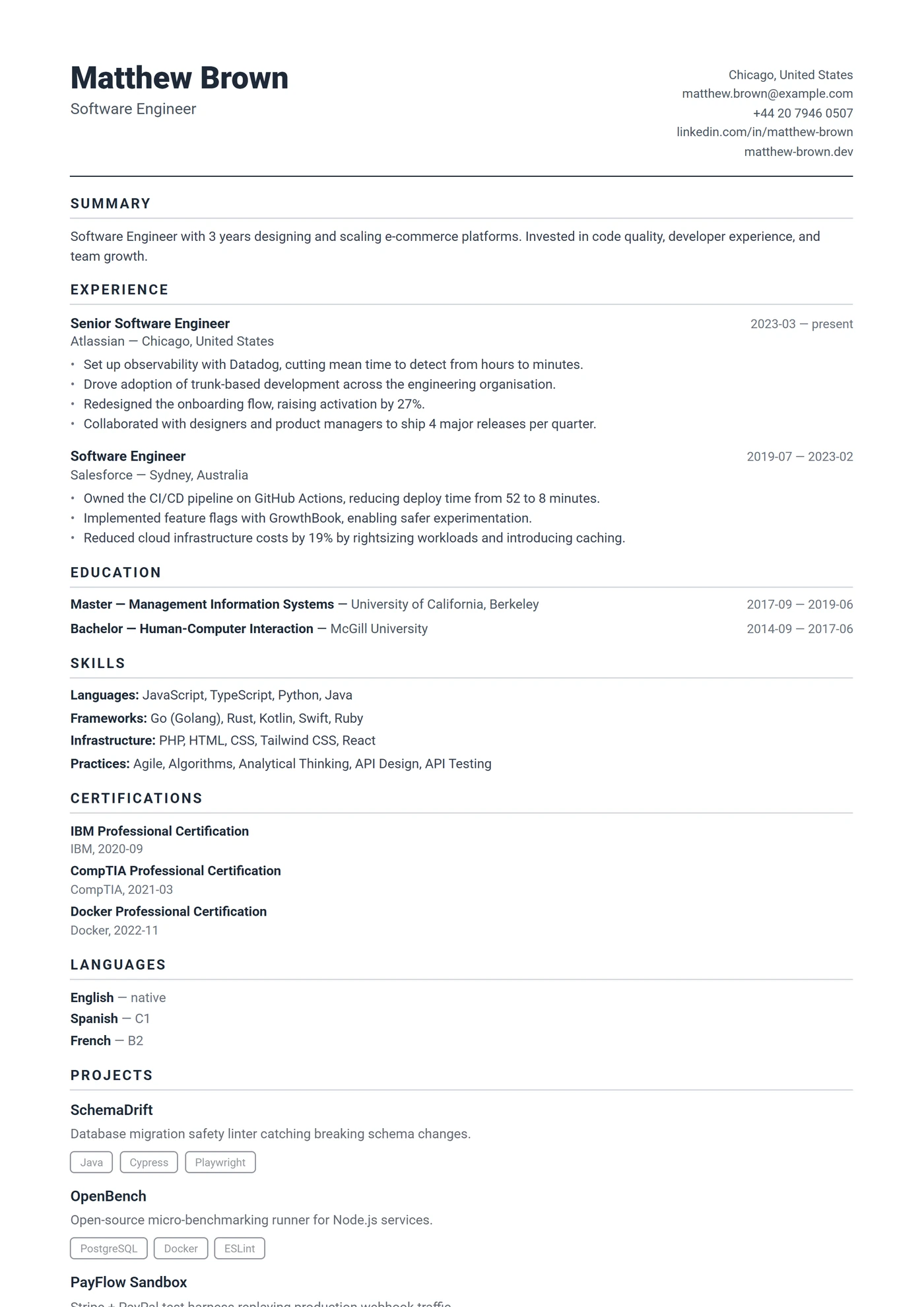
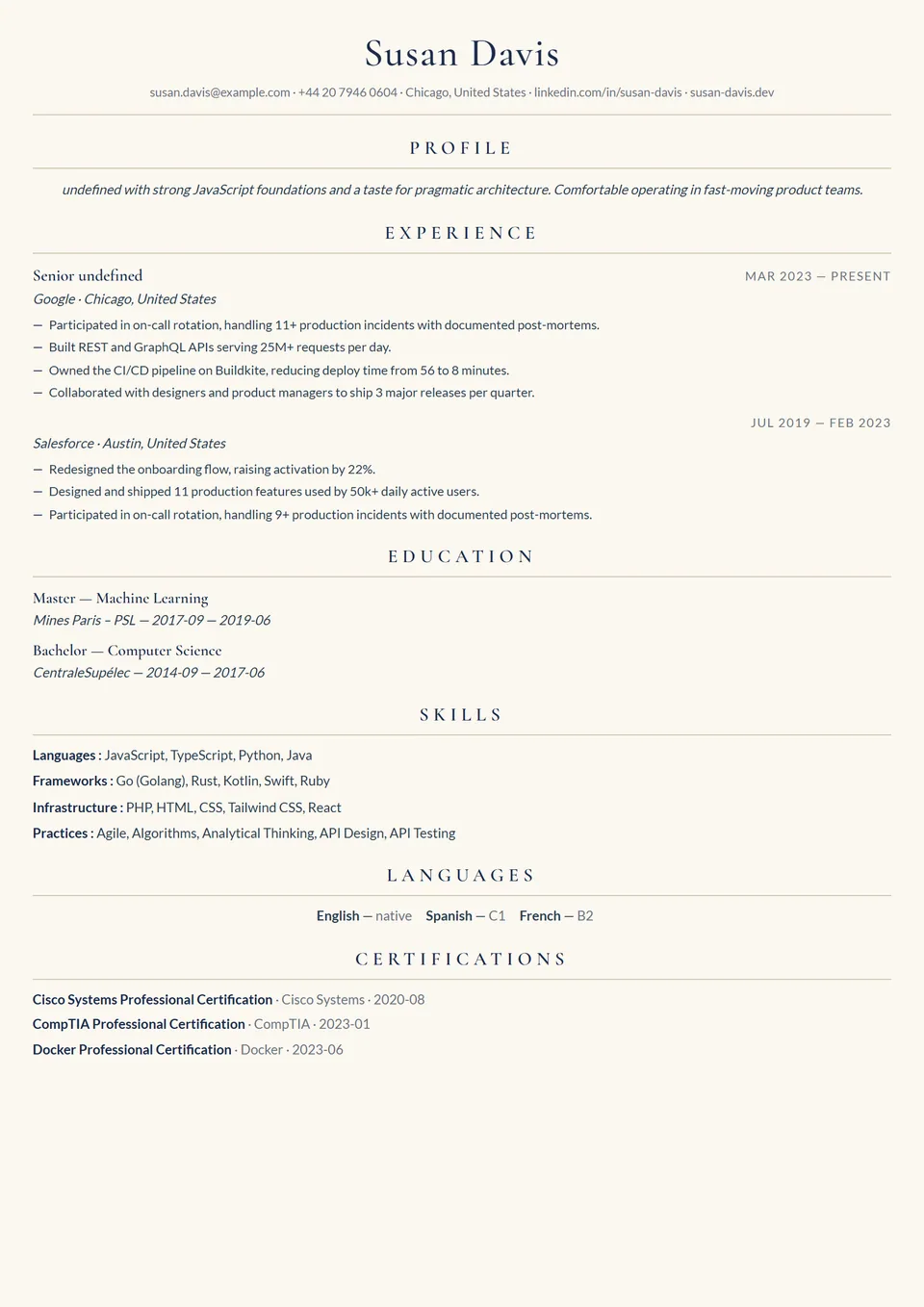
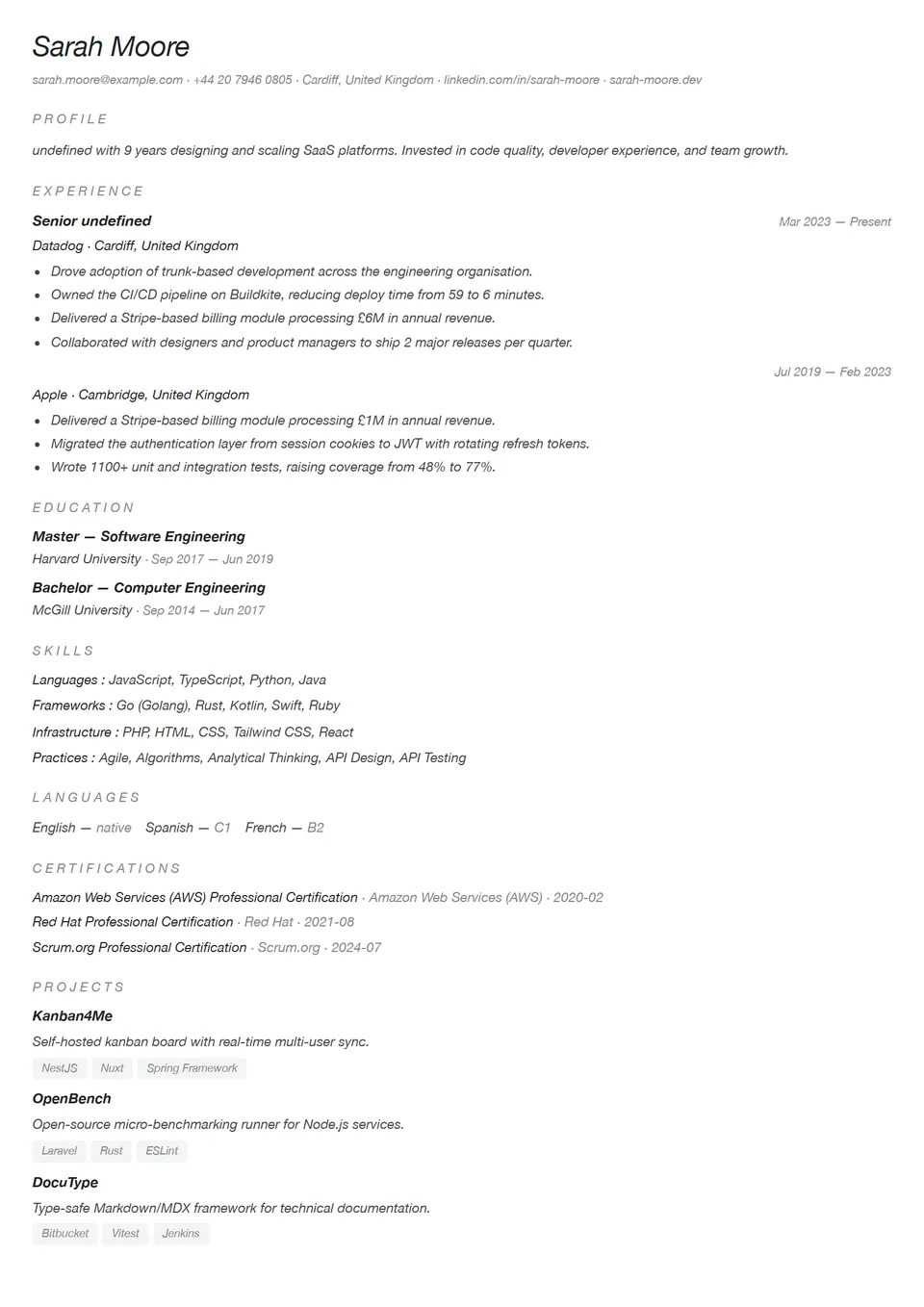
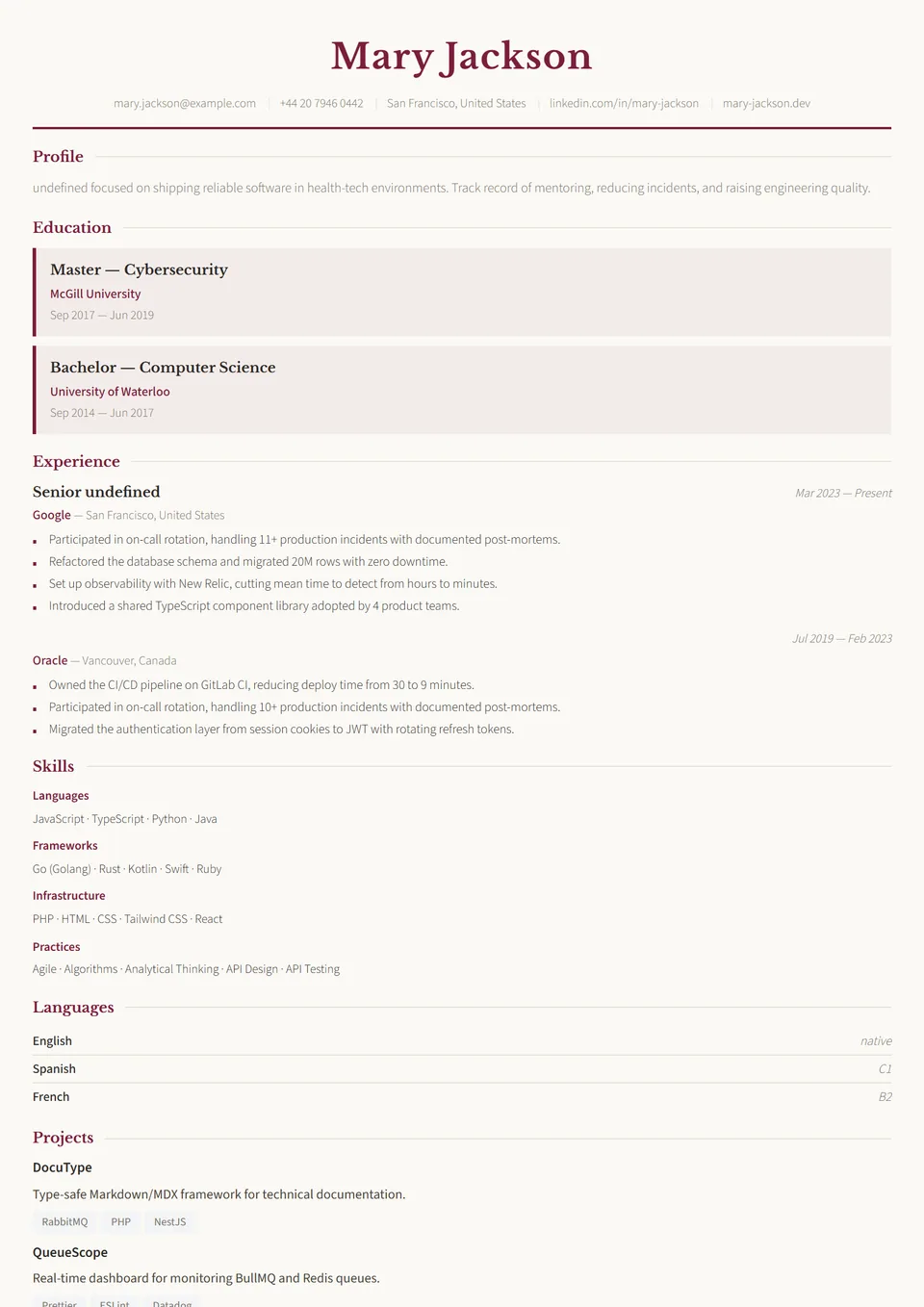
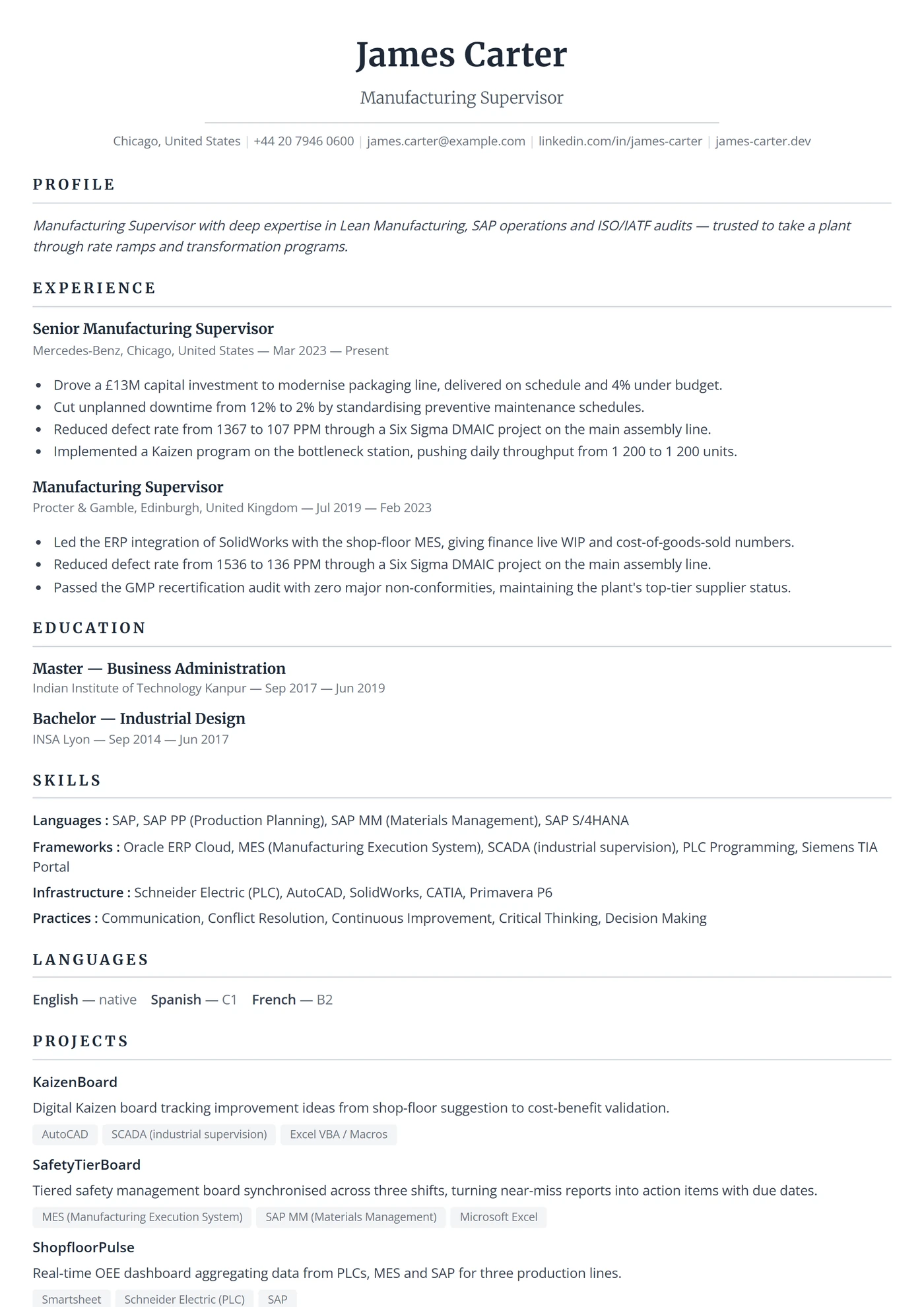
The US Modern template is an American CV in a two-column layout in Inter, with an opening summary, a sidebar for technical skills, certifications and links (LinkedIn, GitHub, portfolio), and a main column for Experience and Education. Reverse chronological order. No photo, no birth date. The format keeps American concision while borrowing visual codes from contemporary tech engineering — suited to candidates targeting startups, scale-ups and modern teams on the West Coast and East Coast.
Who is it for?
For US candidates targeting startups, scale-ups and modern teams in tech, product and design — software engineers, designers, product managers, growth marketers, data scientists, ML engineers, DevOps/SRE. Suitable for applications to Google, Meta, Amazon, Apple, Microsoft, Stripe, Datadog, Snowflake, Databricks, MongoDB, Cloudflare, Vercel, Netlify, GitHub, Notion, Linear, Figma, Airbnb, Uber, Lyft, DoorDash, Instacart, Robinhood, Coinbase, Anthropic, OpenAI, and the long tail of Series A-D backed by Sequoia, a16z, Founders Fund, Index Ventures, Accel. Also suitable for design profiles (Apple Design, Figma Design, Linear Design, Notion Design, Stripe Design, Airbnb Design, Spotify Design, Pinterest Design, Slack Design) and for PMs targeting Associate Product Manager rotations (Google APM, Meta RPM, Stripe APM, Airbnb APM).
How to use it
The opening summary holds three to four lines — oriented toward measurable impact ("Senior Software Engineer, 7 yrs at Stripe and Datadog, specializing in API performance and developer experience for B2B SaaS. Led migration reducing p99 latency 65%"). The sidebar accommodates technical skills (languages: Go, TypeScript, Rust, Python; frameworks; cloud: AWS Pro, GCP Pro), certifications (CKAD, CKA, AWS Solutions Architect Professional, GCP Professional Cloud Architect), links (LinkedIn, GitHub, personal portfolio) and languages. The main column holds experience reverse-chronological with quantified impact and stack mentioned. For ML/AI profiles, mention published papers (NeurIPS, ICML, ICLR, ACL) and frameworks (PyTorch, JAX, HuggingFace). Long-tail: "software engineer Stripe CV", "ML engineer Anthropic resume", "product manager Figma CV", "staff engineer Notion CV", "design lead Linear CV".
Frequently asked questions
Does the two-column layout cause issues for US ATS?
No for modern ATS used by scaleups and big tech: Greenhouse (Stripe, Airbnb, Notion, Linear, Anthropic), Lever (Figma, Datadog, Snowflake), Workday (Google, Meta, Amazon, Apple), Ashby (increasingly used at Series B-C). These ATS correctly parse two-column structures generated by modern PDF frameworks. For legacy ATS at some traditional companies (Oracle Taleo, IBM Kenexa BrassRing), a preliminary extraction test can reveal section inversions — in that case, switch to a one-column variant.
Should GitHub and portfolio really be listed in the sidebar?
Yes for tech, product and design profiles. The sidebar holds the links block at the top: LinkedIn (custom /in/firstnamelastname URL), GitHub (account with visible contributions, not an empty account), personal portfolio (short domain .dev, .design, .engineer), possibly Twitter/X for public tech profiles. For ML engineers and researchers, add Google Scholar or Semantic Scholar. For designers, Are.na, Dribbble (declining), personal portfolio. Avoid links to inactive accounts — a GitHub with 3 old commits sends a negative signal.
How do you indicate a career transition (eg. consulting → tech) in this template?
Open the summary with a clear pivot line ("Former Bain consultant transitioning to product management, completed Stripe APM rotation and shipped 3 B2B SaaS launches at Series B fintech"). List recent experience in alignment with the target (Product Manager first, Consultant after). For APM rotations (Google, Meta, Stripe, Airbnb), cite shipped projects with business impact. For late pivots (5+ years in consulting), a recent MBA (Stanford GSB, Harvard, Wharton, MIT Sloan) remains a valid reorientation signal even 2-3 years after graduation.