About this template
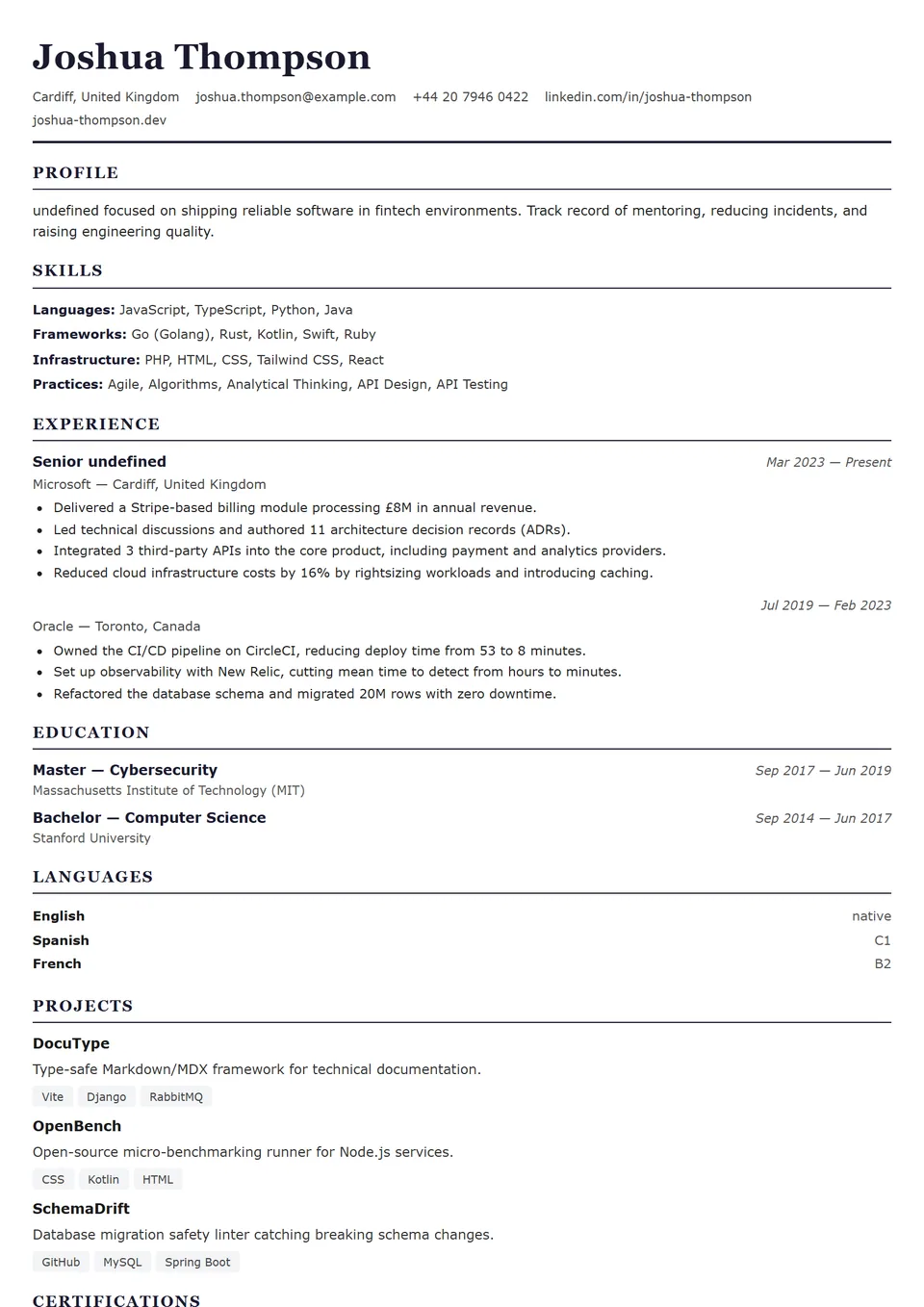
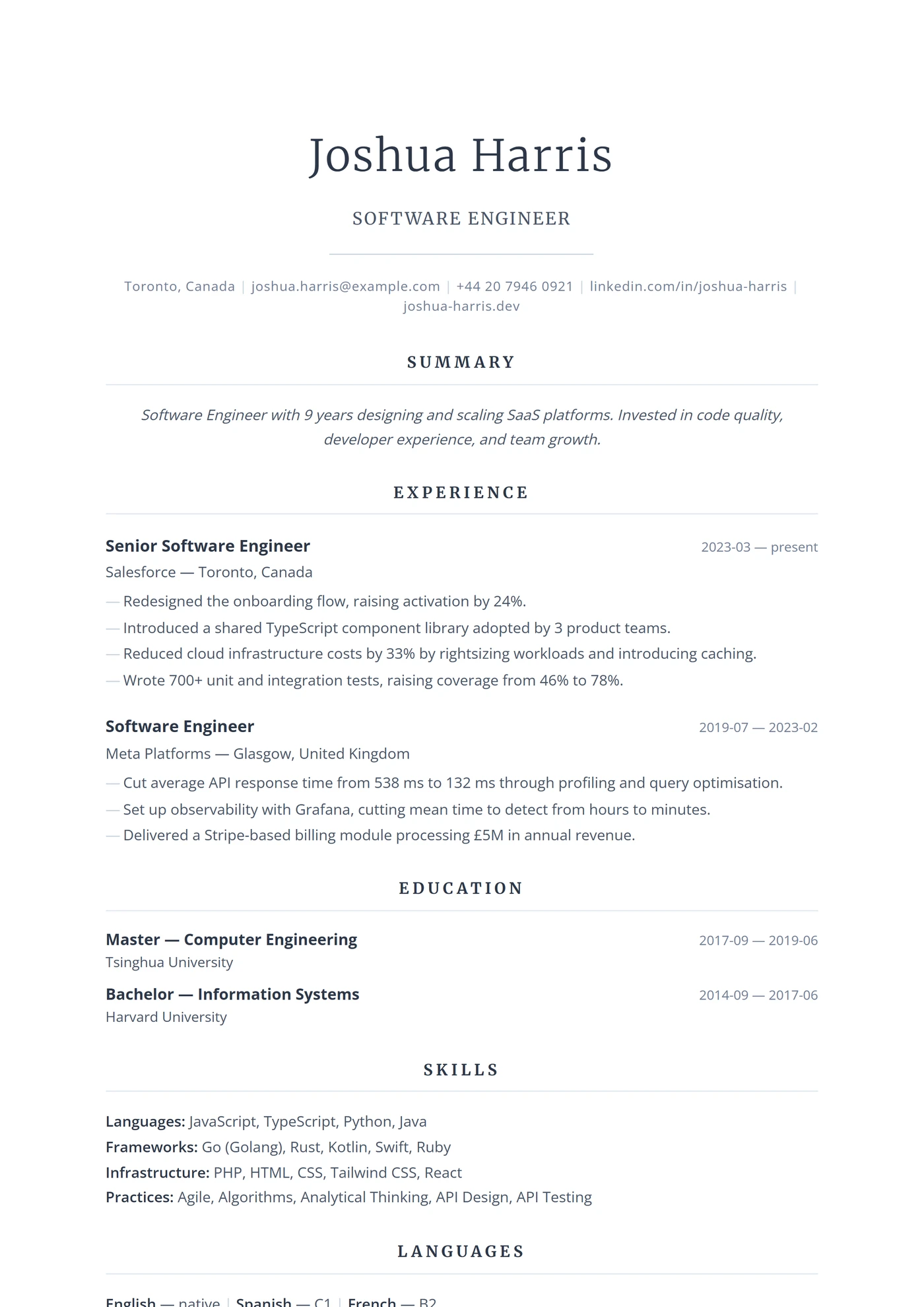
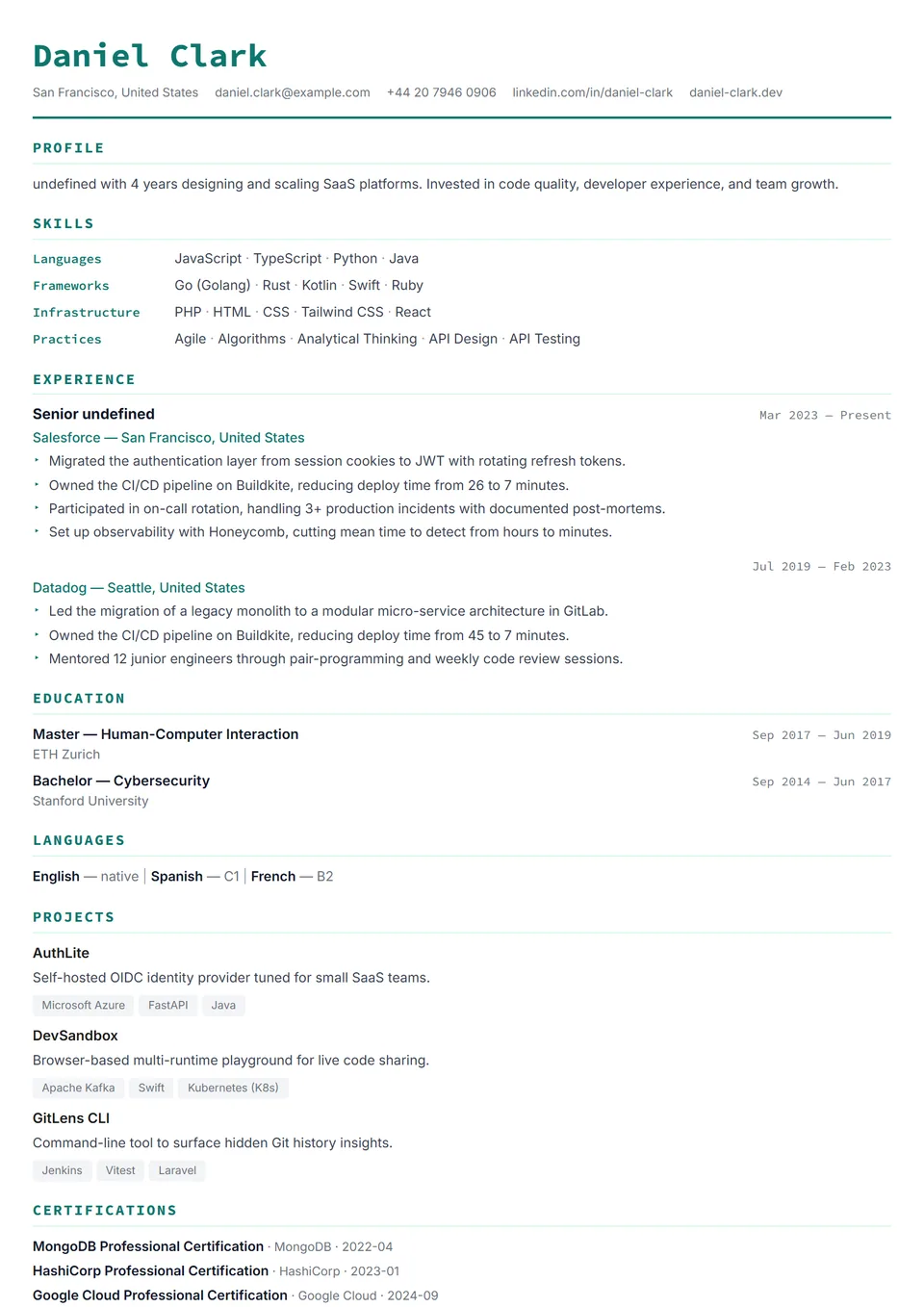
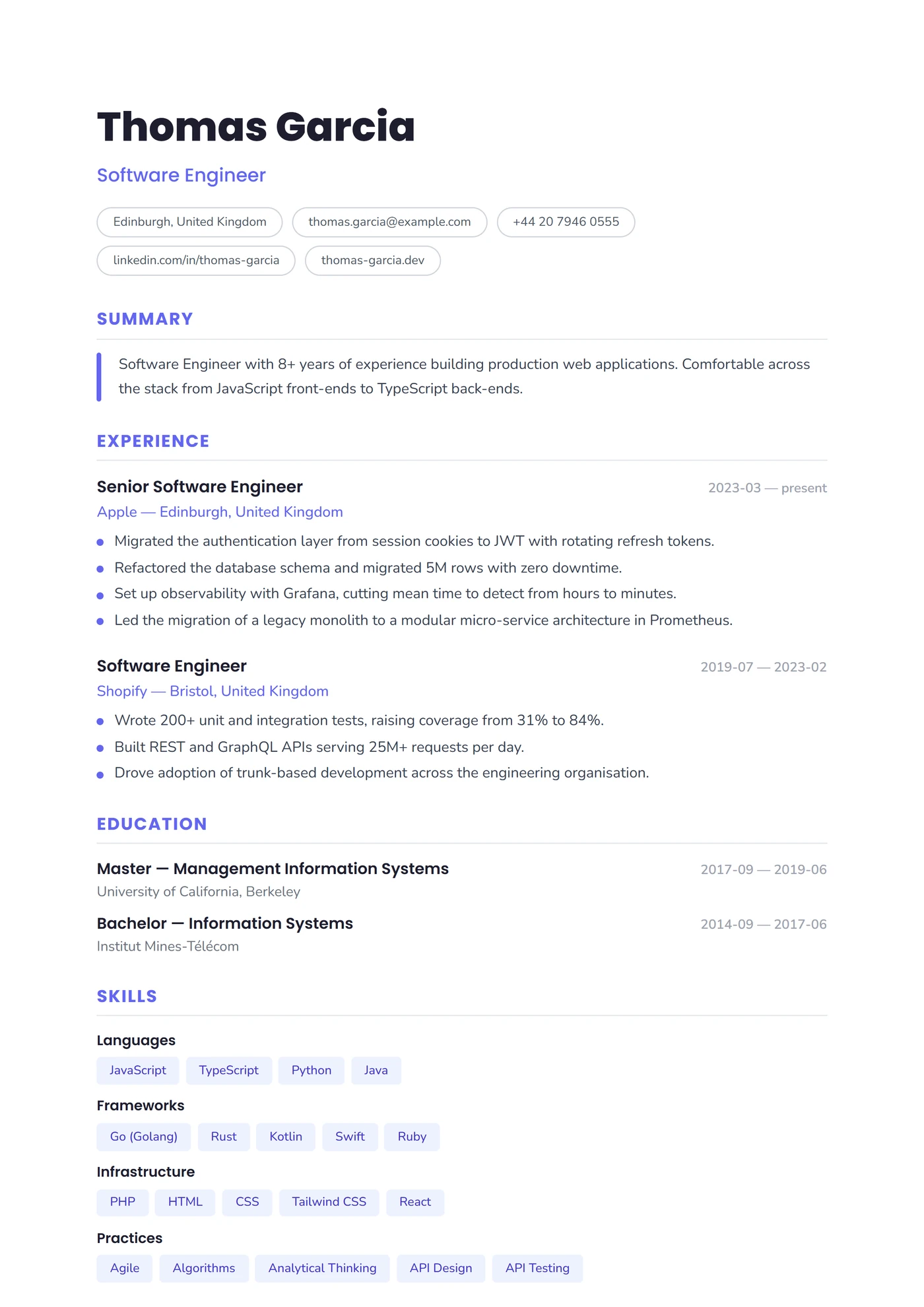
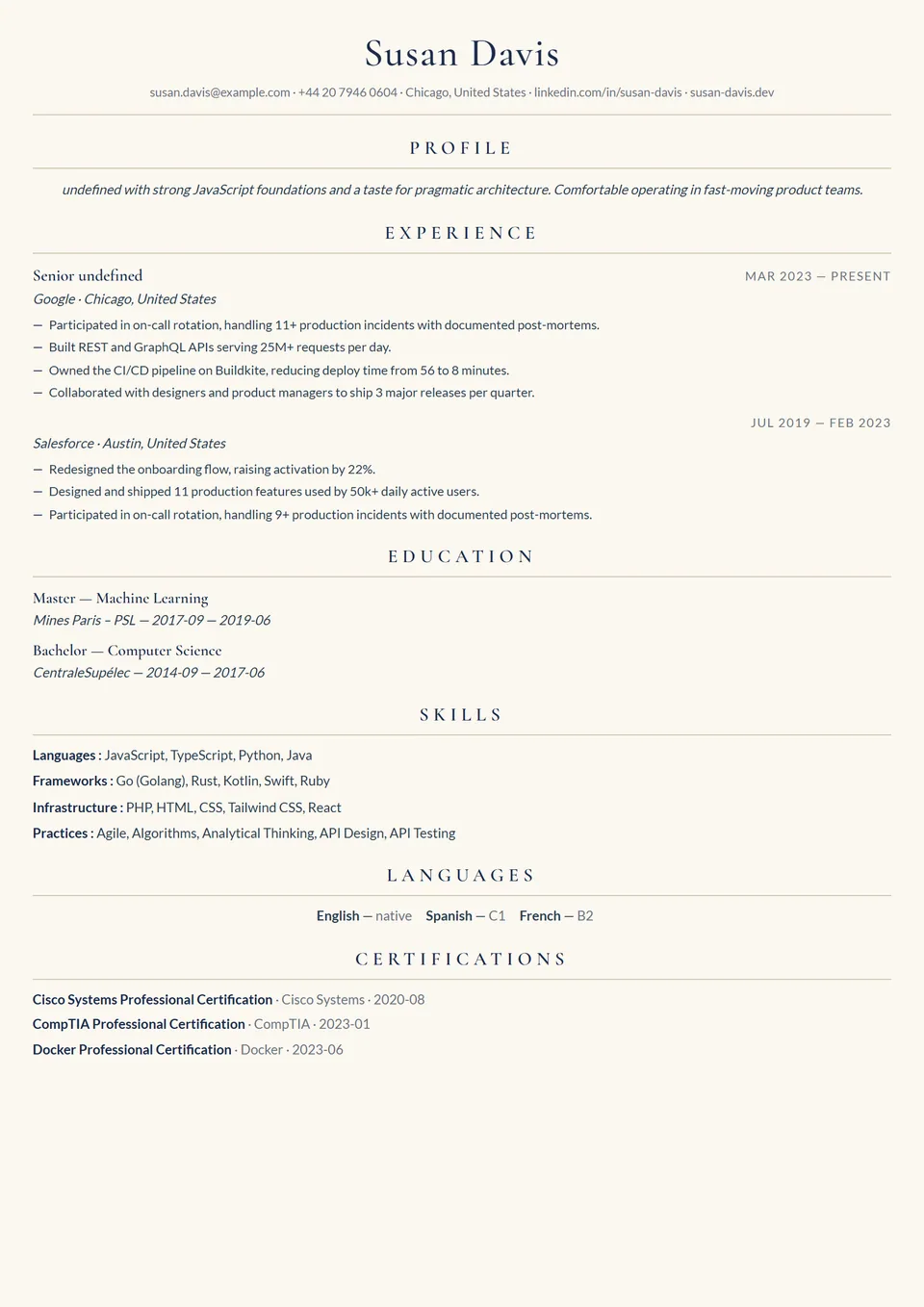
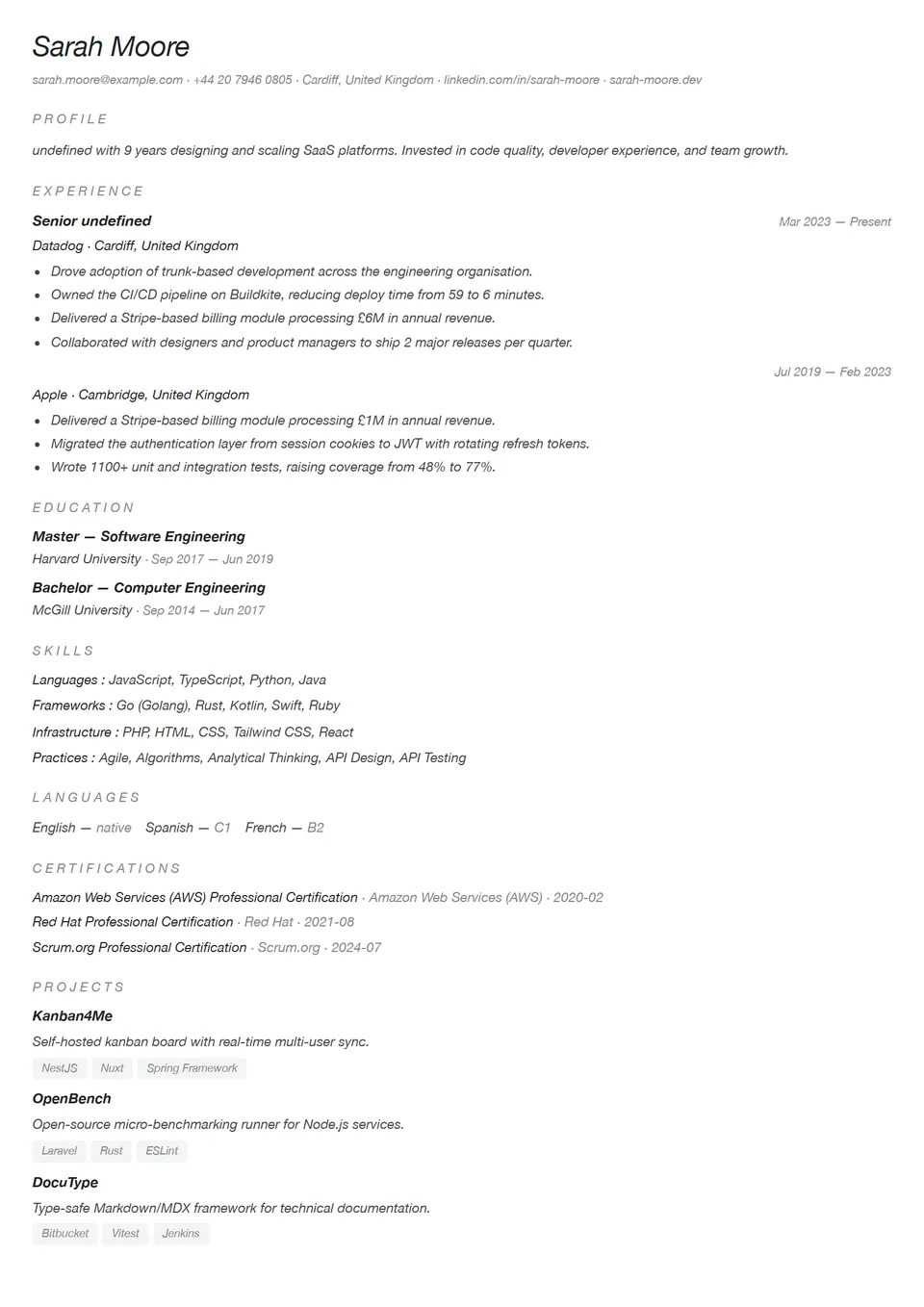
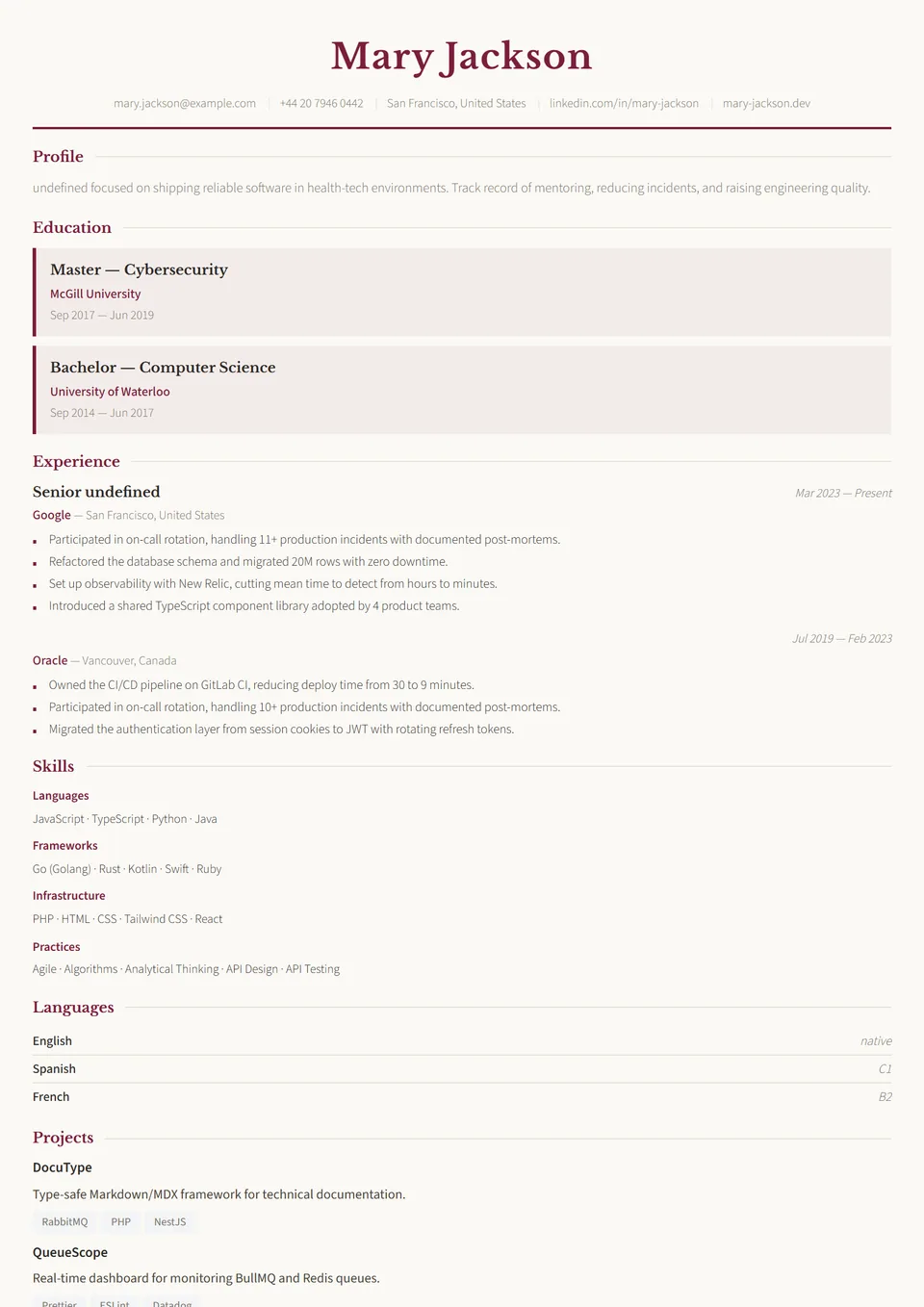
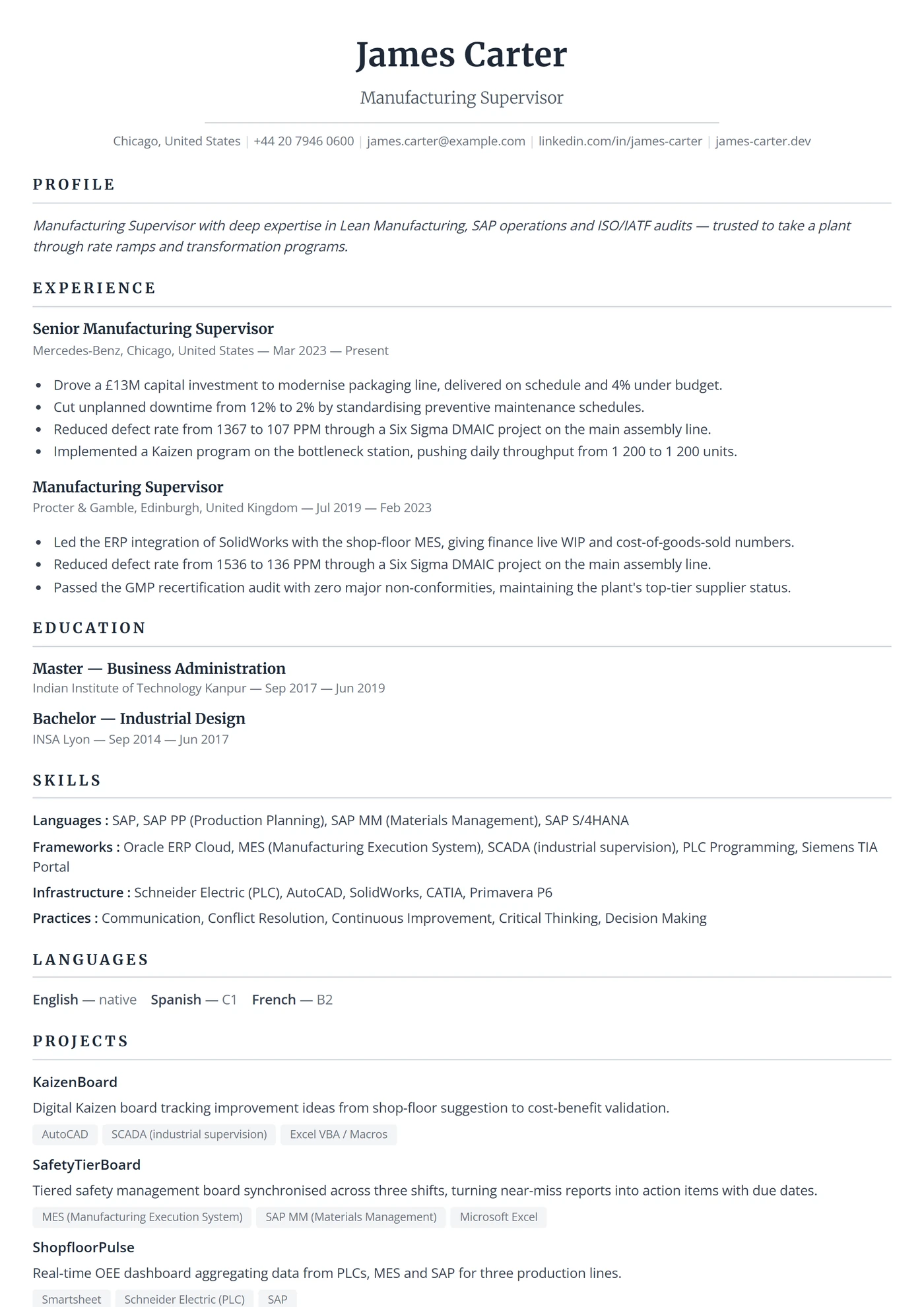
The US Compact template is an American one-page CV in Calibri or Source Sans Pro, with an opening summary of three lines oriented toward quantified results and an Experience block in reverse chronological order. No photo (strict US anti-discrimination), no birth date, no nationality (except visa status if applicable). The one-page compactness is precisely the code expected by mid and late-career American recruiters who scan dozens of CVs in minutes.
Who is it for?
For established to senior US candidates with eight to fifteen years of experience who must keep the document on a single page. Software engineers, product managers, marketing managers, finance directors applying to big tech (Google, Meta, Amazon, Apple, Microsoft), scaleups (Stripe, Airbnb, Uber, Lyft, DoorDash, Instacart, Robinhood, Coinbase, Figma, Notion, Linear), finance (Goldman Sachs, Morgan Stanley, JPMorgan Chase, Citi, Blackstone, KKR, Apollo) and senior consultants (McKinsey, BCG, Bain, Deloitte Strategy, PwC Strategy&). Suitable for MIT, Stanford, UC Berkeley, Carnegie Mellon, Princeton, Harvard, Wharton, Yale graduates and self-taught profiles from the tech or product community (YC alumni, Stripe Press alumni, Founders Fund alumni).
How to use it
The summary holds strictly three lines: career pattern, sector expertise, quantified value delivered ("Product Manager, 9 yrs leading B2B SaaS launches with $50M+ ARR delivered across Stripe and Figma"). Reverse chronological on Experience with at most 2 bullets per role, each bullet quantified in business metrics ("increased onboarding conversion from 38% to 61% in 2 quarters through self-serve funnel redesign"). No photo, no birth date, indicate visa status if applicable ("US citizen", "Green Card holder", "H-1B visa, sponsor required after Q3 2026"). For finance, mention certifications (CFA Level 3, Series 7, Series 63, FINRA-registered). For tech, list stack and open-source contributions. Long-tail: "product manager Stripe CV", "software engineer Google resume", "finance director Goldman Sachs CV", "senior consultant McKinsey US resume", "growth marketer Series B startup CV".
Frequently asked questions
Is one page really standard for a US senior?
Yes for corporate profiles with less than 15 years' experience — that's the dominant convention for big tech (Google, Meta, Amazon, Apple, Microsoft, Stripe, Airbnb) and finance (Goldman, Morgan Stanley, JPMorgan). Above 15 years and for Director/VP profiles, two pages become acceptable. For academic profiles (scientific publications, MD-PhD), the academic CV format (3-10 pages) is expected and differs from the corporate resume. Corporate US recruiters aggressively filter CVs longer than one page for early and mid-career profiles.
Should the visa status be indicated for an international candidate?
Yes, this is expected and omitting is a bad signal. Indicate precisely: "US citizen", "Green Card holder", "H-1B visa, sponsor required (current sponsor expires Q4 2026)", "O-1 visa eligible", "TN visa for Canadian/Mexican applicants", "F-1 OPT until 2026, STEM extension possible". For profiles requiring sponsorship, some big tech (Google, Meta, Amazon, Apple, Microsoft, Stripe) actively sponsor senior technical profiles. Other companies (most Series A-C scaleups, hedge funds, mid-tier consultancies) don't sponsor — stating the status filters false leads.
How do you quantify each bullet for US corporate?
With measurable, dated and attributable business metrics: revenue generated, conversion rate improved, cost reduced, team managed, budget managed, deals signed, users onboarded, latency improved, certifications obtained. Condensed STAR format (Situation Task Action Result) in one line: "Reduced churn 24% to 11% over 3 quarters by launching predictive retention model on Salesforce Einstein, generating $4.2M in retained ARR". Avoid qualitative bullets ("led strategic initiative") which are read as fluff by US recruiters — every line without numbers is suspect.