
When You Need a Cover Letter for Machinist
A cover letter for a standard Machinist job application allows you to demonstrate your understanding of precision manufacturing processes and explain how your technical expertise aligns with the employer's specific machinery and production requirements. It provides context for your certifications, specialized training, and hands-on experience with CNC machines, lathes, mills, and other equipment that may not be fully captured in your resume's bullet points. Use it to showcase your commitment to quality, safety standards, and continuous improvement in a competitive manufacturing environment.
For a Machinist internship or apprenticeship, your cover letter should emphasize your eagerness to learn, any relevant coursework or vocational training, and your understanding of fundamental machining principles even if you lack extensive shop floor experience. Highlight your mechanical aptitude, attention to detail, willingness to work with experienced machinists, and any hands-on projects from technical school or hobby work that demonstrate your genuine interest in the trade. Focus on your potential, work ethic, and commitment to mastering both manual and CNC machining skills under supervision.
When transitioning into a Machinist role from another field, your cover letter should bridge the gap by emphasizing transferable skills such as technical problem-solving, precision work, quality control experience, or mechanical knowledge from related industries like automotive repair, fabrication, or engineering support. Explain your motivation for pursuing machining, any relevant training or certifications you've completed (such as CNC programming courses or blueprint reading), and how your unique background brings fresh perspective to manufacturing challenges. Address head-on why you're making the change and demonstrate your commitment through concrete steps you've taken to prepare for the role.
An internal promotion cover letter for a senior Machinist or lead role should adopt a collaborative and forward-looking tone, highlighting your deep familiarity with the company's equipment, processes, and quality standards. Emphasize specific contributions you've made to reduce scrap rates, improve cycle times, mentor junior machinists, or solve complex tooling challenges, and articulate your vision for how you'll contribute at the next level. Acknowledge your track record within the organization while demonstrating readiness to take on greater responsibility for training, process optimization, or production leadership.
Recommended templates for Machinist
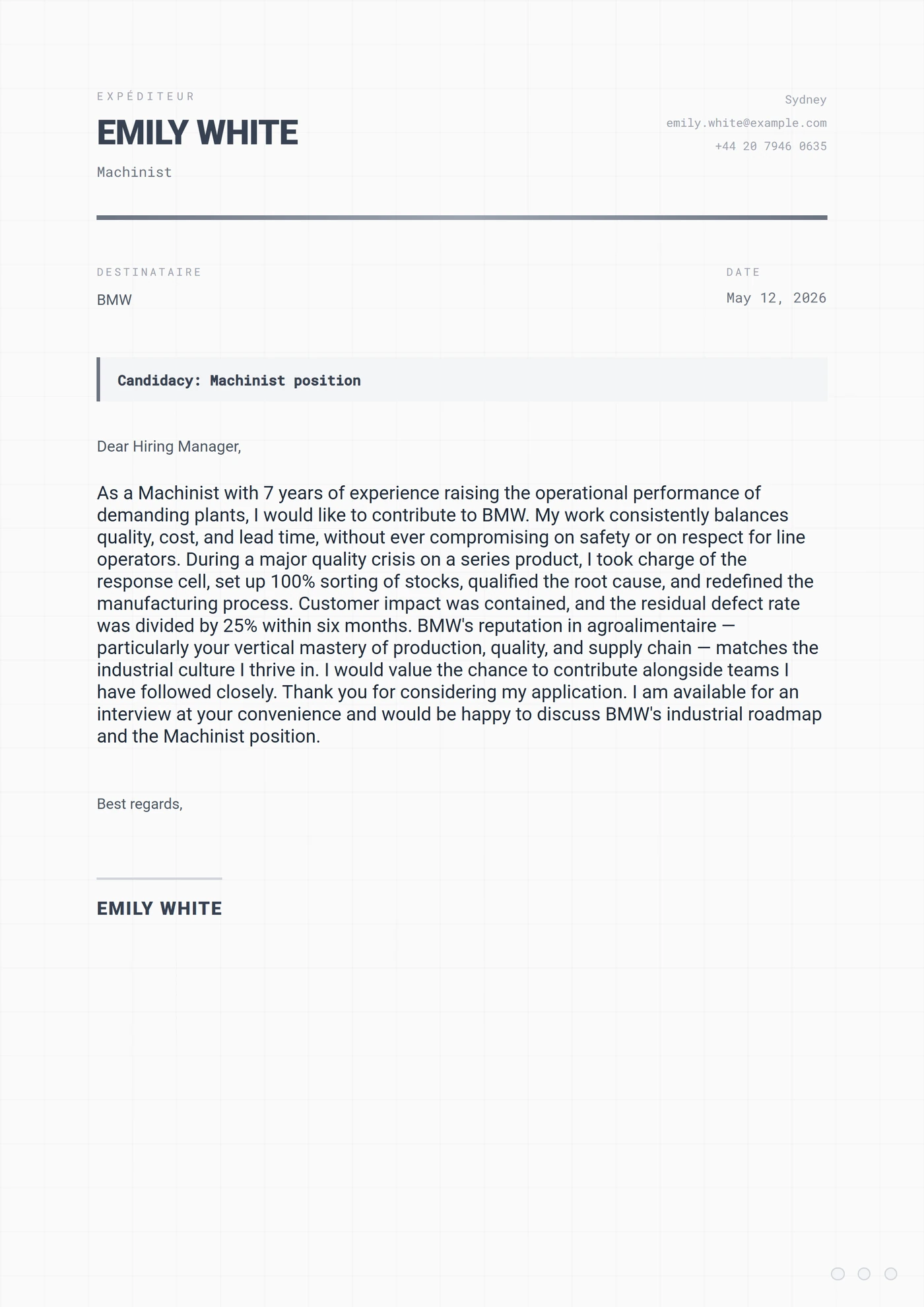
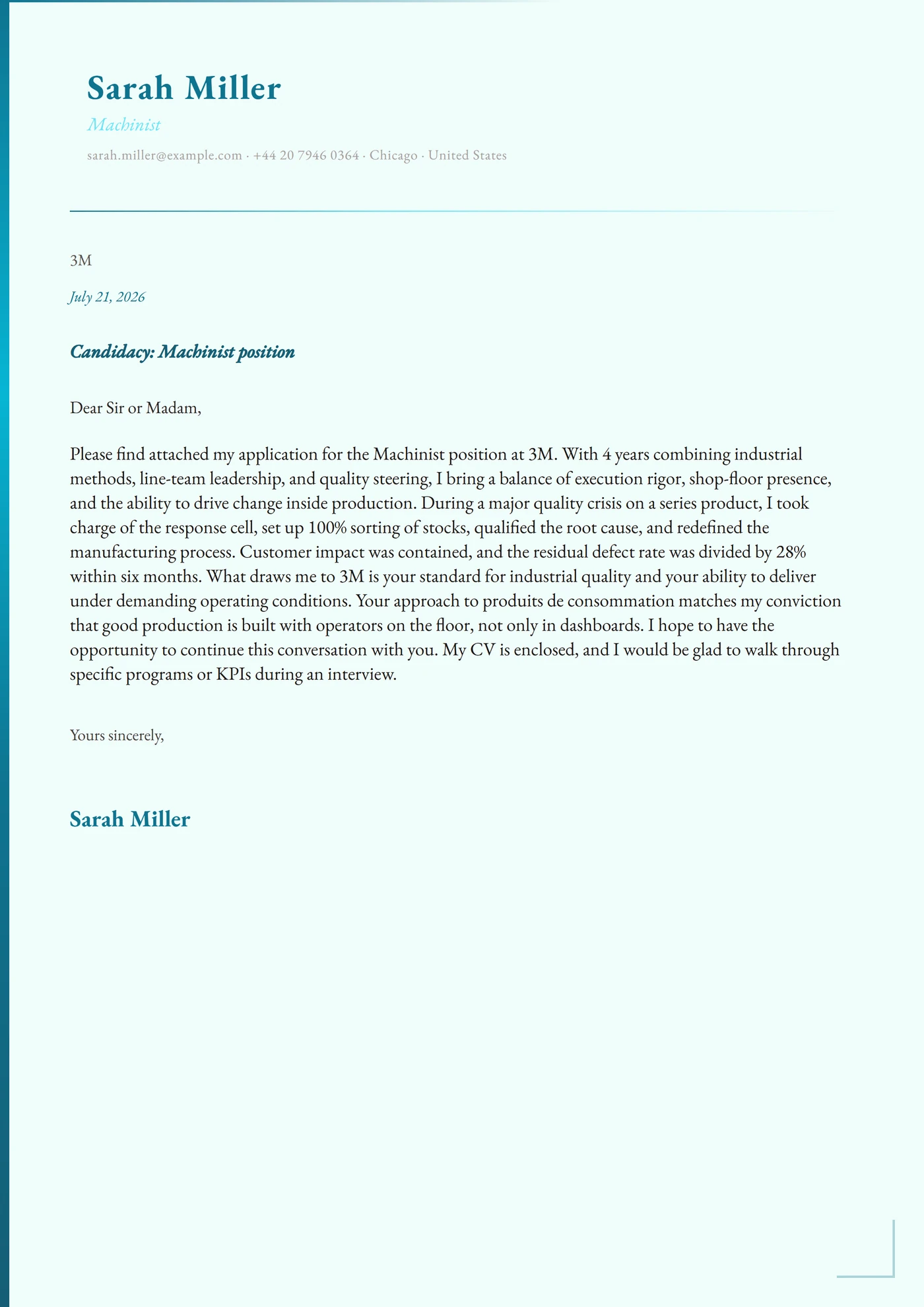
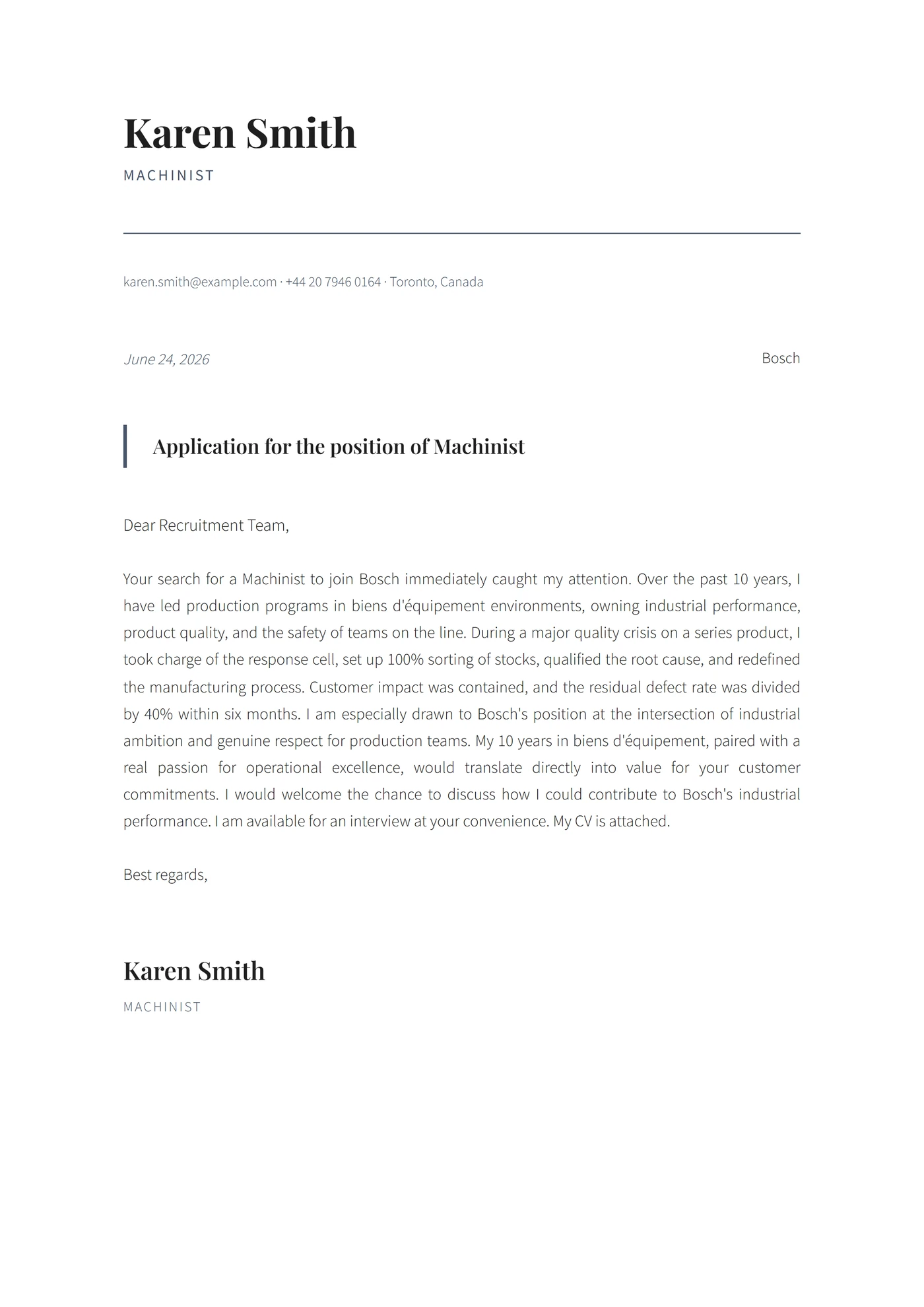
Three templates selected for this role, from junior to senior level. Tap a template to discover its full design and use it in your document.
How to Write a Machinist Cover Letter
Open your Machinist cover letter with a personalized greeting that addresses the hiring manager by name whenever possible—check the job posting, company website, or LinkedIn to find the shop supervisor, manufacturing manager, or HR contact rather than using generic salutations. Your first sentence should immediately establish your machining credentials and express genuine interest in the specific role, for example: "As a CNC Machinist with five years of experience programming and operating multi-axis mills in high-precision aerospace manufacturing, I am excited to apply for the Machinist position at [Company Name] where quality and tight tolerances are paramount." Avoid generic openings like "I am writing to apply for the position" or clichéd phrases such as "I am a hard worker"—instead, lead with a concrete hook that demonstrates your understanding of the company's industry, products, or manufacturing challenges. If you have a connection to the company (worked with their equipment, admire their reputation for quality, or were referred by a current employee), mention it in your opening paragraph to establish immediate relevance. The goal is to capture attention in the first 3-4 lines by showing you're not sending a mass-produced letter but have tailored your application to their specific machining needs and shop culture.
Structure the body of your Machinist cover letter in 2-3 focused paragraphs that move from your technical qualifications to specific achievements and then to your fit with the company's needs. The first body paragraph should detail your core machining competencies—types of machines you operate (manual lathes, CNC mills, grinders, EDM), materials you work with (steel, aluminum, titanium, plastics), and relevant certifications or training (NIMS credentials, blueprint reading, GD&T knowledge). Be specific about your programming skills (Mastercam, G-code, Fanuc controls) and inspection capabilities (micrometers, calipers, CMM operation). The second paragraph should showcase 2-3 quantifiable achievements that demonstrate your impact: reduced scrap rates by 15% through improved tooling setups, maintained tolerances within ±0.0005 inches on critical aerospace components, or trained three apprentices who became certified machinists. Use the STAR method implicitly—describe the situation, your technical approach, and the measurable result. The final body paragraph should connect your skills to the employer's specific needs mentioned in the job posting, whether that's experience with their industry (medical devices, automotive, defense), familiarity with their equipment brands, or alignment with their emphasis on lean manufacturing or continuous improvement. Balance technical prowess with soft skills like problem-solving, teamwork with engineers and quality inspectors, and commitment to safety protocols.
Close your Machinist cover letter with a confident call to action that expresses your eagerness to discuss how your skills can contribute to their production goals, such as: "I would welcome the opportunity to discuss how my experience with precision 5-axis machining and commitment to zero-defect manufacturing can support [Company Name]'s reputation for quality. I am available for an interview at your convenience and can provide work samples or references from previous supervisors." Avoid passive or apologetic language like "I hope to hear from you" or "Thank you for considering my application"—instead, project professionalism and readiness. Use a formal sign-off such as "Sincerely" or "Best regards" followed by your full name. If submitting electronically, include your contact information (phone and email) below your name even though it appears in your header, making it easy for the hiring manager to reach you. Do not introduce new information in your closing paragraph or repeat your entire resume—keep the ending concise, forward-looking, and action-oriented, reinforcing your enthusiasm for the specific role and company.
Machinist cover letters should strike a professional yet practical tone that reflects the precision and no-nonsense culture of manufacturing environments—avoid overly casual language but don't be so formal that you sound stiff or disconnected from shop floor realities. Use clear, direct sentences with concrete technical terminology that demonstrates your hands-on expertise (tolerances, feeds and speeds, work offsets, fixturing) rather than vague corporate jargon or flowery language. The manufacturing industry values competence, reliability, and results, so your tone should convey confidence in your abilities backed by specific examples rather than generic enthusiasm. While you should maintain respectful, grammatically correct writing, it's appropriate to use industry-standard abbreviations and terms that hiring managers in machining will immediately understand (CNC, OD/ID, TIR, SPC). Avoid humor, overly personal anecdotes, or creative flourishes that might work in marketing or design roles—machinists are hired for technical skill and dependability, so your language should reflect those priorities. Balance confidence with humility by acknowledging you're always learning and improving, which resonates in a trade where even master machinists encounter new challenges and technologies throughout their careers.
Skills to Mention in Your Machinist Cover Letter
Common Mistakes
Generic Machinist cover letters that could apply to any manufacturing job fail to mention the specific machines, materials, industries, or tolerances relevant to the employer's operation, making you appear unfocused or mass-applying. Fix this by researching the company's products and manufacturing focus (aerospace, medical, automotive, job shop) and tailoring your examples to match their needs—if they specialize in titanium machining for aerospace, highlight your experience with difficult-to-machine materials and tight aerospace tolerances rather than generic production work. Specificity demonstrates genuine interest and helps hiring managers visualize you operating their equipment on their shop floor.
Machinist cover letters should be concise and respect the hiring manager's time—aim for three-quarters of a page to one full page (approximately 250-400 words) that can be read in under two minutes. Manufacturing supervisors and HR professionals reviewing dozens of applications will skip overly long letters, so cut unnecessary background, redundant resume repetition, or lengthy explanations of basic machining concepts the reader already understands. Focus on your 2-3 strongest qualifications and most impressive achievements, using tight, specific language that conveys maximum information in minimum space—every sentence should add new value or evidence of your fit for the role.
Simply listing machining duties like "operated CNC mills" or "read blueprints" without quantifiable achievements makes your cover letter read like a job description rather than a compelling case for why you're the best candidate. Reframe your experience by adding measurable outcomes: instead of "programmed CNC machines," write "programmed and optimized 15+ CNC mill setups that reduced cycle time by 20% while maintaining tolerances of ±0.001 inches." Include metrics like scrap reduction percentages, parts per hour improvements, uptime increases, cost savings from tooling optimization, or the complexity of projects (number of operations, axes, or tolerance requirements) to demonstrate the impact and sophistication of your work.
Formatting mistakes undermine your professionalism in Machinist applications—use a clean, standard business letter format with 11-12 point readable fonts (Arial, Calibri, Times New Roman), 1-inch margins, and clear paragraph breaks rather than dense blocks of text. Save and submit your cover letter as a PDF to preserve formatting across different systems, and name the file professionally ("FirstName_LastName_Machinist_CoverLetter.pdf") rather than generic names like "CoverLetter.docx." If emailing your application, use a clear subject line such as "Machinist Application – [Your Name] – Job ID [Number]" and ensure your letter fits on one page without requiring scrolling or multiple pages, as hiring managers often print applications for review on the shop floor or in meetings.
Frequently Asked Questions
While some manufacturing employers may not explicitly require a cover letter, submitting one significantly strengthens your application by demonstrating professionalism, attention to detail, and genuine interest in the specific role. In competitive markets or for specialized machining positions (aerospace, medical devices, tool and die), a well-crafted cover letter can differentiate you from candidates with similar technical qualifications by showcasing your understanding of the company's manufacturing challenges and your relevant problem-solving experience. Even if optional, a cover letter is your opportunity to explain career gaps, highlight certifications, or contextualize achievements that raw resume bullets cannot fully convey.
Your Machinist cover letter should be three-quarters to one full page in length, typically 250-400 words or 3-4 concise paragraphs that can be read in under two minutes. Manufacturing hiring managers review many applications and value efficiency, so focus on your strongest qualifications, 2-3 key achievements with metrics, and clear alignment with the job requirements rather than exhaustive career history. If your letter extends beyond one page, you're likely including unnecessary detail or repeating your resume—tighten your language and prioritize the most relevant technical skills and accomplishments for that specific employer.
Yes, customizing your cover letter for each application is essential to demonstrate genuine interest and alignment with the specific employer's needs, equipment, and industry focus. Tailor your examples to match the job description's requirements—if the posting emphasizes Swiss-type lathes and medical device experience, highlight your relevant work with precision small-part machining rather than generic CNC mill experience. Research the company's products, manufacturing processes, and values, then mirror their language and priorities in your letter, showing you understand their unique challenges and can contribute immediately to their shop's success.
In the United States, cover letters are standard for professional Machinist applications, especially for roles requiring specialized skills or certifications, though some high-volume production shops may focus primarily on resumes and skills assessments. In the United Kingdom, cover letters are generally expected for skilled trades positions and demonstrate professionalism, with employers valuing concise explanations of relevant experience and qualifications. Across the European Union, expectations vary by country—Germany and northern European nations typically expect formal application documents including cover letters (Anschreiben/Motivationsschreiben), while southern European countries may be more flexible, but including a well-written letter is rarely disadvantageous and often appreciated as evidence of thoroughness and communication skills.
AI tools can help you draft an initial structure, suggest industry keywords, or refine your language, but you must heavily customize and personalize the output with your specific machining experience, achievements, and genuine voice to avoid generic, detectable AI writing. Hiring managers in manufacturing can spot formulaic or overly polished AI-generated letters that lack authentic technical detail and shop floor reality—use AI as a starting point, then inject concrete examples from your work (specific machines, tolerances, materials, problems you solved) and ensure the tone matches your actual communication style. Always review and edit AI-generated content for accuracy, relevance, and to ensure it doesn't include fabricated credentials or exaggerated claims that you cannot substantiate in an interview.
Use a standard business letter format with your contact information at the top, followed by the date and employer's contact details, then a formal greeting, 3-4 body paragraphs, and a professional closing with your signature. Choose a clean, readable font like Arial, Calibri, or Times New Roman in 11-12 point size, with 1-inch margins and single spacing between lines with a blank line between paragraphs. Save and submit your cover letter as a PDF to ensure formatting consistency across different devices and operating systems, and name the file professionally (e.g., "John_Smith_Machinist_CoverLetter.pdf") so it's easily identifiable in the employer's application system.
Explore more about