About this template
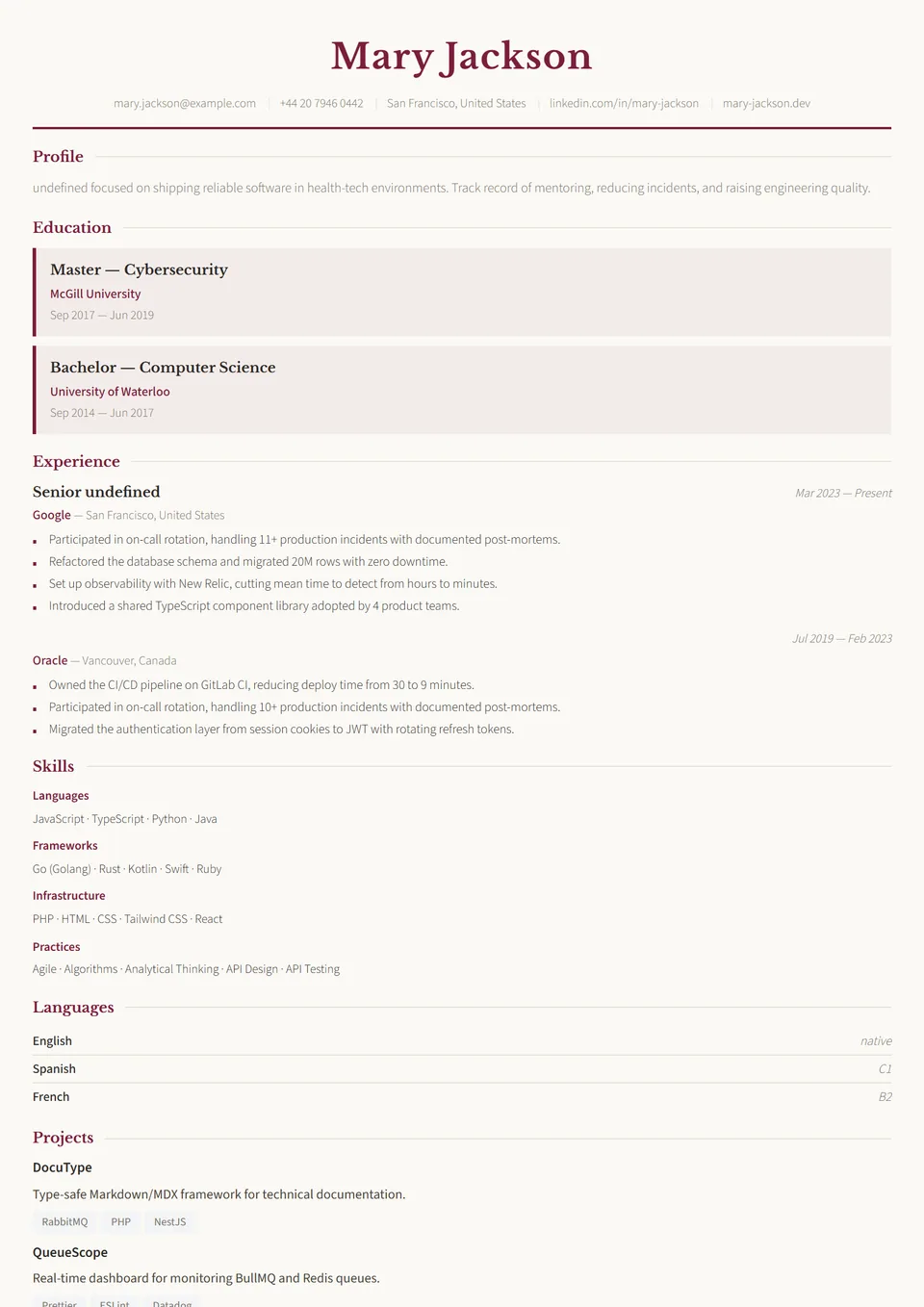
The Languages template is an academic CV in Source Serif Pro with a teal accent and a prominent languages section — designed for linguists, translators, interpreters and academics whose career lives in the gap between systems of meaning. The typography supports rare diacritics (Cyrillic, Arabic, Chinese, Devanagari, IPA) without breaking the PDF text layer, and the layout parses through Workday, Interfolio and the recruitment platforms of language schools (SOAS, INALCO, Geneva FTI, Middlebury Institute, Monterey).
Who is it for?
It fits linguists in tenure-track applications across phonetics, sociolinguistics, historical linguistics and computational linguistics, philologists in CR/DR CNRS section 34 competitions, language-policy researchers applying to Max Planck Institutes (MPI EVA Leipzig, MPI for Psycholinguistics Nijmegen), senior translators and interpreters moving to faculty positions (ESIT, ISIT, Geneva ETI, Monterey MIIS), and candidates for EU institutional language competitions (EPSO AD7 translators and interpreters).
How to use it
Four blocks structure the document — Language competences (CEFR with associated examinations and scores), Research (sociolinguistics, phonetics, historical linguistics, translation studies), Publications, Teaching and training. For rare or dialectal variants (Sorani Kurdish, Tanzanian Swahili, Quebecois French), state the sub-dialect and acquisition context. For EU translator candidates, list official language pairs with translation direction (FR>EN, DE>FR, EN>ES). Useful long-tail queries: 'linguistics professor CV template', 'PhD applied linguistics resume', 'EU translator competition CV', 'interpreter academic transition CV', 'philology researcher SOAS CV'.
Frequently asked questions
How do I list a rare language without overstating competence?
State the precise sub-dialect (for example Sorani Kurdish rather than 'Kurdish'), the actual CEFR level (often A2-B1 for vernacular languages), and the acquisition context (fieldwork, academic training, family immersion). For a SOAS or INALCO committee, honesty of level outweighs language-list inflation — a contextual B2 carries more weight than a phantom C1, and the committee will probe through the cover letter or interview.
Should I list language examinations (TORFL, HSK, JLPT) or only CEFR?
Both. CEFR remains the universal European scale, but for Russian (TORFL), Mandarin (HSK), Japanese (JLPT) and Arabic (ALPT), the test sat with date and level validates competence for specialist committees. For EU language competitions, the internal EPSO examination should also be mentioned with date and result. For US programs, the ACTFL OPI score is widely recognised.
Does the template suit a translator-interpreter profile more than a linguist?
Yes. Use the Research section for translation studies and conference-interpreting work (Meta, The Translator, Interpreting, Target), and add an 'Interpretation and translation missions' block with four columns: date, language pair, mission type (consecutive, simultaneous, technical translation), client or institution. For EU competitions, separate booth missions from written translation contracts — the EPSO panel reads them as distinct competencies.